
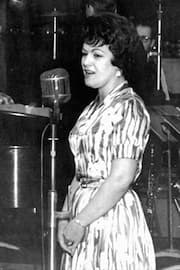
A Voice That Turns Longing into Art, When Distance Meets Devotion in Classic Country Elegance
In the early 1960s, Patsy Cline delivered one of her most delicate and emotionally resonant recordings with “You Belong to Me,” a song that had already achieved widespread popularity in the previous decade. Originally written by Chilton Price, Pee Wee King, and Redd Stewart in 1952, the composition first gained prominence through recordings by artists such as Jo Stafford, whose version topped charts and helped establish the song as a standard.
Cline’s rendition, released in 1962 as part of her album Sentimentally Yours, stands apart not through reinvention, but through refinement. Produced by Owen Bradley, a key architect of the Nashville Sound, the recording blends country sensibility with pop orchestration, allowing Cline’s voice to remain the emotional centerpiece.
The performance itself is understated yet powerful. Rather than relying on vocal excess, Cline uses restraint and phrasing to convey the song’s central theme of love sustained across distance. Lines that reference faraway places and journeys are delivered with a quiet intimacy, transforming the song from a simple travel themed ballad into a deeply personal message of longing. The narrative voice reassures a distant lover that, despite physical separation, emotional connection remains unbroken.
What distinguishes this performance is Cline’s ability to inhabit the lyric. Her tone carries a subtle vulnerability, suggesting both strength and fragility. This balance was a hallmark of her later recordings, particularly in the final years of her career, when her vocal style evolved toward greater nuance and emotional clarity. “You Belong to Me” exemplifies that maturity, offering a listening experience that feels both timeless and immediate.
The accompanying arrangement reinforces this mood. Gentle backing vocals and smooth instrumentation provide a soft framework, never overshadowing the lead vocal. The result is a cohesive sound that aligns with the broader countrypolitan movement of the era, where traditional country themes were presented with polished, crossover appeal.
Today, Cline’s version of “You Belong to Me” endures as a testament to her interpretive skill. While the song itself has been recorded by many artists, her rendition remains one of the most emotionally compelling. It is not merely a cover, but a reinterpretation that reveals new depth within a familiar melody.
In revisiting this performance, listeners are reminded of why Patsy Cline continues to be regarded as one of the most influential voices in American music. Her ability to communicate complex emotion with clarity and grace ensures that songs like “You Belong to Me” continue to resonate across generations.