
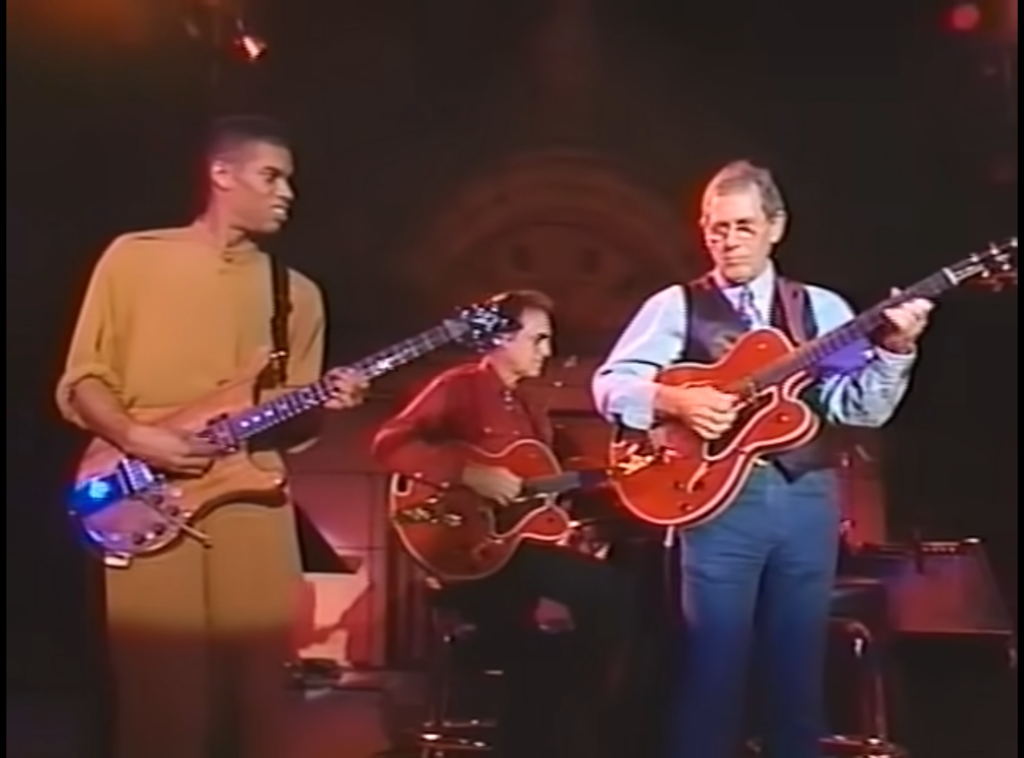
A Dialogue of Giants: The Spellbinding Meeting of Chet Atkins and Stanley Jordan at the 1991 Paul Masson Summer Series
When the historic fingerstyle wisdom of the “Country Gentleman” met the futuristic, two-handed tapping wizardry of a jazz iconoclast, the sun-drenched vineyards of California bore witness to a masterclass in cross-generational respect and acoustic brilliance.
Every so often, the universe of acoustic music orchestrates a meeting so structurally distinct, yet harmoniously perfect, that it lingers in the minds of guitar purists for decades. One of those breathtaking milestones took place under the warm California sky during the 1991 Paul Masson Summer Series (originally broadcast to an international audience by Japan Satellite Broadcasting). The Paul Masson Mountain Winery in Saratoga, California, had long been celebrated for its elegant, open-air summer concerts, but the 1991 pairing of Chet Atkins and Stanley Jordan transcended the standard festival lineup. It brought together two musical architects from completely different worlds: Chet, the pioneer of the classic, alternating-thumb Nashville Sound, and Stanley, the virtuoso who had revolutionized modern jazz with his mind-boggling, piano-like “touch-tapping” technique.
By 1991, Chet Atkins was in his late sixties, a revered patriarch who had spent over forty years shaping the landscape of American guitar music. Yet, despite his legendary status and a mantle overflowing with Grammy Awards, Chet possessed a beautifully restless, eternally curious musical soul. He was never content to simply rest on his laurels; he actively sought out the company of younger innovators who pushed the boundaries of what six strings could do. Enter Stanley Jordan, whose landmark 1985 album Magic Touch had spent a staggering fifty-one weeks at #1 on the Billboard Jazz chart. Jordan didn’t strum or pluck his guitar in the traditional sense; instead, he tapped the fretboard with both hands, striking the strings like piano keys to play intricate rhythms, bass lines, and sweeping melodies simultaneously.
The highlight of the 1991 concert was a magnificent, three-song collaborative set where the two masters sat side-by-side, their contrasting styles weaving a rich, multi-layered acoustic tapestry. The true magic of this meeting was captured beautifully in their performance of Hoagy Carmichael’s timeless standard, “Stardust.” Chet began the piece, his custom nylon-string Gibson singing with a round, velvety warmth that felt as comfortable and deeply comforting as an old friend. As he laid down the gorgeous, familiar melody, Stanley Jordan joined in, using his signature Aronson guitar to tap out shimmering, liquid chords that floated behind Chet’s lines like a constellation of stars. The sound was breathtakingly clean—two completely distinct techniques operating in perfect, unselfish symmetry.
The duo shifted gears to showcase their playful side with a high-energy rendition of the 1925 jazz standard “Sweet Georgia Brown,” followed by a driving, syncopated journey through the rockabilly and blues classic “Mystery Train.” On “Mystery Train,” Chet’s rock-solid, driving Travis-picking thumb set a steady, train-like rhythm down the tracks, allowing Stanley to unleash a flurry of rapid-fire, tap-singled notes that mimicked the wild, kinetic energy of a locomotive pulling out of the station. What made the performance so deeply moving for the sophisticated viewer was the visible, mutual joy passing between them. Chet could be seen smiling widely, shaking his head in absolute wonder at the speed of Stanley’s fingers, while Stanley played with a quiet, deferential reverence, anchoring his futuristic jazz mind in the bedrock of Chet’s timeless groove.
For those who cherish the history of hand-crafted musicianship, looking back at this 1991 broadcast evokes a powerful wave of sweet nostalgia. It takes us back to an era of unhurried, dignified musicianship—a time when a summer concert didn’t need pyrotechnics or digital backing tracks to captivate an audience. The performance relied entirely on the organic resonance of wood, wire, and human genius, framed by the gentle evening breeze of the northern California hills.
Chet Atkins and Stanley Jordan’s collaboration at the 1991 Paul Masson Summer Series remains a dazzling, starlit milestone in the archives of stringed music. It stands as a beautiful, highly reflective reminder that music is a universal language without borders, age, or genre constraints. Decades later, this archival treasure continues to warm our hearts, proving that when two open-minded masters sit down to share a stage, they don’t just play notes—they create a timeless conversation that echoes forever.