
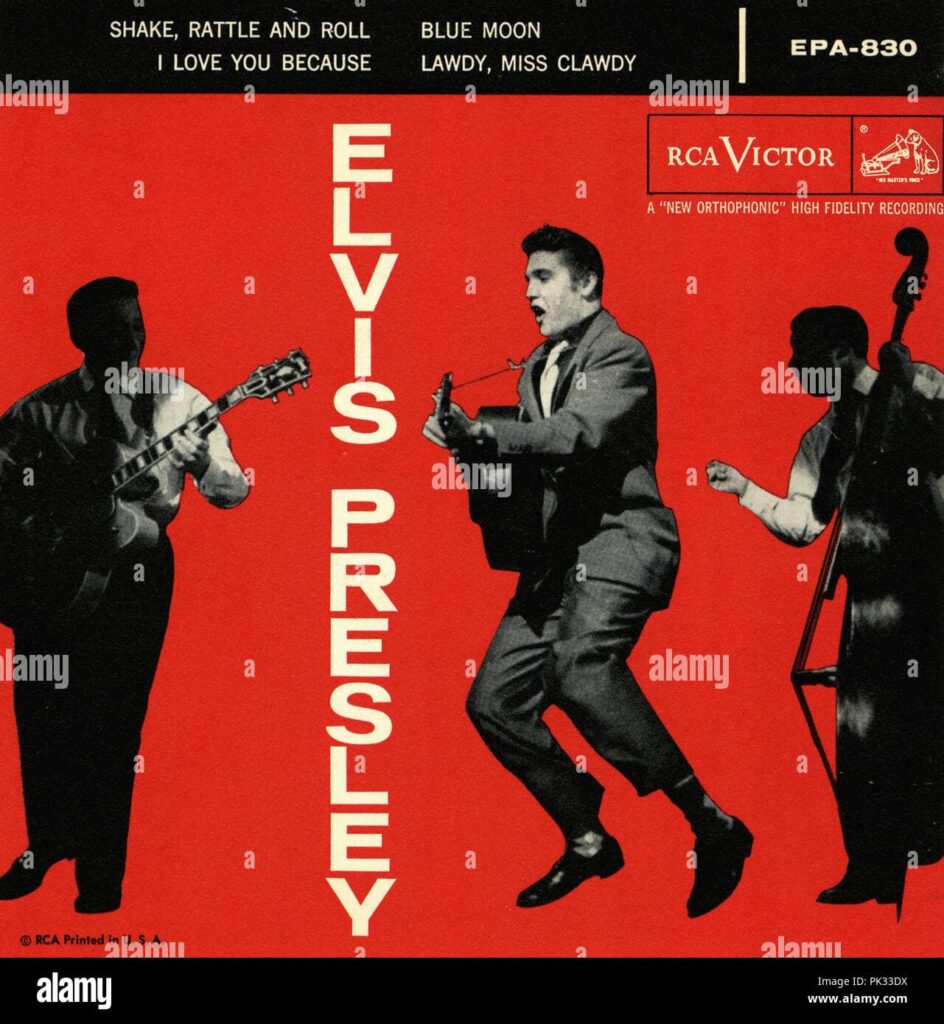
A Love Chosen, Not Demanded: When Devotion Is Rooted in Grace Rather Than Need
When Elvis Presley recorded “I Love You Because” in 1954, he was still an unknown young singer from Memphis, standing at the very beginning of a journey that would reshape popular music. Long before stadiums, films, and global fame, this song captured something essential about Elvis not the swagger, not the spectacle, but the tenderness. It was one of the earliest recordings of his career, made during his first sessions at Sun Studio under the guidance of Sam Phillips, and it revealed a depth of feeling that often gets overshadowed by later legend.
Written in 1949 by country songwriter Leon Payne, “I Love You Because” had already been recorded by several artists before Elvis, but none gave it the quiet emotional gravity he brought. Payne himself was a deeply spiritual and introspective writer, and the song reflects that mindset. It is not a declaration of passion driven by desire, but a statement of love grounded in gratitude, patience, and moral certainty. Elvis understood this instinctively.
Although “I Love You Because” was not released as a charting single at the time and did not enter the Billboard rankings upon its initial recording, its importance lies elsewhere. It later appeared on compilations of Elvis’s early work, including Elvis at Sun, and came to be recognized as one of the purest windows into his formative artistic identity. Historically, it stands alongside “That’s All Right” as evidence that Elvis was never just a rock-and-roll provocateur he was, at heart, a balladeer with deep respect for country and gospel traditions.
The lyrics of “I Love You Because” are striking in their moral clarity. Love is not offered because of beauty, excitement, or convenience, but because of kindness, forgiveness, and loyalty. The narrator loves not for what he receives, but for what the beloved is. This idea love as a conscious choice rather than an emotional impulse gives the song its enduring weight. It speaks softly, but with conviction.
Elvis’s vocal performance is restrained, almost reverent. There is no attempt to embellish or impress. His voice, young and unguarded, carries a sincerity that feels almost fragile. Each line is delivered with care, as if he understands the responsibility of the words. This is especially powerful when viewed in retrospect. Knowing the life Elvis would later live filled with excess, pressure, and longing the purity of this early recording feels almost prophetic.
Musically, the arrangement is simple and rooted in country tradition. The gentle rhythm and minimal instrumentation allow the lyrics to remain front and center. There is space in the recording space for reflection, space for memory. Nothing rushes. Nothing intrudes. This simplicity aligns perfectly with the song’s message: real love does not need decoration.
In the context of early 1950s America, “I Love You Because” resonated with values shaped by faith, family, and personal integrity. It spoke to listeners who understood love as commitment rather than performance. Elvis, raised in a deeply religious household and surrounded by gospel music, absorbed these values naturally. This song is an extension of that upbringing.
Over the decades, as Elvis’s image evolved into something larger-than-life, “I Love You Because” quietly endured as a reminder of where he began. It shows an artist before the armor was built, before the expectations hardened. It is Elvis as a young man singing not to impress the world, but to tell the truth as he understood it.
For many listeners, the song gains power with time. Youth may hear it as idealism. Experience hears it as wisdom. The idea of loving someone not because they fulfill desires, but because they offer steadiness and understanding, becomes more meaningful as life reveals its complexities.
In the end, “I Love You Because” is not a dramatic love song. It is something rarer. It is a statement of values, delivered quietly by a young voice that had not yet learned how loud it could be. And that quiet honesty untouched by fame, untouched by spectacle is exactly why the song continues to matter.