
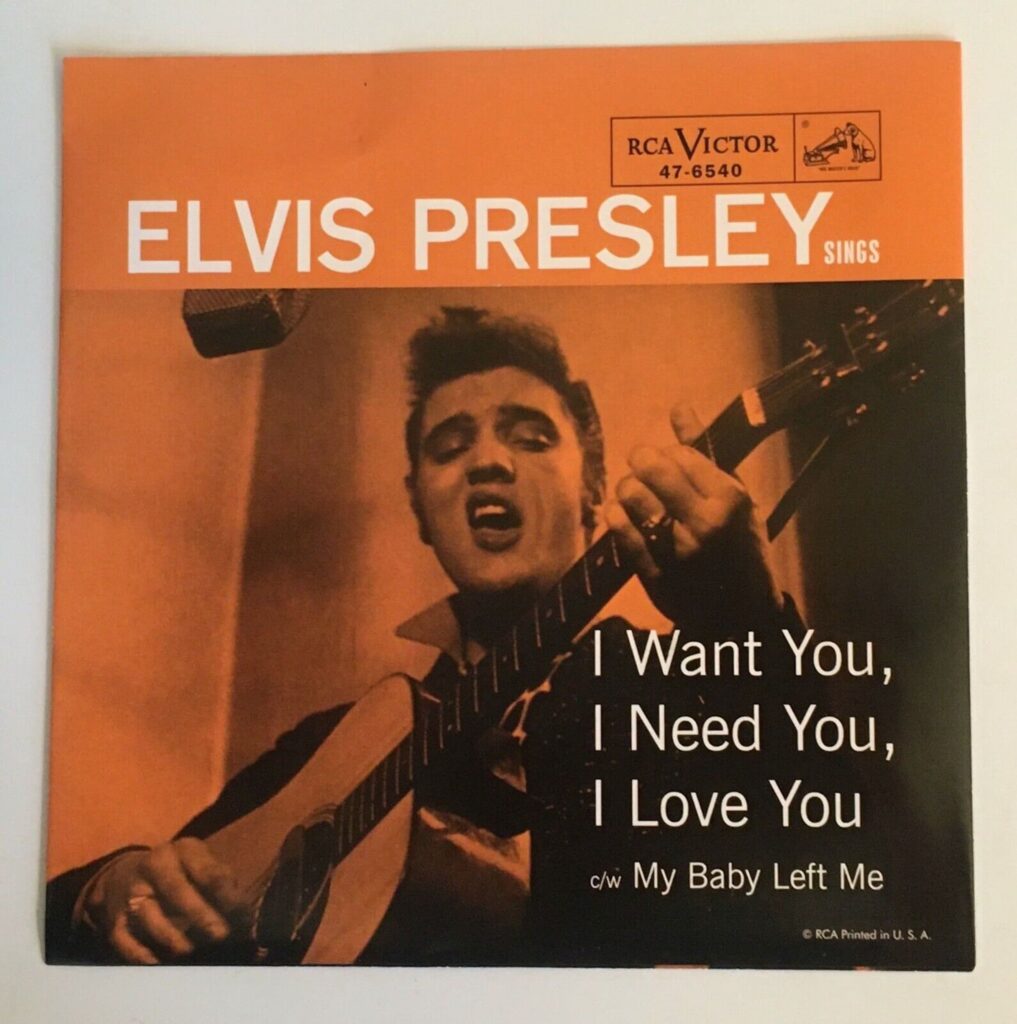
Three Simple Words, One Lasting Promise: Desire, Dependence, and Devotion Entwined
When Elvis Presley released “I Want You, I Need You, I Love You” in 1956, the song arrived at a crucial turning point both in his career and in the emotional vocabulary of popular music. This was Elvis at the moment when youthful urgency began to mature into something more vulnerable, more openly human. Upon its release, the record rose to No. 1 on the Billboard Best Sellers chart and also topped the Billboard Top 100, confirming Elvis not only as a cultural phenomenon, but as a singer capable of expressing emotional dependence with disarming sincerity.
Written by Maurice Mysels and Ira Kosloff, the song is built around a simple progression of feeling. Want. Need. Love. Each phrase deepens the emotional stake, moving from desire to reliance, from attraction to commitment. In an era when male singers were often expected to project control and confidence, this song dared to admit something else that love can involve surrender.
By 1956, Elvis Presley was already reshaping American music. Rock ’n’ roll had made him famous, controversial, irresistible. Yet “I Want You, I Need You, I Love You” revealed another dimension of his artistry. It slowed the tempo, softened the edges, and placed emotional honesty at the center. This was not rebellion. It was confession.
The recording itself has an interesting history. The master take was reportedly damaged during processing, forcing engineers to salvage what they could a fact that adds a layer of fragility to the final sound. There is a slight haze to the recording, a softness that feels unintentional yet perfectly aligned with the song’s emotional tone. Instead of weakening the performance, it enhances it, making the listener feel as though they are overhearing something private rather than witnessing a polished studio product.
Elvis’s vocal delivery is key to the song’s enduring power. He sings with restraint, letting the words carry the emotion rather than pushing them forward. His voice is warm, slightly pleading, but never desperate. There is dignity in his vulnerability. He does not demand love he acknowledges how deeply he depends on it. For many listeners, especially those who have lived long enough to understand the cost of emotional openness, this honesty feels profound.
Musically, the arrangement is spare and balanced. Gentle backing vocals support Elvis without overshadowing him, creating a sense of emotional echo as if the feelings he expresses linger in the air after each line. The rhythm moves steadily, unhurried, reinforcing the idea that this is not a fleeting romance, but a lasting attachment.
In the context of 1950s America, the song carried quiet significance. This was a time shaped by restraint, tradition, and clearly defined emotional roles. To hear a young male singer openly admit need without irony, without bravado was striking. “I Want You, I Need You, I Love You” gave voice to emotions many felt but rarely articulated. It normalized emotional dependence as something sincere rather than weak.
Within Elvis’s early catalog, the song stands as a bridge between genres and identities. It connects his country roots, his gospel sensitivity, and his emerging pop appeal. While rock ’n’ roll brought energy and change, this song brought depth. It reminded listeners that Elvis was not only moving bodies he was reaching hearts.
As the years passed and Elvis’s image grew larger than life, songs like this gained new resonance. What once sounded like youthful devotion begins to feel like something more reflective a reminder of a time when emotions were spoken plainly, without filters or defenses. The simplicity of the lyrics becomes their strength. Life, after all, often reduces us to the same three needs.
Today, “I Want You, I Need You, I Love You” endures not because it is dramatic, but because it is honest. It captures a moment when love is still believed to be enough, when saying how you feel seems more important than protecting yourself from disappointment.
In the end, Elvis Presley does not sing this song as an icon or an idol. He sings it as a man standing openly in his feelings, unguarded and sincere. And perhaps that is why, decades later, the song still lingers like a quiet promise remembered long after the words were first spoken.