
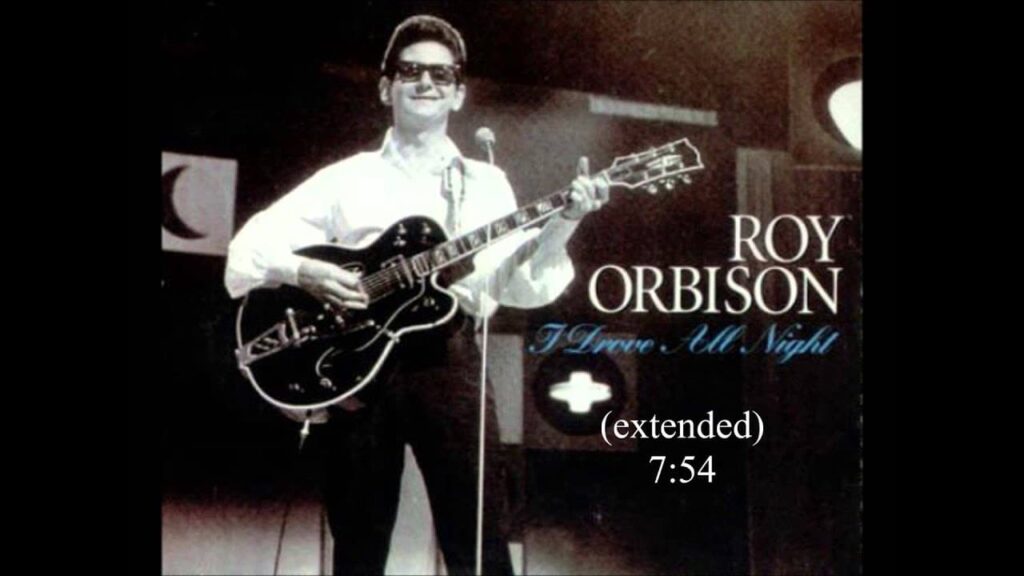
A Song of Relentless Devotion, Where Love Refuses to Sleep and the Night Becomes a Promise
When Roy Orbison recorded “I Drove All Night,” he unknowingly delivered one of the final and most poignant statements of his career— a song about love so urgent that distance, exhaustion, and time itself become irrelevant. Though released only after his death, the recording feels anything but unfinished. Instead, it stands as a powerful reminder of Orbison’s unmatched ability to turn longing into something noble, determined, and deeply human.
“I Drove All Night” was written by Billy Steinberg and Tom Kelly, the celebrated songwriting duo behind several major pop classics of the 1980s. The song was recorded by Roy Orbison in 1987, during a period when his career was experiencing a remarkable late resurgence. At the time, Orbison had re-emerged not as a relic of the past, but as a respected elder statesman whose voice carried emotional authority few could rival.
Tragically, Roy Orbison passed away in December 1988, before the song could be released. His version finally reached the public in 1992, issued as a single and later included on posthumous collections. Upon release, it achieved significant success in the United Kingdom, reaching the Top 10 on the UK Singles Chart, while in the United States it entered the Billboard Hot 100, introducing a new generation to the unmistakable Orbison sound.
What makes Orbison’s version of “I Drove All Night” extraordinary is not its narrative alone, but its emotional posture. This is not youthful infatuation or reckless passion. It is love expressed through action—through endurance. The narrator does not speak of desire abstractly; he moves. He drives. He crosses darkness to reach the one place where meaning resides.
From the opening lines, the song establishes urgency. The night is long, the road is endless, and sleep is impossible. Yet there is no panic in Orbison’s voice. Instead, there is resolve. His vocal delivery is controlled, dignified, and quietly intense. Even as the melody builds, he never loses that sense of purpose. This restraint gives the performance its power.
Vocally, Roy Orbison was uniquely suited to this material. His voice wide-ranging, emotionally transparent, and unmistakably pure carries the song’s longing without exaggeration. When he sings “I drove all night to get to you,” it sounds less like a lyric and more like a confession. There is no embellishment, no bravado. Only truth.
Musically, the arrangement reflects the tension between movement and stillness. The driving rhythm suggests motion, while the sustained chords and melodic arcs mirror the emotional weight of anticipation. The production, though rooted in the late-1980s aesthetic, never overshadows the vocal. Everything is built to support Orbison’s voice, which remains the emotional center.
The meaning of “I Drove All Night” lies in its portrayal of love as commitment rather than fantasy. This is not about romance as an idea it is about choice. The choice to show up. The choice to endure discomfort for connection. In Orbison’s hands, the song becomes a meditation on devotion that feels earned rather than imagined.
The song also gains profound resonance when viewed through the lens of Orbison’s life. Having endured extraordinary personal tragedy and professional fluctuation, Orbison understood loss, patience, and perseverance. That lived experience infuses every note. This is not the voice of someone chasing love it is the voice of someone who knows its value.
It is worth noting that “I Drove All Night” would later become widely known through Cyndi Lauper’s 1989 version, which achieved major chart success. Yet many listeners who encounter Orbison’s recording recognize immediately that the song feels different in his voice. Where Lauper’s version emphasizes urgency and desire, Orbison’s emphasizes destiny and devotion. The journey matters as much as the arrival.
Within Roy Orbison’s catalog, this song occupies a unique place. It bridges eras—classic emotional songwriting delivered through modern production while remaining unmistakably Orbison. It reflects an artist who never lost his emotional compass, even as the world around him changed.
Today, “I Drove All Night” stands as one of the most moving examples of Orbison’s late-career brilliance. It is a song about traveling through darkness guided only by feeling and faith. There is no guarantee of outcome only belief.
And perhaps that is why it endures. Because at its heart, this song is not about the road, the car, or the night. It is about the quiet certainty that somewhere, at the end of all that distance, love is waiting and that reaching it is worth everything it takes to get there.