
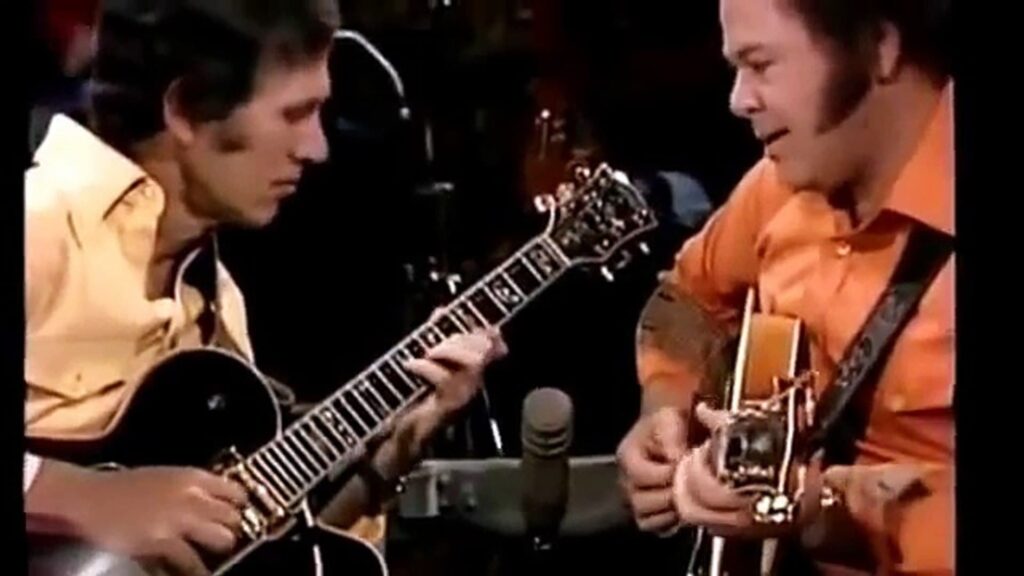
A graceful conversation between strings and memory, where four melodies become one quiet autobiography
The “Medley (Country Gentleman, Mister Sandman, Wildwood Flower, Freight Train)” stands as one of the most revealing portraits of Chet Atkins not as a star, but as a musician reflecting on the road he helped build. More than a showcase of technique, this medley feels like a carefully arranged recollection — four familiar melodies woven together with taste, restraint, and deep respect for tradition. It is music that does not look for applause; it invites recognition.
By the time Chet Atkins began presenting medleys like this in concert and on television, his position in American music was already beyond question. Known worldwide as “Mr. Guitar” and “The Country Gentleman,” Atkins had reshaped country music’s sound from the inside — smoothing its edges, expanding its harmony, and quietly opening its doors to pop, jazz, and folk audiences. This medley, often performed during the late 1960s and 1970s, functions almost like a living résumé, played not with words but with tone.
The opening theme, “Country Gentleman,” is inseparable from Atkins himself. Written by Chet Atkins and Boudleaux Bryant, the tune became Atkins’ signature piece after its release in 1953. As a single, it reached the Top 10 on the Billboard Country chart, and the nickname it inspired followed him for the rest of his life. In this medley, its return feels dignified and understated — not triumphant, but assured. The melody glides in with calm authority, setting the emotional temperature for everything that follows.
From there, Atkins slips seamlessly into “Mister Sandman,” a song originally popularized by The Chordettes in 1954, when it reached No. 1 on the Billboard charts. Atkins’ instrumental version, first recorded in 1954, became one of his most recognizable crossover successes, helping introduce his fingerstyle approach to a broader audience. In the medley, “Mister Sandman” sparkles briefly — playful, light-footed, almost smiling — reminding listeners that elegance and accessibility need not cancel each other out.
The emotional center of the medley arrives with “Wildwood Flower,” one of the oldest and most sacred melodies in American folk and country tradition. First recorded in 1928 by The Carter Family, the song predates Atkins’ career by decades, yet it shaped his musical DNA. His interpretation is reverent, stripped of ornamentation, allowing the melody’s natural sadness to speak. This is where the medley stops entertaining and begins remembering. The notes linger, as if acknowledging the generations that came before the microphone.
Closing the sequence is “Freight Train,” written by Elizabeth Cotten in the early 20th century and recorded by Atkins in 1962. His version became one of the definitive instrumental recordings of the song, admired for its clarity, rhythmic drive, and subtle blues inflection. In the medley, “Freight Train” moves forward with gentle momentum, suggesting motion rather than arrival. It feels symbolic — the road continuing, the journey unfinished.
What makes this medley so compelling is not the difficulty of the arrangements, though Atkins’ control is extraordinary. It is the absence of excess. Every transition is smooth, every phrase carefully weighted. Atkins never overwhelms the listener with speed or volume. Instead, he lets familiarity do the work. These are melodies that have lived many lives, and Atkins treats them as such.
Technically, the performance demonstrates his hallmark Travis-style fingerpicking, combined with jazz-influenced chord voicings and impeccable timing. Emotionally, however, it communicates something deeper: gratitude. There is no attempt to modernize or reinvent these songs. Atkins honors them by playing them clearly, beautifully, and without ego.
In the broader context of his career, this medley represents Chet Atkins at his most reflective. By this stage, he had already won multiple Grammy Awards, produced countless artists at RCA, and helped shape the Nashville Sound itself. He had nothing left to prove. What remained was to remember — and to share that memory through sound.
Listening today, the medley feels timeless. It exists outside trends, outside generations. It speaks to anyone who understands that music is not only about innovation, but continuity. Chet Atkins doesn’t announce his legacy here. He simply plays it.
And in doing so, he reminds us that sometimes the most powerful statements are made not with words, but with a familiar melody, gently returned to its rightful place.