
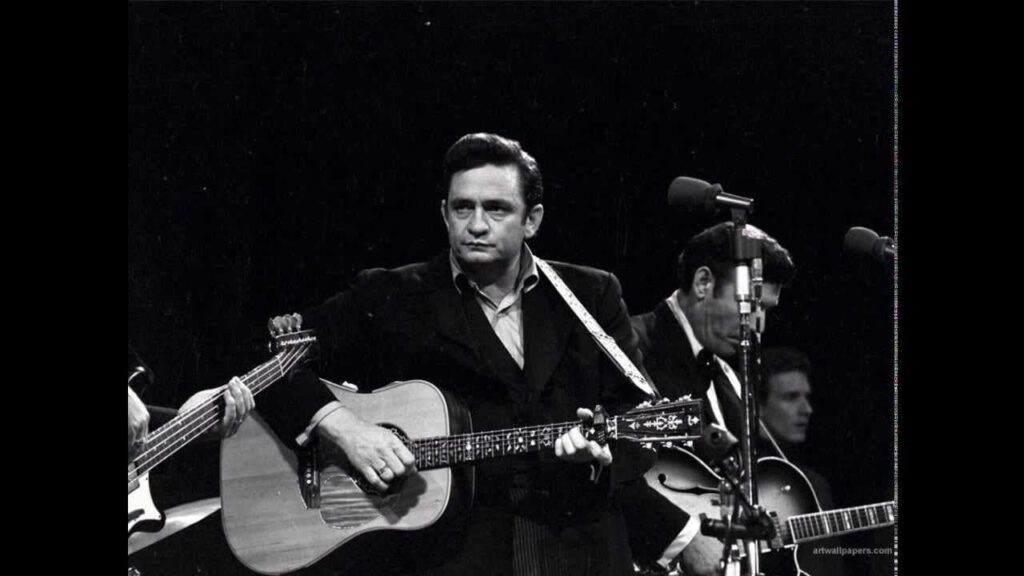
A Weathered Voice Speaking Directly to the Soul of a Lonely Man
When Johnny Cash recorded “Desperado”, he was not covering a popular song in the usual sense. He was answering it. Originally written by Don Henley and Glenn Frey and released by Eagles in 1973, “Desperado” had long been understood as a meditation on isolation, pride, and emotional self-exile. But when Cash approached the song nearly three decades later, he transformed it from gentle advice into something far more personal: a reckoning delivered by a man who had lived the consequences of that lonely road.
Johnny Cash recorded “Desperado” for his landmark album American IV: The Man Comes Around (2002), produced by Rick Rubin. By this point, Cash’s voice was unmistakably aged—deepened, cracked, and stripped of any remaining polish. That voice was no longer capable of pretending. It carried truth whether it wanted to or not. When the single was released, Cash’s version reached the Billboard Hot Country Songs chart, peaking modestly but meaningfully, proving once again that chart positions mattered far less than emotional impact at this stage of his career.
What makes Cash’s “Desperado” so powerful is perspective. The Eagles’ original feels like one man gently urging another to lower his guard before it is too late. Cash, however, sounds like the man who never fully did. There is no judgment in his voice—only recognition. He sings not to the desperado, but as him.
The arrangement is stark and restrained. Sparse acoustic guitar, subtle piano, and long stretches of space surround Cash’s voice, allowing every word to land with gravity. Rick Rubin understood that silence was as important as sound. Each pause feels intentional, as if Cash is choosing carefully which memories to let surface.
Lines such as “You better let somebody love you before it’s too late” take on an entirely new meaning when sung by Cash in the final years of his life. This is not advice offered casually. It feels earned. The lyric becomes less a warning and more a confession—spoken quietly, without regret, but not without cost.
Historically, “Desperado” fits perfectly within the American Recordings series, where Cash revisited contemporary songs and re-framed them through the lens of his own life. Much like his interpretations of “Hurt”, “The Man Comes Around”, or “I Won’t Back Down,” this performance strips away era and genre. What remains is human truth.
Cash’s phrasing is deliberate, almost conversational. He does not rush the melody. He allows the words to sit heavy in the air. There is a sense that he knows how the story ends—and that knowledge changes everything. When he reaches the final lines, there is no dramatic climax. The song simply exhales. That restraint is devastating.
The deeper meaning of “Desperado” in Cash’s hands lies in its acceptance. This is not a song about redemption promised. It is about understanding gained. Cash does not pretend that love cures everything, or that walls can always be taken down in time. Instead, he acknowledges the cost of independence when it hardens into isolation.
For listeners who have lived long enough to recognize themselves in both the warning and the warned, Cash’s version resonates profoundly. It speaks to those who chose self-reliance over vulnerability, strength over surrender, silence over confession. And yet, it never condemns those choices. It simply names them.
Johnny Cash’s “Desperado” stands as one of the most emotionally mature recordings of his late career. It proves that reinterpretation can sometimes surpass originality—not through technical brilliance, but through lived truth. This is not a younger man imagining loneliness. This is a voice shaped by it.
In the end, Cash leaves the listener alone with the song’s central question, unanswered and unavoidable: how much of a life is spent protecting oneself from pain, and how much is lost in the process? He does not resolve that tension. He respects it.
And that is why this version endures. “Desperado”, as sung by Johnny Cash, is not a song asking you to change. It is a song asking you to look honestly at the road you have already walked—and to sit quietly with what you find there.
 Oldies Songs