
A song of love as obsession and destiny, where passion burns brighter than reason
Few recordings in American music history feel as inevitable as “Ring of Fire” by Johnny Cash. First released in 1963, the song quickly became one of the most recognizable and defining works of his career. Issued as a single on Columbia Records and later included on the album Ring of Fire: The Best of Johnny Cash, it reached No. 1 on the Billboard Hot Country Singles chart and crossed over to No. 17 on the Billboard Hot 100 a remarkable feat for a song so unconventional in sound and subject. Its longevity has since far outgrown its initial chart performance, becoming a permanent fixture in the cultural memory.
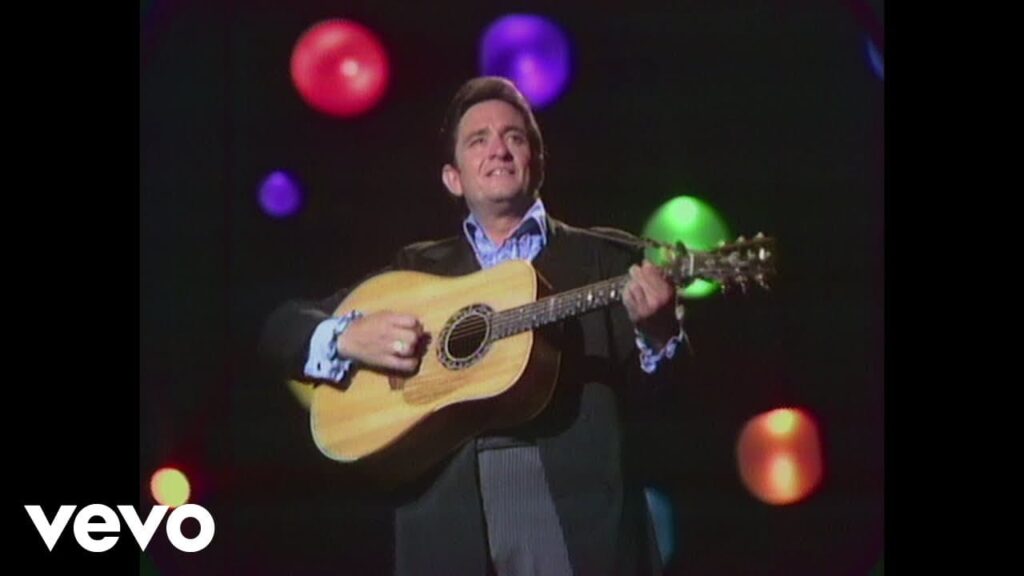
The version most widely known today including the performance featured on The Best of The Johnny Cash TV Show captures the song at its most confident and iconic. By the late 1960s and early 1970s, Cash had fully embraced his role not merely as a country singer, but as a moral narrator, a voice that carried both authority and vulnerability. When he sang “Ring of Fire” during this period, it no longer sounded like a confession it sounded like lived truth.
The song was written by June Carter Cash in collaboration with Merle Kilgore, and its emotional origins are deeply personal. June Carter famously described the song as her attempt to explain falling in love with Johnny Cash an experience she portrayed not as gentle or romanticized, but as overwhelming and consuming. Love, in this song, is not comfort. It is danger. It is heat. It is something that changes you whether you are prepared or not.
Johnny Cash initially hesitated to record the song. It was first released by Anita Carter, June’s sister, in a more traditional country arrangement. But when Cash decided to make it his own, he transformed it entirely. The most striking choice was the inclusion of trumpets, inspired by mariachi music he had heard while traveling. This decision was radical within country music at the time and it worked. The bold, circular trumpet lines create a sonic image of inevitability, reinforcing the idea of being trapped inside emotion with no clear exit.
Cash’s vocal performance is deceptively restrained. He does not shout or dramatize the lyrics. His voice remains steady, almost resigned, as if the outcome is already known. This calm delivery contrasts powerfully with the intensity of the words: “I fell into a burning ring of fire / I went down, down, down.” The repetition is hypnotic, reinforcing the sense of descent, of surrender to something stronger than willpower.
The meaning of “Ring of Fire” lies in its emotional honesty. It refuses to romanticize love as purely redemptive. Instead, it acknowledges love as a force that can both illuminate and destroy. There is no moral judgment in the song only acceptance. Cash does not regret falling into the fire, even though he recognizes the pain. That tension gives the song its lasting depth.
When performed on The Johnny Cash TV Show (which aired from 1969 to 1971), the song took on additional resonance. By that time, Johnny Cash and June Carter were married, their turbulent relationship having survived addiction, separation, and reconciliation. The song no longer felt symbolic it felt autobiographical. Hearing Cash sing it in this context adds layers of meaning that studio recordings alone cannot provide.
The television performances are notable for their simplicity. No excess staging, no visual distraction. Cash stands firm, grounded, letting the song speak for itself. This approach reflected the ethos of the show itself, which prioritized authenticity over polish, giving space to songs that mattered.
Within Johnny Cash’s vast catalog, “Ring of Fire” occupies a unique place. It is neither protest song nor gospel hymn, yet it carries the gravity of both. It speaks to temptation, surrender, and transformation themes that recur throughout Cash’s work. Few artists could balance such intensity with such accessibility.
Decades later, the song remains undiminished. Its imagery is universal, its sound unmistakable. It continues to resonate because it tells the truth without explanation: that some loves arrive gently, and others arrive like fire and once inside, there is no turning back.
In “Ring of Fire,” especially as captured during the era of The Johnny Cash TV Show, Johnny Cash does not warn the listener away from passion. He simply bears witness to it. The fire still burns, and the circle remains unbroken bright, dangerous, and unforgettable.
 Oldies Songs