
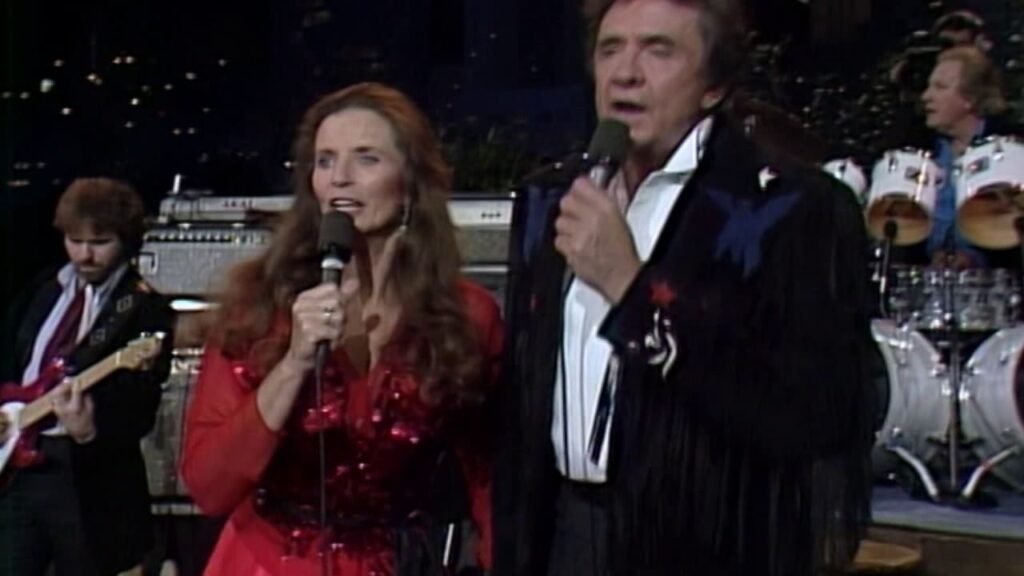
A Shared Smile, a Western Standard, and the Warmth of Two Voices Walking the Same Road
When Johnny Cash and June Carter Cash stepped into “San Antonio Rose” during their Live in Las Vegas, 1979 performance, they were not chasing nostalgia for its own sake. They were honoring a song that belonged to the deep foundation of American music—and doing so in a way only two lifelong partners could. What emerged was not a grand reinterpretation, but something far more lasting: a living conversation between tradition, love, and time.
“San Antonio Rose” was written by Bob Wills, the undisputed father of Western Swing. First recorded instrumentally in 1938, and later released with lyrics in 1940, the song became a landmark success. Bob Wills and His Texas Playboys took it to No. 1 on the national pop charts with the vocal version, an extraordinary achievement for a Western swing band at the time. The song crossed boundaries—country, jazz, pop—long before such crossings were common. By the time Johnny and June sang it decades later, “San Antonio Rose” was no longer simply a hit; it was a standard, woven into the shared memory of American music.
In the 1979 Las Vegas performance, the song takes on a different character. Johnny Cash does not approach it with bravado or reinvention. His voice, by this point in his life, was seasoned and steady, shaped by years of struggle, faith, and endurance. June Carter Cash, ever playful and emotionally intuitive, brings lightness and warmth. Together, they transform the song into something gently domestic—less about longing for a distant rose, and more about companionship that has survived the long road.
The beauty of this performance lies in its ease. There is no tension between the two voices, no need for dramatic contrast. Johnny’s baritone grounds the song, while June’s phrasing lifts it, adding humor and affection. You can hear familiarity in the way they trade lines, the subtle smiles carried in their delivery. This is not performance chemistry—it is lived-in connection.
Lyrically, “San Antonio Rose” has always been a song about distance and memory. The rose symbolizes a love left behind, glowing brighter in recollection than it ever could in reality. When Johnny and June sing it in 1979, the meaning shifts slightly. These are two people who no longer sing about what they lost, but about what they kept. The longing remains in the song, but it is softened by presence.
Musically, the arrangement stays close to tradition. There is a relaxed swing to the rhythm, a nod to Bob Wills’ Texas roots, without turning the moment into a museum piece. The band supports rather than leads. The spotlight remains on the voices and the shared space between them. This restraint reflects Johnny Cash’s late-career philosophy: let the song speak, and don’t interrupt it.
Historically, this performance belongs to a period when Johnny and June were firmly established as more than entertainers. They were symbols of resilience, of love that had survived addiction, separation, and public scrutiny. When they sang together in the late 1970s, audiences were not just listening to music—they were witnessing continuity. “San Antonio Rose” fit naturally into that narrative, because it, too, was a survivor from an earlier age.
June Carter Cash’s role in this performance is especially important. She does not simply support Johnny; she reshapes the emotional tone. Her presence prevents the song from drifting into melancholy. There is humor in her timing, tenderness in her phrasing. She reminds the listener that memory does not have to ache—it can also smile.
The meaning of “San Antonio Rose” in this live setting becomes less about yearning and more about gratitude. It acknowledges the past without being trapped by it. Johnny Cash, who spent much of his career singing about outsiders and wanderers, sounds unusually at peace here. The road has not ended, but it no longer feels lonely.
For those who grew up with this music as part of life rather than fashion, this performance resonates deeply. It recalls a time when songs carried geography, when places mattered, and when love stories unfolded slowly. It also reminds us that great songs do not age—they adapt, gathering new meaning with each voice that carries them forward.
In the end, Johnny Cash & June Carter Cash’s “San Antonio Rose” (Live in Las Vegas, 1979) is not about Texas, nor even about a rose. It is about endurance. About two people standing side by side, singing a song older than their marriage, and making it feel newly alive—not through reinvention, but through shared history.
It is a moment where music stops being performance and becomes presence. And in that quiet, swinging space, “San Antonio Rose” blooms once more—no longer distant, no longer fading, but warmly, unmistakably real.
 Oldies Songs