
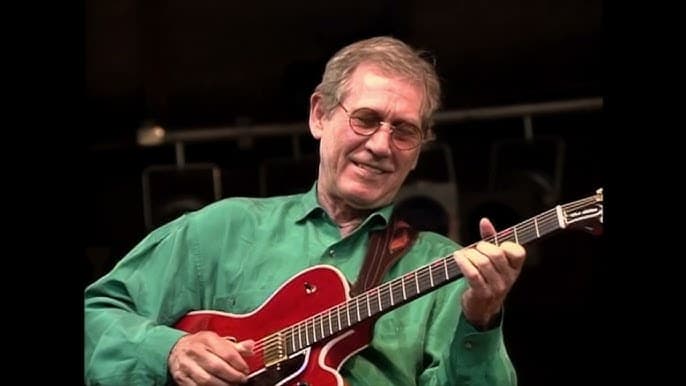
A lifetime of melodies woven into one quiet statement — where Chet Atkins lets his guitar speak for everything he never needed to say
When Chet Atkins performed a Medley, it was never merely a collection of tunes stitched together for convenience. It was a distillation — a musical autobiography told without words. Unlike charted singles or formally released compositions, a Chet Atkins Medley typically appeared in television performances, live concerts, or special recordings rather than on Billboard rankings. As such, it carried no chart position at the time of release. And yet, its significance runs deeper than any numbered placement. A medley, in Atkins’ hands, became a reflection of a lifetime spent shaping sound with humility, precision, and extraordinary taste.
By the time Chet Atkins was widely known as “Mr. Guitar,” his influence had already seeped into nearly every corner of American popular music. He was not only a master instrumentalist but also a visionary producer and executive at RCA Victor, where he helped guide the careers of artists such as Elvis Presley, Jim Reeves, Don Gibson, and Patsy Cline. His fingerprints were everywhere — yet his ego was nowhere. That same philosophy defines his medleys.
A Chet Atkins Medley often draws from familiar standards: country ballads, pop melodies, jazz-inflected themes, and traditional folk tunes. What makes these medleys remarkable is not the choice of material, but the way Atkins reshapes it. He does not announce transitions. He allows one melody to gently dissolve into the next, as though memories themselves were drifting past. The listener often realizes a song has changed only after it already has — a subtlety that reflects Atkins’ lifelong belief that music should feel natural, never forced.
Technically, these medleys showcase his legendary thumb-and-finger picking style, a technique inspired by Merle Travis but refined into something uniquely his own. The thumb maintains a steady bass pulse — calm, dependable — while the fingers articulate melody and harmony above it. In a medley format, this approach becomes especially powerful. Atkins can suggest an entire arrangement — rhythm section, harmony, and lead voice — all within a few inches of strings and wood.
Yet technique is never the point. What defines a Chet Atkins Medley is emotional balance. He resists the temptation to dazzle, even when he easily could. Notes are chosen carefully. Tempos breathe. Silence is respected. There is an understanding that each melody already carries a history — and that his role is not to rewrite it, but to honor it.
These medleys also reveal Atkins’ deep respect for songcraft. He treats well-known tunes not as vehicles for display, but as old friends. Each one is greeted briefly, acknowledged sincerely, and then allowed to move on. There is no lingering nostalgia, no indulgence. Just recognition. This restraint gives the medley its quiet power. It mirrors the way memories surface in real life — briefly vivid, then gently replaced by the next.
Historically, the medley format suited Atkins perfectly during television appearances in the 1950s and 1960s, when time was limited and expectations were broad. In a few short minutes, he could demonstrate range, taste, and mastery without ever raising his voice. Viewers unfamiliar with the technicalities of guitar playing still felt something unmistakable: calm confidence.
Within the broader context of his career, the Medley becomes symbolic. Chet Atkins spent decades bridging worlds — country and pop, tradition and innovation, artistry and commercial success. A medley reflects that bridge-building instinct. Different songs, different moods, different origins — all coexisting peacefully within a single performance.
Listening today, a Chet Atkins Medley feels almost meditative. There is no urgency, no demand for attention. Instead, it invites stillness. It trusts the listener to recognize the melodies, to bring their own memories into the space, and to appreciate the beauty of connection rather than climax.
In the end, a Chet Atkins Medley is not about showcasing how many songs he knew. It is about showing how deeply he understood them. It is the sound of a master looking back — not with pride, but with gratitude — and offering a gentle reminder that music, at its best, is not about being heard loudly, but about being remembered quietly.
 Timeless Melodies