
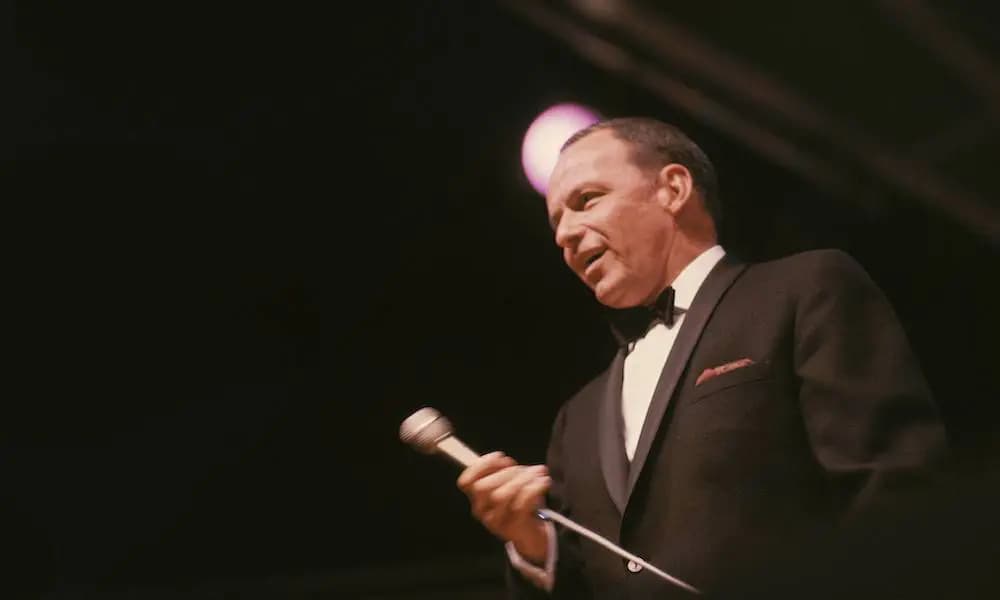
A bruised smile and an unbroken spine where Sinatra turns hard knocks into a declaration of dignity
When Frank Sinatra sang “That’s Life” during A Man and His Music – Part II in 1966, he was not merely performing a hit song. He was delivering a personal manifesto. By this point in his career, Sinatra had lived several artistic lives idol, exile, comeback king and this song captured that entire journey in just over three minutes. Originally released as a single in 1966, “That’s Life” climbed to No. 4 on the Billboard Hot 100 in early 1967, becoming one of Sinatra’s last major pop-chart successes and one of his most defining statements.
The song itself was written by Dean Kay and Kelly Gordon, inspired by the raw, brassy swagger of contemporary soul recordings. Sinatra first heard the tune through a recording by O.C. Smith, but immediately recognized something personal in its defiant tone. At a time when rock music dominated youth culture and Sinatra was often dismissed as a relic of another era, “That’s Life” allowed him to answer critics without naming them with wit, grit, and unshakable self-respect.
The television special A Man and His Music – Part II, broadcast in 1966, provided the perfect setting. Unlike traditional variety shows, this series was designed as a curated portrait of Sinatra’s artistry and worldview. It was reflective, selective, and unapologetically adult in tone. When “That’s Life” appears in the program, it feels less like a song choice and more like a thesis statement.
Musically, the arrangement is bold and assertive. Brass punches through the mix, the rhythm section swings with confidence, and the tempo pushes forward with controlled force. Sinatra enters with clipped phrasing, half-sung, half-spoken, as if addressing an old adversary perhaps fate itself. His voice is weathered now, carrying the grain of experience rather than youthful smoothness. That texture is essential. This is not the sound of someone imagining hardship; it is the sound of someone who has survived it.
Lyrically, “That’s Life” is built on contrasts “I’ve been a puppet, a pauper, a pirate, a poet, a pawn and a king.” These lines resonate especially deeply when sung by Sinatra, whose career had indeed swung between extremes. In the late 1940s and early 1950s, his popularity collapsed, his film career faltered, and his personal life unraveled. Many had counted him out. His resurgence in the mid-1950s, fueled by Capitol Records and later Reprise Records, was one of the great comebacks in American music. This song acknowledges those falls without bitterness and those rises without arrogance.
What sets Sinatra’s performance apart, especially in A Man and His Music – Part II, is his refusal to sentimentalize struggle. There is no self-pity here. Even the line “I can’t deny it” is delivered with a shrug rather than a sigh. The message is clear: life is unpredictable, unfair, and relentless but surrender is optional.
The cultural timing also matters. In the mid-1960s, America itself was restless, questioning old certainties. Sinatra, often labeled conservative or traditional, responds not by retreating into nostalgia but by asserting resilience. “That’s Life” does not cling to the past. It faces the present head-on.
Unlike many of Sinatra’s romantic ballads, this song does not seek connection through vulnerability. Instead, it offers solidarity through honesty. It says: everyone falls; what matters is standing back up. That message, delivered with Sinatra’s unmistakable authority, gave the song its lasting power.
Today, “That’s Life” endures not because of its chart success, but because of its truthfulness. It feels earned. In the context of A Man and His Music – Part II, it stands as a summation of a career, a philosophy, and a man who refused to be reduced to a single chapter.
In the end, when Frank Sinatra sings “I’m gonna roll myself up in a big ball and die,” there is a pause and then resolve. Because we know he won’t. And neither does he.