
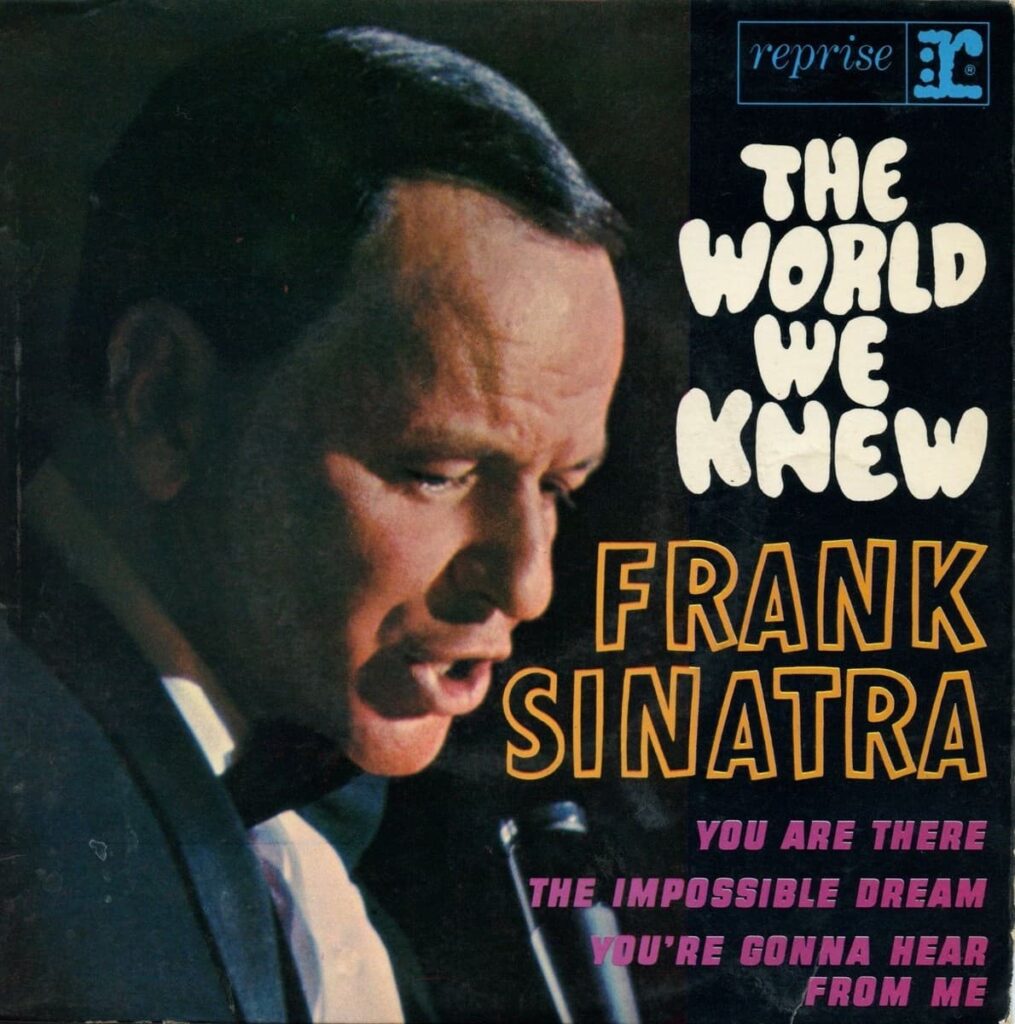
A poignant reflection on lost love and remembered dreams The World We Knew (Over and Over)
Frank Sinatra’s “The World We Knew (Over and Over)” is a gentle, wistful meditation on days gone by a yearning for a brighter past and the ache of realizing what once was may never return.
When Frank Sinatra released The World We Knew (Over and Over) in 1967, it struck a chord with listeners who carried their own memories close. The song came from his studio album The World We Knew, recorded in the summer of that year. As a single, it reached No. 30 on the Billboard Hot 100 in September 1967. More strikingly, it spent five weeks at No. 1 on the Billboard Easy Listening (Adult Contemporary) chart, becoming Sinatra’s sixth and final single to top that particular list. In the UK, it also made an appearance, peaking at No. 33 on the Official Charts.
The story behind the song is colored by sophisticated collaboration. The melody comes from Bert Kaempfert, the German composer and bandleader, while the lyrics were penned by Carl Sigman and Herbert Rehbein. Their creative union gives the song a slightly continental elegance, a sense of space and longing shaped by orchestral strings and a measured pace.
Lyrically, Sinatra revisits a world that once seemed almost magical, singing about a time “once when you walked beside me, that inconceivable, that unbelievable world we knew.” He paints those memories in vivid light: neon signs transforming into stars, sun and moon belonging to them, and every path they walked turning to gold. Yet, for all its beauty, there’s also an inevitable fragility “the dream was too much for you to hold.”
This duality between the radiant memory and the painful acceptance of its loss is at the emotional heart of the song. Sinatra’s voice, warm and seasoned, carries that bittersweet nostalgia. There is no anger; rather, a quiet sadness, an elegy for something irreplaceable. When he repeats “over and over, I keep going over the world we knew,” it feels like both comfort and torment, a melody that loops in the mind like a beloved photograph.
Musically, the arrangement leans into Sinatra’s classic strengths. The orchestral score is elegant without being extravagant: gentle strings, subtle brass, and a rhythm that supports without pushing. The production, under Jimmy Bowen, gives Sinatra room to “tell” rather than simply “sing,” letting every note linger in the air, as if inviting the listener to lean in more intimately.
But the meaning of The World We Knew resonates beyond just a nostalgic love song. It suggests a deeper meditation on what it means to lose a shared vision not just a person, but what might have been. The “world” Sinatra refers to is more than physical; it’s a landscape of dreams, shared hopes, and perhaps illusions. The repetition “over and over” is not only about memory, but about the inescapable cycle of returning to what once felt whole, even when one knows that time has irrevocably changed things.
Over time, the song has held its quiet power. It is often regarded as one of Sinatra’s more thoughtful, introspective tracks not a brash chart-topper, but a deeply felt reflection. It has been adapted and translated in other languages: for example, Charles Aznavour rendered it in French as “Un monde avec toi.” Its melody and mood have also inspired later artists; notably, Josh Groban covered it on his album Harmony.
Listening now, one decades later, this song offers a gentle space for reflection. It calls to mind those evenings when the world felt full of promise, and that hopeful closeness with another seemed boundless. But there is also a wisdom in its trembling admission: that some dreams, no matter how golden, don’t withstand the test of time.
Frank Sinatra delivers The World We Knew (Over and Over) with a graceful humility. It’s a song about love, but more about what remains after love changes; a memory cherished, a dream mourned, and a voice that forever echoes through the delicate corridors of the heart.