
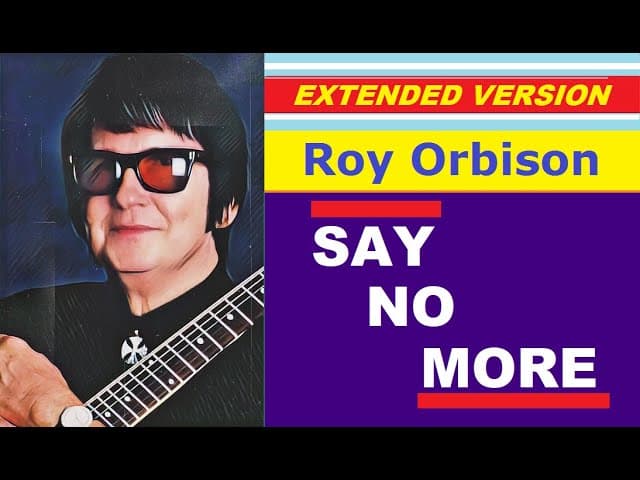
A Quiet Surrender to Love’s Inevitability, Where Silence Speaks Louder Than Promises
When Roy Orbison recorded “Say No More”, he was already recognized as one of the most emotionally distinctive voices in popular music a singer who did not merely perform songs, but inhabited them. Released in 1966 as part of the album The Orbison Way, “Say No More” did not emerge as a chart-dominating single, nor was it designed to. It did not enter the Billboard Hot 100 upon release, and yet its importance lies elsewhere: in mood, in emotional precision, and in the way Orbison could transform restraint into quiet devastation.
By the mid-1960s, Roy Orbison stood apart from his contemporaries. While much of popular music leaned toward youth, rebellion, or optimism, Orbison sang from a place of emotional solitude. His songs were populated by lonely figures, men who loved deeply and suffered silently. “Say No More” belongs firmly in this lineage. It is not dramatic in structure, but it is profound in implication a song about recognition rather than persuasion.
The title itself is revealing. “Say No More” suggests the moment when words become unnecessary, when truth has already been understood. In Orbison’s world, love often arrives too late, or is recognized only at the point where loss becomes inevitable. This song captures that fragile instant when one person realizes that the other no longer needs convincing, that the heart has already decided.
Musically, the song is understated by Orbison’s standards. There are no soaring crescendos or operatic climaxes. Instead, the arrangement is smooth, measured, and deliberately controlled. The orchestration supports the vocal without overwhelming it, allowing Orbison’s phrasing to carry the emotional weight. Each line is delivered with careful restraint, as though saying too much might fracture the moment entirely.
Vocally, Roy Orbison is masterful in his economy. He does not push his voice toward extremes. Instead, he allows subtle inflections to do the work slight pauses, softened consonants, gentle rises in pitch that suggest vulnerability without naming it outright. This approach gives “Say No More” an intimacy that feels almost confessional, as if the listener has been entrusted with something unspoken.
Lyrically, the song revolves around acceptance. There is no argument, no confrontation, no attempt to reclaim what has slipped away. The narrator understands. He has reached the point where explanation would only cheapen the truth. In this sense, “Say No More” is not a song of defeat, but of emotional clarity. It recognizes that love, once altered, cannot be negotiated back into place.
Within The Orbison Way, the song contributes to an album that marked a subtle transition in Orbison’s career. While earlier works emphasized dramatic loneliness, this period reveals a deeper resignation a maturity shaped by experience rather than longing. The album itself did not produce major hits, but it remains critically respected for its cohesion and emotional depth. “Say No More” exemplifies that spirit perfectly.
What makes the song endure is its realism. Many love songs rely on hope or heartbreak as their engine. This one relies on understanding. It speaks to the moment when emotions settle, when certainty replaces confusion, even if that certainty is painful. There is a dignity in that realization, and Orbison honors it by refusing to overstate the emotion.
Over time, “Say No More” has become one of those quietly admired recordings often overlooked, yet deeply valued by those who listen closely. It rewards attention not with immediate drama, but with resonance. The more one listens, the more the silences between the lines begin to speak.
In the vast catalog of Roy Orbison, filled with towering classics and unforgettable melodies, “Say No More” stands as a reminder of his greatest gift: the ability to convey complex emotional truth with remarkable simplicity. It does not linger loudly. It stays quietly.
And long after the final note fades, what remains is the feeling that something important has been acknowledged without being explained that sometimes, when the heart understands, there truly is nothing left to say.