
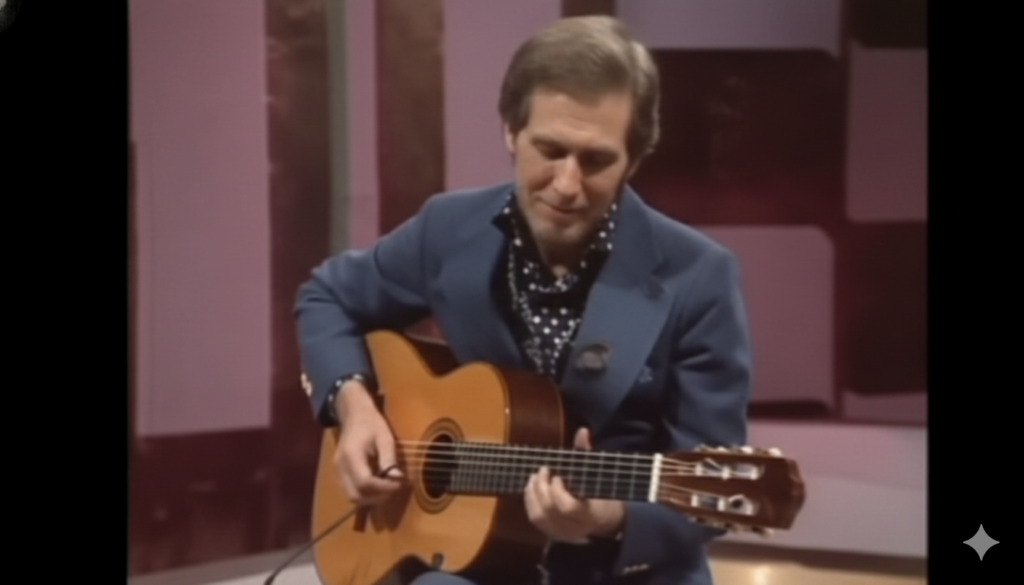
A flowing meditation where melody moves like water, carrying grace, control, and quiet mastery
“Cascade” by Chet Atkins is one of those instrumental pieces that does not ask for attention, yet slowly earns it—note by note, breath by breath. Released in 1961 on the album Chet Atkins Workshop, the track stands as a refined example of Atkins’ ability to turn the guitar into a voice of atmosphere rather than assertion. It is music that moves forward gently, like falling water, never rushing, never stopping—true to its title and its spirit.
At the time of its release, Chet Atkins Workshop was a significant commercial and artistic success. The album reached No. 6 on the Billboard Top Country Albums chart and also crossed over to the pop market, peaking around No. 37 on the Billboard Top LPs chart—an impressive achievement for a largely instrumental record led by a solo guitarist. “Cascade” itself was not issued as a standalone single and therefore did not chart independently, but it became one of the album’s most admired tracks among musicians and dedicated listeners, quietly reinforcing Atkins’ reputation as the most tasteful guitarist of his era.
By 1961, Chet Atkins was far more than a performer. He was already a guiding force behind RCA Nashville, shaping what would become known as the Nashville Sound—a smoother, more elegant approach that brought country music into living rooms that once resisted it. Yet “Cascade” feels deliberately removed from industry concerns. There is no commercial hook, no dramatic climax. Instead, the piece unfolds patiently, built on a flowing melodic line supported by Atkins’ trademark fingerstyle technique.
The brilliance of “Cascade” lies in its illusion of effortlessness. Atkins allows the melody to ripple across the strings with a liquid smoothness, while the alternating bass provides a steady, grounding current beneath it. Every note is clean, controlled, and intentional, yet never stiff. The guitar seems to breathe. The listener does not hear technique first; technique disappears into feeling. This was always Atkins’ greatest strength—his refusal to impress for the sake of impressing.
There is also a subtle emotional narrative at work. “Cascade” does not tell a story with conflict or resolution, but with continuity. It suggests motion without destination, reflection without melancholy. The music evokes images of water moving over stone, of time passing without urgency. In an era when popular music increasingly leaned toward volume and velocity, Atkins offered a counterstatement: that beauty could be found in restraint, and depth in simplicity.
From a compositional standpoint, “Cascade” reflects Atkins’ deep understanding of balance. The melody never overwhelms the harmony, and the harmony never competes with the rhythm. Space is as important as sound. Small pauses allow phrases to linger, inviting the listener inward rather than pushing outward. This sense of proportion is what separates Atkins from countless skilled guitarists—he was not merely playing music; he was shaping silence around it.
The title itself is revealing. A cascade is continuous, natural, and unforced. It does not strive to be dramatic; it simply follows gravity. In much the same way, Chet Atkins lets the music fall where it may. There is humility in this approach, a quiet confidence that trusts the listener to listen deeply rather than be persuaded.
Over the decades, “Cascade” has endured not through constant airplay, but through rediscovery—passed along by guitarists, collectors, and listeners who value craftsmanship over spectacle. It remains a touchstone for those who understand that instrumental music can speak with as much emotional clarity as any lyric.
In “Cascade,” Chet Atkins leaves behind a gentle lesson: that mastery is not about control alone, but about knowing when to let go. The notes flow, the moment passes, and what remains is a feeling—calm, steady, and quietly unforgettable.