
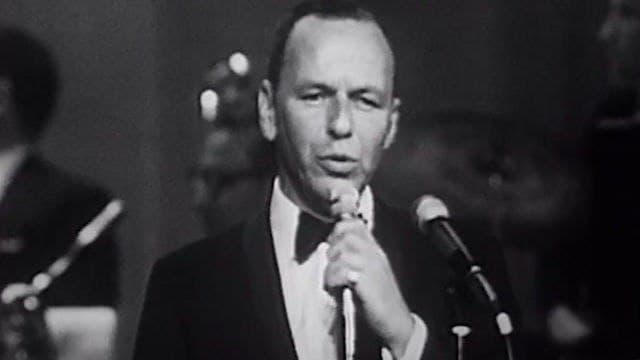
A declaration of swing-era optimism, where romance is lifted beyond gravity and time itself seems to pause
Few performances capture the elegance, confidence, and emotional precision of Frank Sinatra quite like “Fly Me to the Moon”, especially in his 1965 live performance at the Kiel Opera House in St. Louis, Missouri. By this point in his career, Sinatra was no longer proving anything he was refining a legacy. This rendition is not merely a live version of a popular song; it is a masterclass in phrasing, restraint, and emotional authority, delivered by an artist fully at ease with his own voice and place in music history.
“Fly Me to the Moon” was written in 1954 by Bart Howard, originally titled “In Other Words.” While several artists recorded it earlier, the song became inseparably linked to Sinatra after his 1964 studio recording with Count Basie and the Count Basie Orchestra, arranged by the legendary Quincy Jones. That version appeared on the album It Might as Well Be Swing, a record that reaffirmed Sinatra’s dominance in the jazz-pop landscape during the mid-1960s.
Although the single itself was not released as a traditional chart-topping hit, its cultural impact far exceeded chart positions. Notably, Sinatra’s version became historically symbolic when it was played during NASA’s Apollo missions, including Apollo 10 and Apollo 11, forever binding the song to humanity’s literal journey to the moon. Few popular songs can claim such an honor.
By the time Sinatra stepped onto the stage at the Kiel Opera House in 1965, the song had already evolved from a romantic standard into something almost mythic. In this live performance, Sinatra sings with a relaxed authority never rushing, never overselling. His voice floats effortlessly over the orchestra, bending time with subtle pauses and perfectly weighted consonants. Every phrase feels intentional, as though spoken rather than sung.
What distinguishes this performance is Sinatra’s command of space. He allows silence to work for him. When he sings “Fill my heart with song…”, there is a quiet confidence that suggests love is not something to chase, but something already understood. The swing rhythm propels the song forward, yet Sinatra remains unhurried, leaning slightly behind the beat a technique few singers ever mastered as naturally.
The arrangement stays faithful to the swinging big-band style that defined his collaborations with Count Basie, even when performed live. Brass accents sparkle without overpowering the vocal, while the rhythm section maintains a buoyant pulse that feels almost conversational. This balance allows the song to feel both intimate and grand a rare combination.
Lyrically, “Fly Me to the Moon” is deceptively simple. It uses celestial imagery not to escape reality, but to elevate everyday emotion. Love becomes a journey, not toward fantasy, but toward deeper understanding. Sinatra delivers these lines not with youthful wonder, but with seasoned assurance. The romance here is not idealized it is affirmed.
In the context of the mid-1960s, this performance also stands as a quiet counterpoint to a rapidly changing musical world. Rock music was louder, younger, and increasingly experimental. Sinatra did not compete with these trends; he ignored them. Performances like this one remind us that sophistication does not need reinvention it only needs conviction.
The Kiel Opera House performance captures Sinatra in full command of his craft. There is no excess emotion, no vocal acrobatics. Instead, there is clarity, warmth, and a sense of continuity an artist carrying forward a tradition while keeping it alive through subtle renewal.
Over the decades, “Fly Me to the Moon” has been sung by countless performers, but Sinatra’s live renditions from this era remain definitive. They do not belong to a specific decade; they exist outside of fashion. This 1965 performance, in particular, feels preserved in amber untouched by time, yet alive with human presence.
In the end, Frank Sinatra’s “Fly Me to the Moon” (Live at the Kiel Opera House, 1965) is more than a song about love. It is a statement of artistic maturity proof that when elegance meets experience, the result does not age. It simply endures, swinging gently in orbit, forever just out of reach, yet always familiar.