
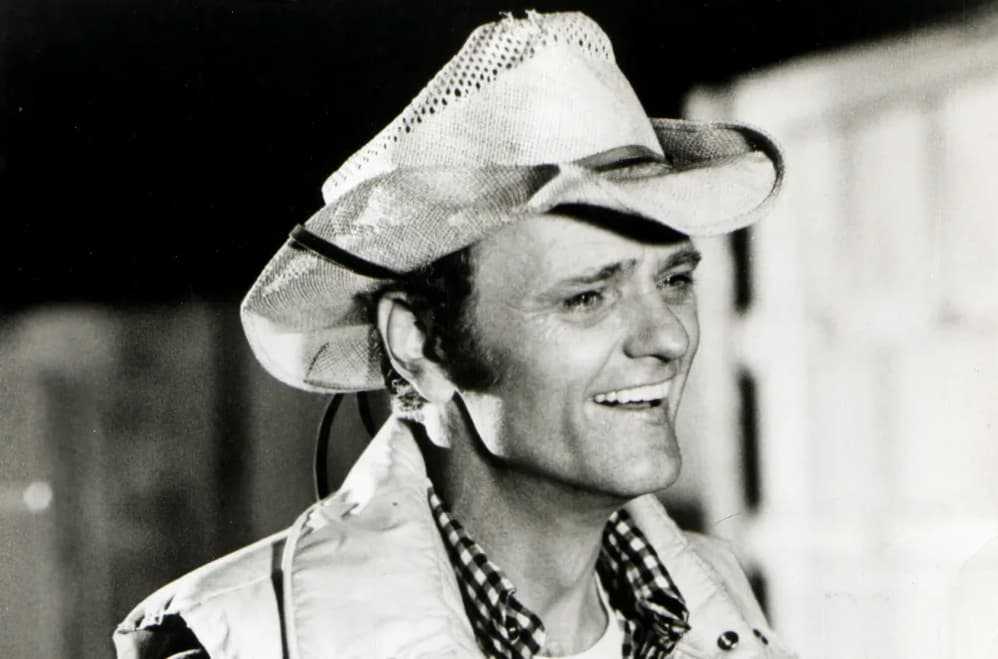
A Roaring Anthem of Rebellion and Motion on the Open Highway
When Jerry Reed unleashed “East Bound and Down” in 1977, the song wasn’t merely another country hit—it was a cultural ignition point. Written by Reed and fellow Nashville craftsman Dick Feller, the track powered its way up the Billboard Hot Country Singles chart, ultimately reaching No. 2. Featured on the soundtrack to the film Smokey and the Bandit, in which Reed co-starred alongside Burt Reynolds, the song quickly transcended its cinematic roots to become an emblem of American road culture. It was as much a character in the film as any actor—a musical embodiment of speed, defiance, and joy barreling down a southern highway at full throttle.
The genesis of “East Bound and Down” lies in that perfect collision between Hollywood’s appetite for adventure and Nashville’s golden era of musicianship. Director Hal Needham’s film demanded a song that could capture not just motion but attitude—the reckless confidence of a man racing against time and authority. Reed, already an acclaimed guitarist and songwriter known for his nimble fingerpicking and sly humor, distilled that spirit into two-and-a-half minutes of pure kinetic energy. His voice—half grin, half growl—rides over a rhythm section that feels like rubber on asphalt, while the Telecaster twang provides both propulsion and punctuation.
Lyrically, the song is a celebration of freedom cloaked in the language of outlaw enterprise. The protagonist isn’t merely hauling cargo; he’s testing limits, pushing back against restriction, reveling in the risk of being caught. The “east bound” journey becomes a metaphor for living on one’s own terms—a constant forward motion that refuses to yield to convention or caution. Reed’s delivery exudes camaraderie; it invites listeners into that cab beside him, urging them to share in the reckless laughter of the chase. Beneath its exuberance lies something deeper: an understanding that rebellion can be joyous, even communal.
Musically, “East Bound and Down” stands as one of country music’s most dynamic recordings of its era. The arrangement is tight but never stiff—a testament to Nashville’s top-tier session players who could turn raw energy into polished craftsmanship without sanding off its edge. Reed’s guitar work flashes with dexterity yet never overplays; it dances around the groove rather than dominating it. The result is a track that feels simultaneously spontaneous and precise—a rolling thunderstorm shaped into melody.
Decades later, “East Bound and Down” remains more than a nostalgic relic from a CB-radio age; it endures as a symbol of unrestrained American motion. Every revving engine on an open road seems to hum its rhythm, every driver chasing sunset or freedom hears its echo. In Reed’s world, speed was not just velocity—it was vitality—and this song remains his most enduring testament to life lived at full throttle, eastbound toward whatever horizon beckons next.
 Timeless Melodies