
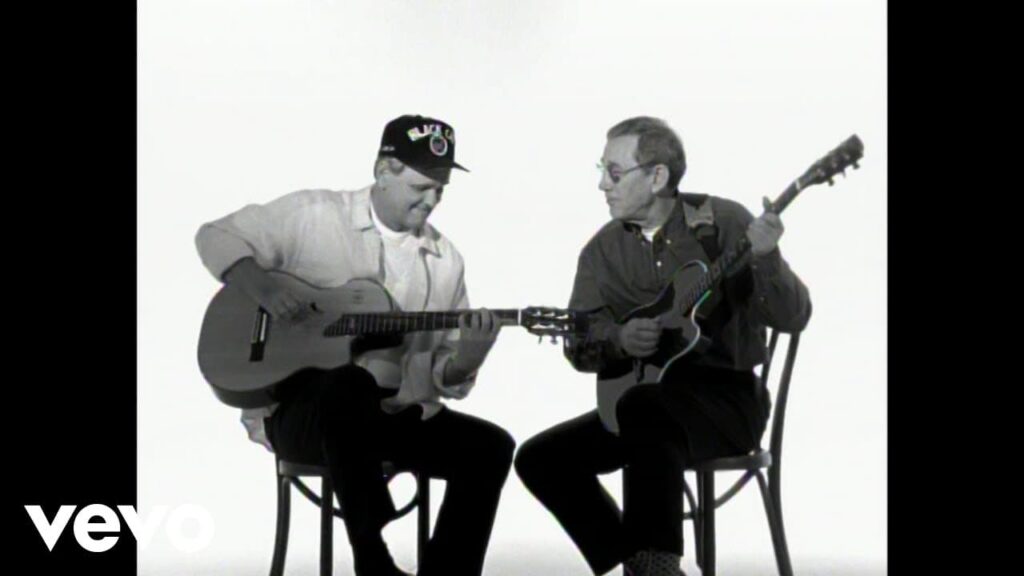
A playful duel of fingers and friendship where virtuosity smiles, teases, and never forgets to have fun.
When Chet Atkins & Jerry Reed performed “The Claw”, they offered something rarer than a chart-topping hit: a living conversation between two guitars, spoken in humor, respect, and effortless mastery. “The Claw” was written by Jerry Reed, first introduced in the early 1970s, and while it never appeared as a major charting single, its legacy has proven far more enduring than many songs that once crowded the rankings. This piece became a defining moment in guitar history not through commercial ambition, but through personality, technique, and sheer joy.
At the time of its emergence, Chet Atkins was already revered as “Mr. Guitar,” the architect of the Nashville Sound, a man whose influence stretched far beyond country music into jazz, pop, and classical phrasing. Jerry Reed, on the other hand, was the mischievous genius a songwriter, actor, and guitarist whose style defied formal labels. When these two came together, “The Claw” became less a performance and more a friendly contest, one that never sought a winner.
The title itself hints at the spirit of the piece. “The Claw” refers to Jerry Reed’s unconventional right-hand picking technique, a method that looked almost accidental but produced astonishing rhythmic complexity. His thumb seemed to attack the bass strings while his fingers snapped out syncopated melodies with playful aggression. Chet Atkins, whose own fingerstyle technique was refined, elegant, and almost orchestral, responds not by overpowering Reed, but by dancing alongside him sometimes guiding, sometimes stepping back, always listening.
There is no traditional “story” in “The Claw”, yet it tells one all the same. It speaks of friendship built on mutual admiration rather than competition. One can hear moments where the guitars seem to laugh, moments where one player nudges the other into a new phrase, and moments where silence itself becomes part of the joke. This is music that trusts the listener, inviting them into a shared moment rather than delivering a polished statement.
Because “The Claw” is an instrumental, it bypassed conventional radio formulas and thus never found a place on major pop or country charts. But among musicians especially guitarists it quickly became legendary. Performances of the piece, particularly those captured on television specials and live recordings, circulated like treasured stories passed from hand to hand. In this way, “The Claw” earned a different kind of ranking: a permanent place in the informal canon of American guitar music.
The meaning of the piece lies not in lyrics, but in attitude. “The Claw” celebrates individuality. Jerry Reed refuses to smooth out his rough edges, while Chet Atkins shows that true mastery includes generosity. Atkins never dominates the exchange, despite his stature. Instead, he amplifies Reed’s eccentric brilliance, allowing it to shine while subtly anchoring the performance with his impeccable timing and harmonic sense.
Emotionally, the piece carries a warmth that is often missing from technically demanding music. There is no tension born of ego. Instead, there is curiosity, delight, and a shared understanding that music can be both serious and lighthearted at once. In a time when performances were often carefully controlled, “The Claw” feels refreshingly human spontaneous, imperfect in the best ways, and deeply alive.
Over the years, “The Claw” has come to symbolize a certain era in American music a time when musicians gathered not to chase trends, but to explore what their hands and hearts could discover together. It reminds us that brilliance does not always announce itself loudly. Sometimes it grins, leans back, and lets the fingers do the talking.
In the end, Chet Atkins & Jerry Reed did not need charts, trophies, or headlines for “The Claw.” What they created was something far more lasting: a moment of shared artistry that continues to inspire listeners who value craftsmanship, humor, and the quiet confidence of musicians who knew exactly who they were and had nothing left to prove.