
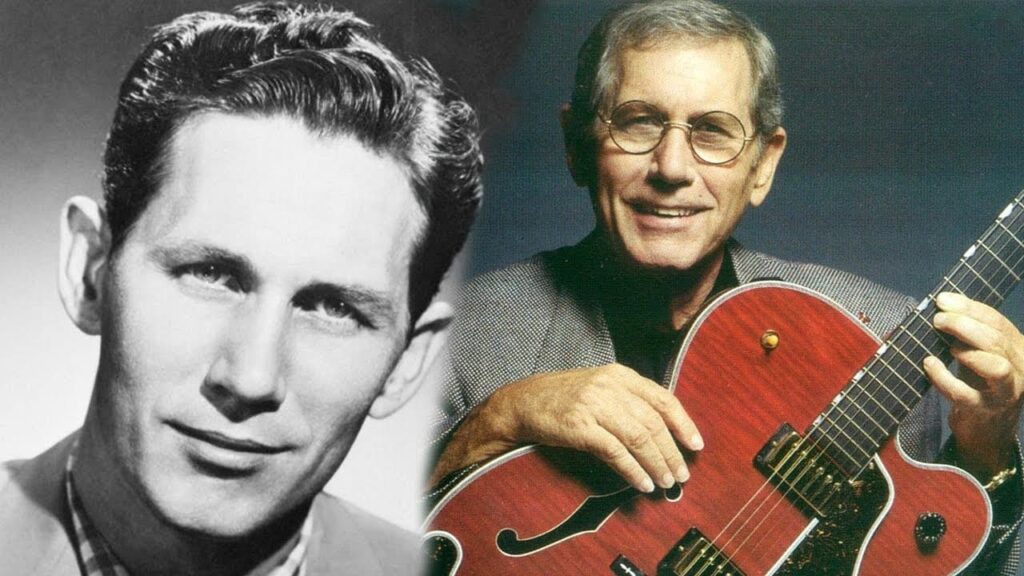
A quiet conversation between mainland mastery and island soul where steel strings learn to breathe like ocean air.
When Chet Atkins explored “Hawaiian Slack Key”, he was not chasing novelty or trend. He was listening. Long before genre fusion became fashionable, Atkins had already spent a lifetime absorbing musical languages from across the world jazz phrasing, classical discipline, pop accessibility, and deep-rooted country tradition. His approach to Hawaiian slack key guitar was another chapter in that lifelong dialogue: respectful, curious, and deeply restrained.
Unlike many of his commercially successful recordings, “Hawaiian Slack Key” was never intended as a chart contender. It did not appear on the Billboard singles charts upon release, nor was it promoted as a crossover hit. Yet, as with much of Atkins’ later instrumental work, its importance lies not in rankings but in intent. By the time he recorded this piece, Chet Atkins was already recognized globally as “Mr. Guitar,” a figure whose influence had shaped the sound of modern country music and beyond. What he sought here was not recognition, but understanding.
Slack key guitar known in Hawaii as kī hō‘alu is built on openness. Strings are loosened, retuned, allowed to resonate freely. The technique creates a sense of space, warmth, and gentle melancholy, echoing waves, wind, and memory. For a guitarist so famously precise and controlled, this might seem an unlikely pairing. Yet Atkins approached slack key not as a technical challenge, but as a philosophy. He allowed the guitar to ring longer, breathe deeper, and speak softer.
In “Hawaiian Slack Key,” Atkins does not attempt to imitate traditional Hawaiian masters outright. Instead, he honors the style by meeting it halfway. His thumb maintains a steady, grounding bass — familiar territory while his melody lines drift with an unhurried grace. Notes are not rushed toward resolution. They linger, overlap, and fade naturally, creating a soundscape rather than a statement. This patience is essential to the song’s emotional effect.
There is no dramatic arc in this piece. No chorus demands attention. No flourish announces virtuosity. And yet, virtuosity is everywhere hidden in touch, timing, and tone. Atkins understood that slack key guitar is less about display and more about atmosphere. The listener is invited not to follow a story, but to inhabit a moment. It feels like sitting quietly as daylight shifts, noticing time rather than measuring it.
Historically, Chet Atkins had long admired Hawaiian music. The steel guitar’s influence on country music is well documented, and Atkins himself acknowledged how Hawaiian sounds shaped early American guitar styles. In this sense, “Hawaiian Slack Key” feels like a homecoming a return to a source that had quietly informed his musical vocabulary all along. The piece becomes a gesture of gratitude, a nod to the traditions that helped make his own voice possible.
Emotionally, the music carries a gentle introspection. There is calm here, but not emptiness. The tuning allows harmonics to shimmer unexpectedly, like memories surfacing without warning. Each phrase seems aware of its own fragility. This is music that does not insist on being remembered, yet somehow stays with you.
For listeners familiar with Atkins’ earlier, more structured recordings, “Hawaiian Slack Key” reveals another side of his artistryone less concerned with architecture and more with air. It sits comfortably alongside his contemplative interpretations of “Londonderry Air” and “Amazing Grace,” works where the guitar becomes a vessel for reflection rather than instruction.
In the broader landscape of Atkins’ career, this piece underscores a rare quality: humility. Despite his stature, he approached another culture’s musical language not as a master claiming new territory, but as a guest removing his shoes at the door. He listened first. He spoke second.
“Hawaiian Slack Key” remains a quiet jewel within Chet Atkins’ vast catalog. It reminds us that true musicianship is not only about how much one knows, but about how gently one approaches what is unfamiliar. Long after louder performances fade, this piece continues to resonate like the soft echo of strings retuned, loosened, and finally allowed to speak in their own time.