
A quiet return to contentment where relief arrives gently, and happiness feels earned rather than announced.
When Chet Atkins recorded “Happy Again,” he offered one of the most understated emotional statements in his vast catalog. This was not a song designed to capture radio attention or climb the charts. “Happy Again” was never released as a commercial single, nor did it appear on the Billboard charts at the time of its release. Instead, it lived where much of Atkins’ most meaningful work resides within albums and performances meant for careful listening rather than mass excitement. And in many ways, that quiet placement suits the song perfectly.
By the time Chet Atkins turned to pieces like “Happy Again,” his reputation was already secure. Known worldwide as “Mr. Guitar,” he had reshaped the sound of country music, guided countless artists as a producer, and demonstrated that the guitar could speak with elegance, humor, and restraint. This later period of his career reveals something deeper: a musician less concerned with innovation for its own sake, and more focused on emotional clarity. “Happy Again” belongs to that reflective chapter.
The title alone suggests a journey rather than a moment. Happiness here is not sudden joy or youthful excitement. It is the quieter satisfaction that comes after hardship, disappointment, or long endurance. Atkins does not rush toward that feeling. Instead, he lets it unfold slowly, phrase by phrase, allowing the listener to feel the distance traveled before arriving at calm.
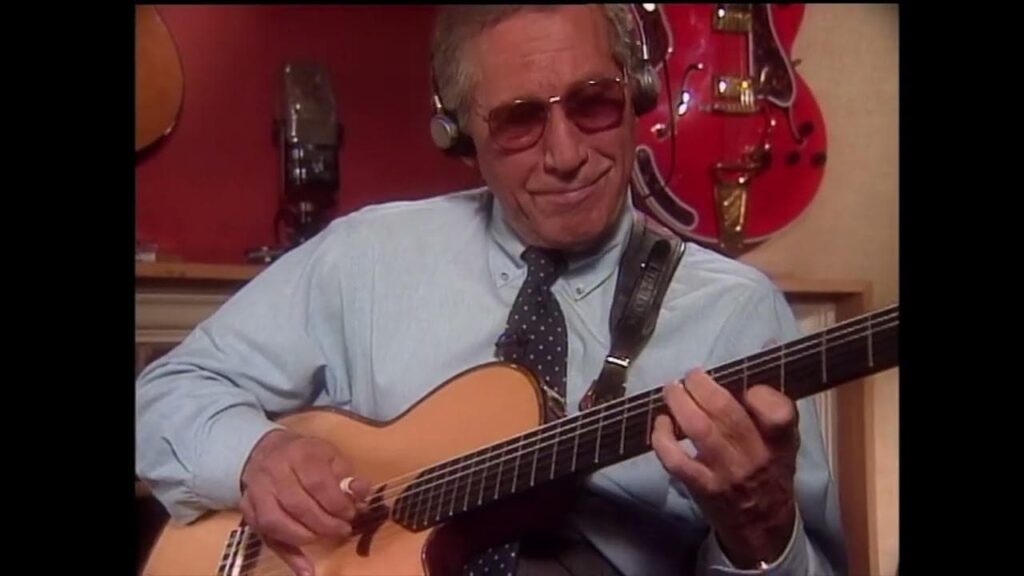
Musically, “Happy Again” is built on simplicity. The melody is gentle, almost conversational, carried by Atkins’ signature fingerstyle technique. His thumb provides a steady, reassuring bass line, while the melody floats above with an unhurried grace. There are no sharp edges, no dramatic turns. Each note seems aware of the space around it, as if acknowledging that peace often lives in restraint.
What makes this piece especially moving is what Atkins chooses not to do. There is no technical display meant to impress. No rapid runs or complex harmonics demanding attention. Instead, the mastery is subtle in touch, tone, and timing. The guitar speaks softly, but with confidence, like someone who has learned that happiness does not need to be defended or explained.
Although “Happy Again” does not carry an explicit narrative, it suggests one intuitively. The opening phrases feel tentative, reflective — as though remembering a time when contentment felt distant. As the piece progresses, the melody relaxes. The notes breathe more freely. By the end, there is no triumphant resolution, only acceptance. Happiness is present, but it is calm, settled, and deeply human.
This emotional approach reflects Chet Atkins’ broader philosophy as a musician. Throughout his career, he believed that music should serve the song, not the ego. In “Happy Again,” the song serves the feeling. It does not insist that everything is perfect. It simply suggests that peace has returned quietly, almost unnoticed, until one realizes it has been there all along.
Historically, this piece fits comfortably among Atkins’ reflective instrumentals such as “Cascade,” “Londonderry Air,” and “Amazing Grace.” These works share a common thread: they treat the guitar not as a vehicle for speed, but as a voice capable of compassion. In a musical world often driven by urgency, Atkins chose patience.
The absence of chart recognition does not diminish “Happy Again.” In fact, it enhances its intimacy. This is music meant to be discovered rather than promoted, revisited rather than consumed once. It rewards stillness. It asks the listener to slow down and notice how gently joy can return.
In the context of Chet Atkins’ legacy, “Happy Again” feels like a personal note rather than a public statement. It reflects a man who had seen success, pressure, and expectation and who emerged valuing balance over applause. The guitar does not shout its happiness. It confirms it.
Long after louder recordings fade from memory, “Happy Again” remains quietly present. It reminds us that happiness is not always a celebration. Sometimes it is simply the absence of weight, the ease of breathing again, and the comfort of knowing that peace once lost can still find its way back, one gentle note at a time.