
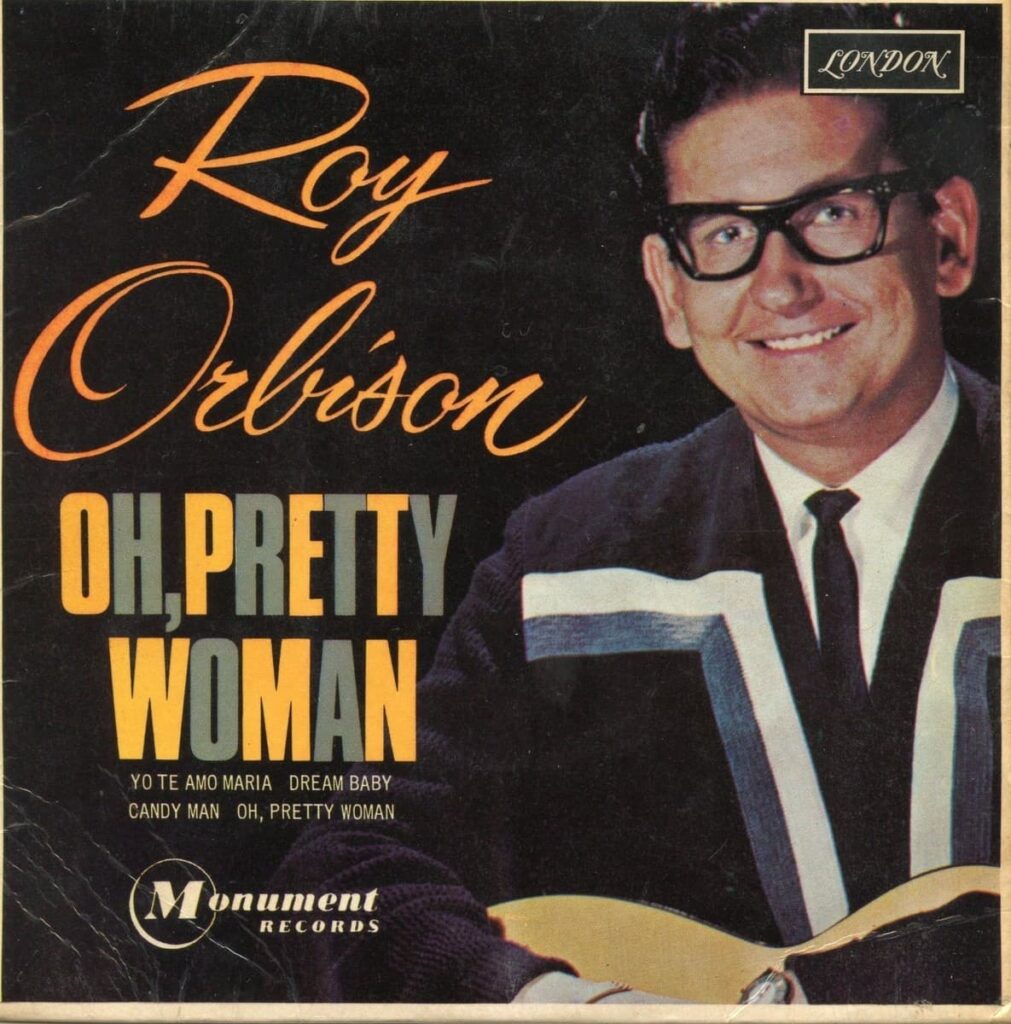
A timeless hymn to beauty and longing
When Roy Orbison released “Oh, Pretty Woman” in August 1964, it soared to the very top — spending three weeks at No. 1 on the Billboard Hot 100, becoming one of his most iconic and enduring songs.
From its very first, unforgettable guitar riff to Orbison’s soaring, tender voice, “Oh, Pretty Woman” is more than just a catchy rock-and-roll tune — it’s a gentle confession, a longing glance, a moment paused in time. The backstory is charming in its simplicity: Orbison was at home with his songwriting partner Bill Dees when his wife, Claudette, announced she was heading into town. When Roy asked if she needed money, Bill quipped, “A pretty woman never needs any money.” From that phrase, the song took shape. The two of them leaned in: Orbison strummed his guitar, while Dees tapped rhythms on the table as if mimicking the click-click of high heels on the pavement. By the time Claudette returned — only about forty minutes later — they had the bones of the song.
Recorded on August 1, 1964, at Monument Studios in Nashville, the session featured talented musicians: Billy Sanford on guitar delivering that punchy, unforgettable riff, accompanied by Jerry Kennedy and Wayne Moss. The production, overseen by Fred Foster, gives the song a clean but driving rock feel — a heart-pounding beat, crisp instrumentation, and a vocal that is pure Orbison: smooth, emotionally charged, delicate and bold all at once.
Chart-wise, the song was a runaway success. After debuting, it climbed quickly, knocking off The Animals’ “House of the Rising Sun” to claim the top of the Hot 100 for three weeks. In the United Kingdom, it also reached No. 1 and remained on the chart for 18 weeks, a sign of its broad appeal. By the end of the year, Billboard even ranked it the No. 4 song of 1964.
But chart success tells only part of the story. The song’s deeper meaning resonates through its simple yet profound emotional arc. On the surface, Orbison is expressing admiration for a beautiful woman walking by — “Pretty woman, walking down the street” — but in his voice there’s more than just flirtation. There is wonder, awe, uncertainty, and a little ache. As the lyrics unfold, he pleads, “Pretty woman, don’t walk on by … don’t make me cry”. That mix of hope and vulnerability — that fear that she may not pause for him — gives the song emotional weight far beyond a simple crush.
In the middle section, there’s a growl, an exclamation of “Mercy!”, and a moment when he seems to realize this is not just fantasy — he dares to believe she might actually turn around. That blend of swagger and fragility is quintessential Orbison. Music historians point out that while many of his earlier songs were deeply melancholic (“Only the Lonely,” “Crying,” “Running Scared”), “Oh, Pretty Woman” marks a different energy — more confident, more immediate, yet still carrying his signature emotional pull.
The cultural legacy of “Oh, Pretty Woman” is vast. Over time, the song has been covered by artists from Van Halen to Al Green, and it inspired the title of the 1990 film Pretty Woman starring Julia Roberts and Richard Gere. In recognition of its lasting importance, the song was inducted into the National Recording Registry by the U.S. Library of Congress in 2007.
Even decades later, hearing that first guitar (click-click-… boom… ) can carry any listener — especially those who remember the golden age of vinyl — back to a place where emotions felt bigger and simpler all at once. It evokes jukeboxes in dim-lit diners, late-night radio, and a time when longing could be caught in just three minutes of melody.
Roy Orbison himself was a very different kind of rock star. He wasn’t flashy; he often hid behind dark glasses, seemed shy, almost withdrawn on stage. Yet his voice — operatic, soaring, clean — carried a profound emotional honesty. That contrast — between his reserved presence and the emotional power of his singing — gives “Oh, Pretty Woman” its timeless magic.
In the end, this song is not just about beauty passing by: it’s about a longing so pure and honest that even the boldest request — “don’t walk on by” — feels like a whisper. And in that whisper, millions of listeners over generations have heard a reflection of their own hopes and fears.
So when we bring “Oh, Pretty Woman” into memory, we’re not just remembering a chart-topping hit. We’re remembering a moment — a captured feeling of admiration, desire, vulnerability — carried on a voice that asked, softly but boldly, “won’t you stay with me just a while?”