
A Hurricane Captured in Black and White: The Electric Fury of Jerry Lee Lewis on the Historic Saturday Night Beech-Nut Premiere
With a feral, untamed energy that shattered the polite conventions of 1950s television, Jerry Lee Lewis turned the premiere of The Dick Clark Show into an explosive baptism of fire, leaving an indelible scar of raw rock ‘n’ roll rebellion on the hearts of a generation.
For those who lived through the cultural earthquake of the late 1950s, the world was sharply divided into two eras: before and after the arrival of “The Killer.” In early 1958, television was still a medium of starch and safety, designed to soothe suburban living rooms. But on February 15, 1958 (with kinescope recordings forever archiving the historic premiere weekend starting February 14, 1958), a force of nature breached the gates. Jerry Lee Lewis stepped onto the stage of the very first broadcast of The Dick Clark Saturday Night Beech-Nut Show in Manhattan, New York. When he launched into “Great Balls of Fire,” it wasn’t just a musical performance; it was a sensory assault that permanently altered the trajectory of youth culture.
By the time of this legendary television appearance, “Great Balls of Fire” was already an absolute juggernaut. Released in November 1957 on the iconic Sun Records label, the single had skyrocketed to #2 on the Billboard Hot 100, held the #1 spot on the Country charts, and conquered the UK Singles Chart at #1. Yet, hearing the record on a monaural phonograph was nothing compared to the visual shockwave of seeing Jerry Lee perform it live. Dick Clark’s new weekly show, sponsored by Beech-Nut Gum and aimed squarely at the burgeoning teenage demographic, was designed to showcase the nation’s top hits. But while other artists of the night like Connie Francis and Pat Boone offered polished, respectable charm, Jerry Lee Lewis brought the raw, untamed spirit of the Mississippi delta straight into the camera lens.
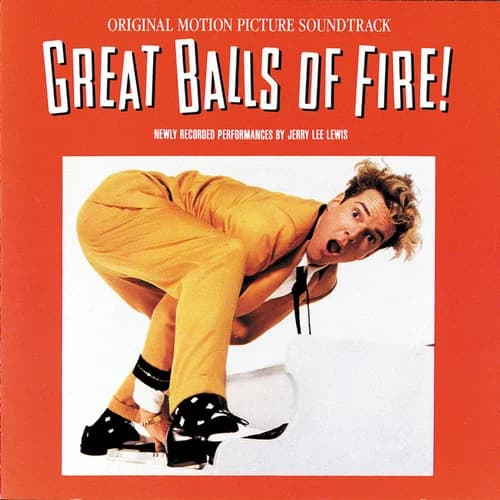
The story of that night is the stuff of rock ‘n’ roll folklore. Clad in a draped suit with his wild, blonde curls falling frantically over his forehead, Jerry Lee didn’t just play the piano—he combated it. He attacked the keys with a frantic, machine-gun staccato, kicking his piano bench back with a defiant heel and playing standing up, his entire body vibrating to the rhythm of his own internal engine. The teenagers in the Manhattan studio audience, accustomed to the polite swaying of the era, were whipped into a visible frenzy, gasping and screaming as Jerry leaned over the keys, looking directly into the camera with a manic, charismatic grin. This performance, which also featured his brand-new single “Breathless,” became the gold standard for live rock ‘n’ roll television.
Behind the scenes, the sheer audacity of “Great Balls of Fire” carried a heavy weight. Written by Otis Blackwell and Jack Hammer, the song’s title was a Southern slang term that carried deeply religious, apocalyptic overtones. As a deeply religious young man himself, raised in the Assemblies of God church alongside his cousin Jimmy Swaggart, Jerry Lee spent his entire life tormented by the belief that he was singing the “devil’s music.” During the recording sessions at Sun Studios, he had famously engaged in a fiery, alcohol-fueled theological debate with producer Sam Phillips, arguing that his music was dragging both him and his listeners straight to hell. That spiritual tension, that terrifying sense of dancing on the edge of damnation, is precisely what gave the song its dangerous, magnetic edge.
For the sophisticated listener looking back across the decades, this February 1958 broadcast is a poignant capsule of a fleeting moment of pure, uninterrupted momentum. It was recorded just months before the scandalous British press revelations regarding his marriage to his young cousin Myra would temporarily derail his mainstream career. In this broadcast, we see The Killer at the absolute peak of his youthful, untouchable power. The visual nostalgia of the kinescope—the grainy black-and-white contrast, the sharp crackle of the audio, the ferocious chomping of chewing gum by the studio teens—evokes a powerful, bittersweet longing for a time when music felt incredibly dangerous, urgent, and miraculously alive.
To watch Jerry Lee Lewis tear through “Great Balls of Fire” on that cold winter night in 1958 is to understand the very spark that ignited the rock ‘n’ roll revolution. It reminds us of an era of sweet rebellion, where a piano could be turned into a drum, and a single song could make the ground beneath our feet shake. It remains a towering, blazing monument to a man who lived his life with his foot on the pedal, proving to the world that some fires simply cannot be put out.