
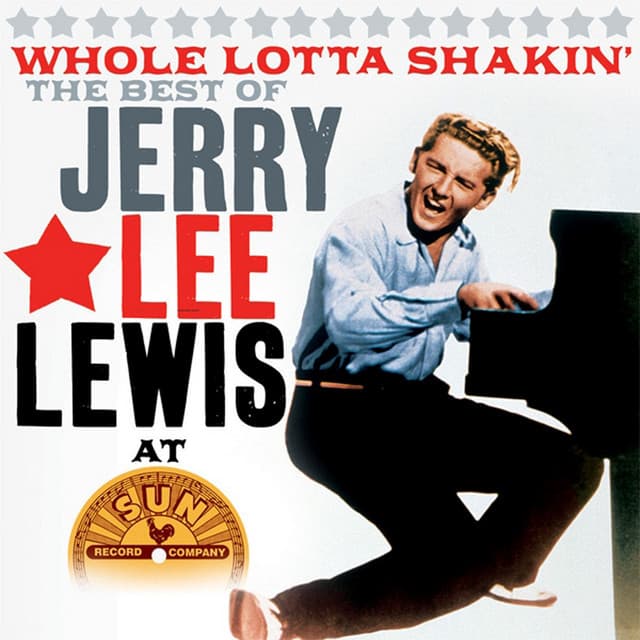
The Day the Earth Trembled Under a Piano Bench: Unleashing the Raw, Unapologetic Fire of the “Killer”
When the needle first dropped on Jerry Lee Lewis’s “Whole Lotta Shakin’ Going On” in 1957, the polite world of the mid-century social order didn’t just crack it shattered. Released on the legendary Sun Records label out of Memphis, the song became a cultural phenomenon of unprecedented proportions, achieving the rare feat of hitting number one on the Billboard Country and R&B charts simultaneously, while peaking at number three on the Billboard Hot 100. For those who remember the sheer, visceral shock of hearing that first boogie-woogie bassline, this track represents the definitive “Big Bang” of rock and roll. It was a declaration of independence, a surge of adrenaline, and a masterful display of piano-pounding virtuosity that announced the arrival of “The Killer” a man who didn’t just play the music, but seemed to be consumed by it.
The story behind the recording is a piece of American folklore. Originally a song recorded by Big Maybelle, Jerry Lee and his band had been “seasoning” the track during their high-energy live sets throughout the South. When they finally entered Sun Studio to record it, they did so in a single, lightning-strike take. The producer, Jack Clement, famously recalled that the session felt less like a professional recording and more like an exorcism. There were no overdubs and no second chances; what we hear on the record is the raw, unedited power of a 21-year-old Lewis pushing a piano to its physical limits. The famous “hushed” section in the middle of the song where Jerry Lee whispers for the crowd to “stand in one little spot” was an improvised stroke of genius that built a level of tension and release rarely seen in popular music at the time.
Lyrically and musically, “Whole Lotta Shakin’ Going On” is an anthem of liberation. While the words ostensibly describe a frantic dance party, the subtext was a revolutionary invitation to abandon restraint. The “Real Love” here isn’t a polite or romantic one; it is a primal love for the rhythm, the moment, and the thrill of the “shake.” For the sophisticated listener who can look back on the 1950s with clarity, the song serves as a reminder of the era’s hidden electricity. It took the sophisticated structures of boogie-woogie and injected them with a dangerous, country-fried energy. Jerry Lee’s left hand provided a relentless, driving “walking” bass, while his right hand cascaded across the keys with a precision and ferocity that defied his lack of formal training. It was music that demanded a reaction a sonic challenge to the status quo.
To listen to this track today is to feel the phantom vibrations of a thousand high school gymnasiums and roadside honky-tonks. It evokes a powerful nostalgia for a time when music felt like a secret shared between the young and the bold a period of chrome-laden cars, drive-in theaters, and the electric thrill of a radio station that played something your parents didn’t quite approve of. For the listener who values the history of the Rock and Roll Hall of Fame, this recording is a foundational text. It brings back the scent of hair oil and the tactile memory of a heavy vinyl 45-rpm disc. There is a “danger” in the recording that remains undimmed by the decades; it still sounds urgent, still sounds alive, and still sounds like the future.
Ultimately, Jerry Lee Lewis and “Whole Lotta Shakin’ Going On” remain inseparable from the myth of the American rebel. The song was the catalyst that propelled him to international stardom and established the piano as a lead instrument capable of competing with the loudest electric guitars. To revisit it now is to honor the audacity of an artist who refused to play by the rules. It invites us to remember our own moments of unbridled joy and the times when we, too, felt the world was “shakin'” beneath our feet. As the final, crashing chords ring out, we are left with the undeniable truth that some fires, once lit, never truly go out they just keep on burning in the quiet corners of our collective memory.