
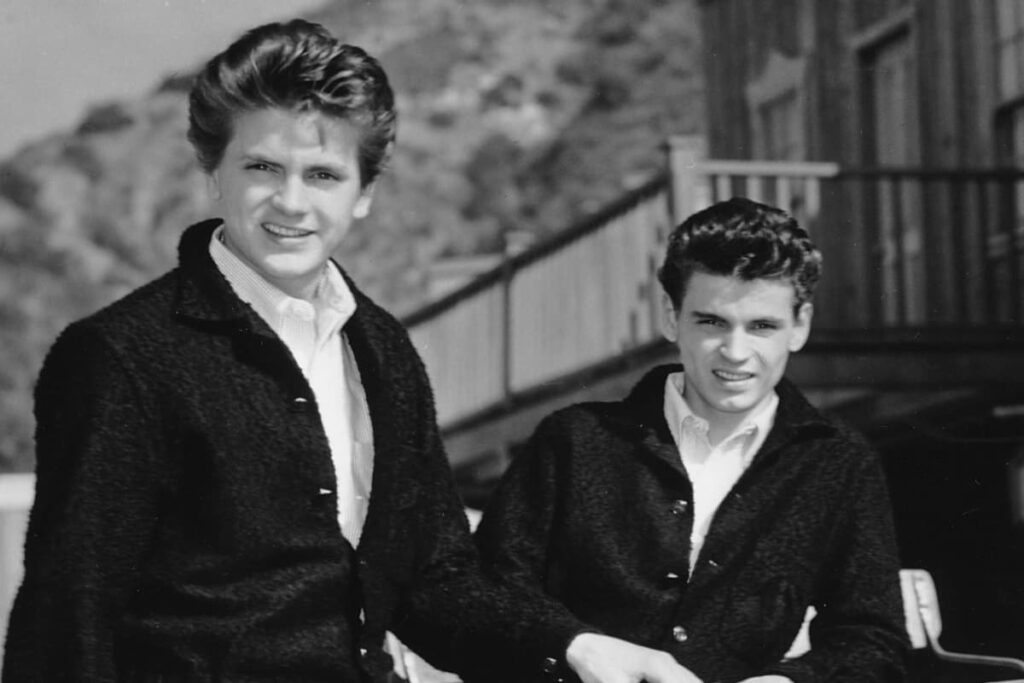
A tender confession of heartbreak, carried on the gentle harmonies of two voices that understood love’s deepest wounds
When The Everly Brothers recorded “Love Hurts” in July 1960 for their album A Date with the Everly Brothers, they likely never imagined how far this quiet, aching ballad would travel. Released later that year, the album climbed to No. 9 on the Billboard Pop Albums chart and reached No. 3 in the UK, giving the song a soft place to begin its long journey into music history. Though never issued as a single largely due to a publishing dispute that prevented a standalone release “Love Hurts” soon became one of the most enduring and emotionally honest laments in the brothers’ entire catalog.
The song was crafted by the celebrated songwriting pair Boudleaux and Felice Bryant, whose work defined much of the Everlys’ early success. But unlike the duo’s brighter, youthful hits such as “Wake Up Little Susie” or “Bye Bye Love,” this composition carries a different weight a weary knowledge that love, for all its sweetness, can leave behind bruises no eye can see. Where many love songs of the era wrapped heartbreak in poetic flourishes, “Love Hurts” speaks with unflinching simplicity, using plain words to express truths that linger long after romance fades.
The Everly Brothers delivered this sorrow with a kind of softness that made the pain feel familiar rather than overwhelming. Don Everly’s tender lead, entwined with Phil’s near-angelic harmonies, creates a sense of two hearts learning the same lesson at the same time. There is no dramatic swell, no orchestral flourish only two voices sharing a quiet ache. Their performance is restrained, almost fragile, as if each word must be handled delicately to avoid reopening an old wound.
Because their version was never sent to radio as a single, there are no chart numbers tied specifically to “Love Hurts.” But to measure this song by charts alone would be to misunderstand it. Songs that are destined to endure do not always rush to the spotlight. Some, like this one, whisper their way into memory passed from turntable to turntable, from one wistful heart to another. Over time, it became one of those recordings listeners rediscovered during late-night reflections or moments when old love stories resurfaced without warning.
The emotional power of “Love Hurts” lies in its truthfulness. The opening lines
“Love hurts, love scars, love wounds and mars…”
hold a kind of honesty that time does not diminish. Anyone who has loved deeply knows that affection can leave marks no doctor can heal. Listening to the Everlys sing these words feels like revisiting an old diary entry or stumbling upon a forgotten photograph: familiar, tender, and quietly painful.
Though later versions most famously by Nazareth, Roy Orbison, and Emmylou Harris would bring the song new fame, the original recording by The Everly Brothers remains the purest expression of its sentiment. There is something uniquely intimate about their interpretation, something untouched by later dramatic arrangements. Their voices do not seek to dazzle; they seek only to understand, and in doing so, they help the listener understand as well.
For many, hearing “Love Hurts” is a return to earlier years a reminder of loves that once felt invincible, and heartbreaks that seemed impossible to survive. It rekindles the quiet loneliness of a late-night drive, the sting of a goodbye left unfinished, or the way certain names can still pull at the heart even decades later.
Ultimately, “Love Hurts” endures because it speaks to a universal truth: love may lift us, but it also leaves us vulnerable. And in the tender hands of The Everly Brothers, that vulnerability becomes something almost beautiful a gentle reminder that even sorrow has its place in the story of a life well lived.