
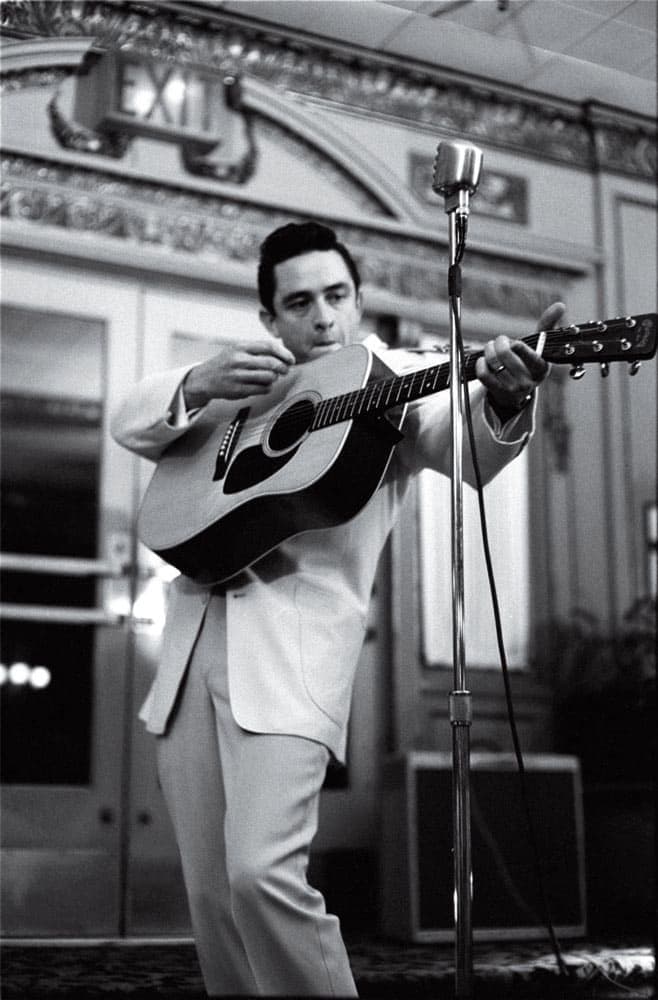
A raw glimpse into heartbreak and human vulnerability
When Johnny Cash released “Cry! Cry! Cry” in 1955, it was not merely a debut single—it was the opening of a door into a voice that would come to define the sound of American country music. Issued on Sun Records, this song introduced the world to Cash’s deep, resonant baritone and his ability to transform simple lyrics into a gut-wrenching narrative of love, loss, and regret. The song reached No. 14 on the Billboard Country Singles chart, establishing Cash as a rising star in a post-war America hungry for authentic emotion.
The story behind “Cry! Cry! Cry” is as fascinating as the song itself. At the time, Johnny Cash was a young man in his early twenties, having just returned from military service. He brought with him a sense of discipline, a touch of melancholy, and a voice that seemed to carry the weight of experience far beyond his years. Collaborating with Sam Phillips at Sun Records, Cash crafted a song that was deceptively simple: a plea to a lover to face the consequences of heartbreak. The lyrics — “Cry, cry, cry, baby, cry” — are repeated with such a raw intensity that they resonate as both accusation and confession.
Musically, the song blends the early rockabilly energy that Sun Records popularized with a stark, almost haunting minimalism. The guitar rhythm is steady, the percussion subtle, and Cash’s voice carries the story. There is no overproduction, no embellishment — only the human emotion, laid bare. This stripped-down style became a hallmark of his early work and contributed to the song’s enduring impact.
“Cry! Cry! Cry” is more than just a story of romantic betrayal. It captures a universal human experience: the vulnerability of loving and losing, the way heartbreak can expose raw edges of one’s soul. Older listeners, in particular, may find themselves transported to their own moments of youthful longing or quiet despair, recognizing the honesty in Cash’s voice that transcends generations. There is no pretense here; every note is an invitation to feel, to remember, and to empathize.
The song also reflects Cash’s unique ability to combine narrative depth with musical clarity. While many of his contemporaries relied on ornamentation or theatricality, Cash’s genius lay in making every syllable carry emotional weight. The storytelling is direct yet layered: the repetition of “cry” becomes almost hypnotic, embedding itself in the listener’s consciousness while simultaneously evoking the relentless pain of a heart betrayed.
In terms of legacy, “Cry! Cry! Cry” set the stage for a career that would span decades. It demonstrated early on what Cash could do: convey profound emotion with minimal instrumentation, communicate narrative through intonation, and create songs that felt personal, almost confessional, even as they were released to the public. While it may not have been his highest-charting single, the song’s influence is immeasurable; it foreshadowed the storytelling brilliance of later classics like “Folsom Prison Blues” and “I Walk the Line”.
Listening to “Cry! Cry! Cry” today, especially for those who remember the golden age of Sun Records, is like stepping into a dimly lit hall of memory. The echo of the guitar, the sincerity of Cash’s voice, and the simplicity of the arrangement evoke a time when music was raw, immediate, and profoundly human. It reminds us that, even in moments of sorrow, there is beauty in honesty — that the act of singing one’s heart can transcend time, connect souls, and create enduring art.
In the end, Johnny Cash’s “Cry! Cry! Cry” is not just a song about heartbreak. It is a testament to the power of vulnerability, a declaration of the human experience in all its simplicity and complexity. It is the opening note of a career that would forever redefine what it means to tell a story through song, inviting listeners — young and old alike — to feel deeply, remember openly, and listen with both ears and heart.
 Oldies Songs