
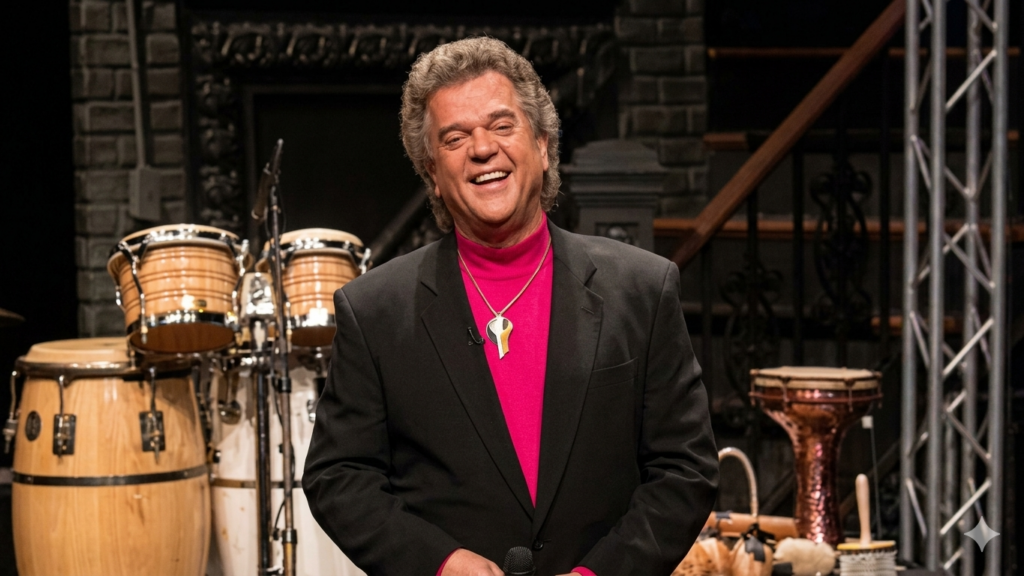
A voice that never aged — Conway Twitty revisits heartbreak with quiet mastery and timeless control
When Conway Twitty stepped onto the stage for “Sunday Night Music” in 1990 to perform “It’s Only Make Believe,” he wasn’t introducing a song — he was returning to a defining moment of his life. Originally recorded in 1958, the song had launched him into international stardom, reaching No. 1 on the Billboard Hot 100 and also topping charts in the United Kingdom. More than three decades later, this live performance revealed not nostalgia, but endurance — a voice shaped by time, yet still unmistakably powerful.
Written by Conway Twitty (born Harold Jenkins) and drummer Jack Nance, “It’s Only Make Believe” was born out of longing. At the time of its creation, Twitty was a young artist struggling to find his place in the industry, often compared to Elvis Presley because of his vocal tone and style. The song itself reflects emotional distance — a man watching the woman he loves pretend their relationship is real, while knowing it exists only in illusion. That tension between appearance and truth became the emotional core of the record.
In the 1990 television performance, something remarkable happens: the song matures along with the singer. The youthful urgency of the 1958 recording is replaced by reflection. Twitty no longer sounds like a man discovering heartbreak — he sounds like one who has lived with it. His phrasing becomes more deliberate, his pauses more meaningful. Where once there was dramatic climb, now there is control.
Musically, the live arrangement is faithful but softened. The dramatic orchestral swells of the original are restrained, allowing Twitty’s voice to take full command. His baritone — deeper, richer, and seasoned — carries the melody with effortless authority. He doesn’t push the high notes as sharply as he once did; instead, he leans into them, shaping them with experience rather than force.
What makes this performance so compelling is its honesty. By 1990, Conway Twitty had long transitioned into one of country music’s most successful artists, with over 50 No. 1 hits on the Billboard Country chart — more than any other artist at the time. Songs like “Hello Darlin’” and “Linda on My Mind” had defined an era. Yet here, he returns to the song that began it all, not to relive youth, but to reinterpret it.
The lyric “my one and only prayer is that someday you’ll care” carries a different weight now. It no longer feels like a plea — it feels like a memory. Twitty delivers it with calm acceptance, as though the outcome is already known. That subtle shift transforms the song. What was once longing becomes reflection; what was once illusion becomes understanding.
There is also a quiet dignity in the performance. Twitty does not rely on theatrics or nostalgia-driven energy. He stands, sings, and allows the years to speak through his voice. It is a reminder that great songs are not fixed in time — they evolve with the artist.
Listening today, this 1990 rendition of “It’s Only Make Believe” feels almost like a conversation between past and present. The young man who first sang it and the seasoned artist who revisits it are both there, layered within the same melody.
In the end, Conway Twitty proves that some songs are not meant to be left behind. With time, they deepen. And in this performance, he doesn’t just sing about illusion — he reveals the truth that remains long after the illusion fades.
 Oldies Songs