
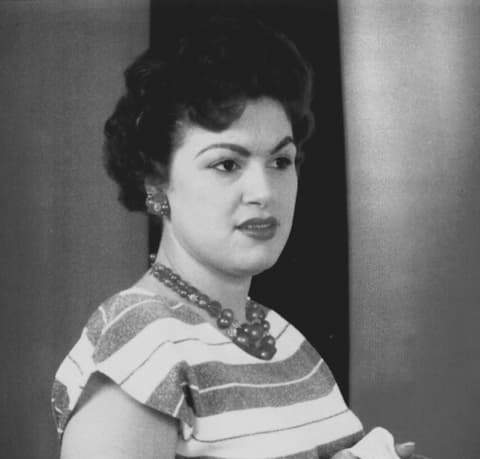
Before the Heartbreak, a Laugh: Patsy Cline in Her Earliest Light
Long before her voice would come to define heartbreak in American country music, Patsy Cline stood on stage with a very different energy. In a 1956 performance of I Love You Honey, she revealed a side of herself that history would almost forget. Playful, teasing, and disarmingly light, this moment captures an artist still searching for her identity.
At the time, Cline was far from the towering figure she would later become. She had yet to break through with the hits that would cement her legacy. Instead, she was performing in modest venues, building a career step by step. The recording itself had an uncertain beginning. Originally cut in 1955, the song was delayed by producers who doubted its strength. That hesitation now feels striking, given how vividly it captures a formative moment in her development.
The performance carries the unmistakable tone of 1950s honky tonk. Upbeat and rhythmically bright, it leans into humor rather than sorrow. The lyrics playfully suggest affection tied to material comfort, offering a cheeky take on romance. It is a sharp contrast to the emotional depth that would later define Cline’s most celebrated work. Here, she is not the voice of longing and loss, but of wit and charm.
What makes the moment particularly compelling is the distance between the song’s tone and the singer’s lived reality. Behind the lighthearted delivery was a young woman navigating financial instability and an unpredictable industry. The irony is subtle but powerful. A song that flirts with the idea of loving for money is performed by an artist still struggling to secure her own future.
This early recording also hints at a transition underway. Around this period, Cline began working with producer Owen Bradley, a key architect of what would become the Nashville Sound. Though not yet fully formed, the seeds of that smoother, more polished style can be sensed in her controlled vocal delivery and phrasing.
Viewed today, the performance feels like a snapshot taken just before history intervened. It is a reminder that legends are not born fully realized. They evolve through uncertain beginnings, overlooked recordings, and moments that only later reveal their significance.
In I Love You Honey, there is no trace of the tragedy or emotional weight that would later shape Cline’s legacy. Instead, there is something more fleeting and perhaps more human. A young artist, smiling through a song, unaware of the voice she would soon become.