
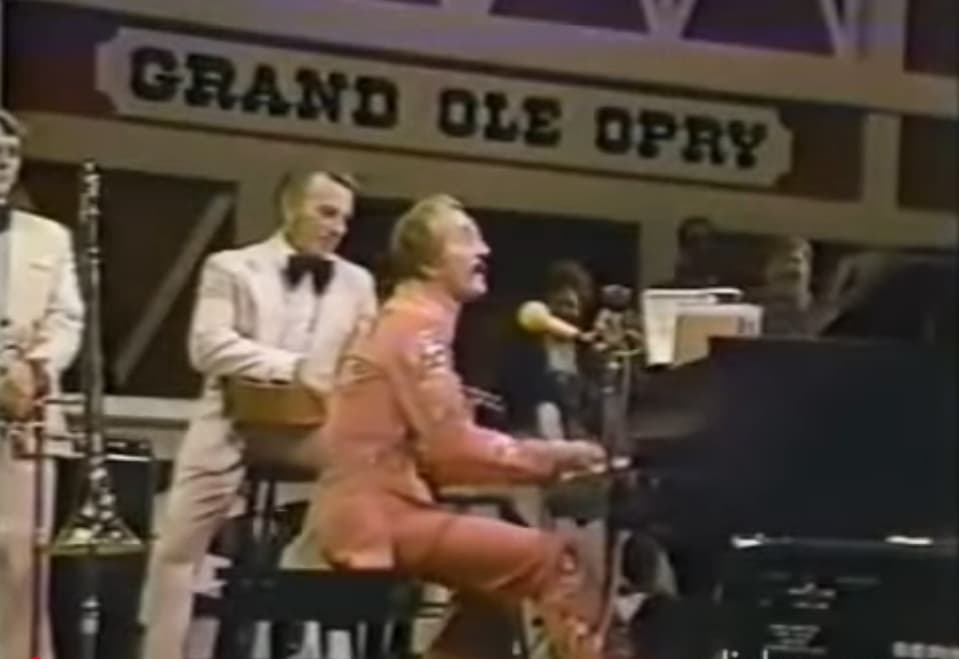
A last, trembling declaration of devotion delivered by a voice already stepping into legend.
When Marty Robbins stepped onto the Grand Ole Opry stage for the final time in late 1982, he carried with him a lifetime of musical wanderings, from gunfighter ballads to velvet smooth countrypolitan pop. That night, one of the songs he chose to leave behind was Love Me, a ballad included on his 1976 album El Paso City, a record that reaffirmed his enduring creative spark and rose to the top of the Billboard Country Albums chart. Though Love Me itself was never released as a charting single, Robbins’ late career performances of the piece gained a reverent afterglow, especially in hindsight. Listeners would return to it after his passing and hear, within its tenderness, the unmistakable weight of a man who understood how fragile time had become.
Robbins’ final Opry appearance has long been remembered less as a staged performance and more as an intimate farewell. He had already undergone years of health struggles, yet his voice remained unmistakably his: warm, unhurried, and painted with that curious blend of Western romanticism and Nashville polish that only he could inhabit without artifice. When he chose Love Me for that final set, he was not revisiting one of his chart giants. Instead, he reached for something quieter, something shaped by the vulnerability that had always lived beneath the surface of his most beloved work. In doing so, he allowed the song to become a window into the emotional gravity of his final days.
Love Me is, at its core, a plea spoken in the smallest emotional register, one that bypasses drama in favor of human simplicity. Its lyrics bypass metaphor and grand gestures, settling instead into the kind of confession that happens when two people are alone with their fears. Robbins sings not as a storyteller crafting characters, but as a man setting aside the bravado of his Western epics to reveal the fragile architecture of longing. Every line feels like the moment when someone reaches across the quiet to say what they should have said long before: stay with me, hold on, do not let this slip away.
The beauty of Robbins’ delivery lies in its restraint. He knew better than most that emotion grows heavier when left unadorned. The gentle phrasing, the soft curves of his vibrato, the way he lingers on certain vowels as if reluctant to let them go — these choices allow the song to bloom without flourish. The arrangement on El Paso City mirrors that emotional discretion. Instead of sweeping strings or grand crescendos, it leans on minimal accompaniment, giving his voice the empty space it needs to unravel into meaning.
In the years since his passing, Love Me has become something more than a deep album cut. For many listeners, it has become the emotional signature of Robbins’ final chapter. When fans revisit the recording of that last Opry night, they do not hear a man fading. They hear a man distilling a lifetime of musical honesty into a single, plaintive truth. Love Me stands as the quiet ember of a towering career — not the flame of his greatest hits, but the slow, glowing warmth of a voice that understood love, loss, and the need to be held just a moment longer before goodbye.
 Timeless Melodies
  Oldies Songs