
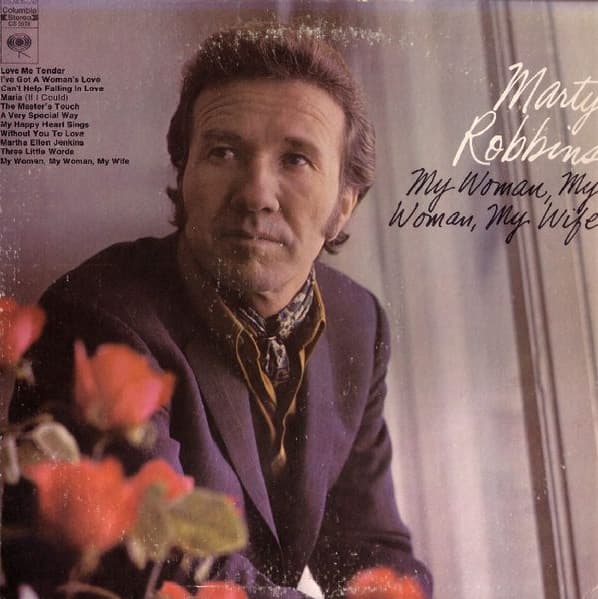
A Hymn to Enduring Love and the Quiet Strength of Devotion
When Marty Robbins released “My Woman, My Woman, My Wife” in January 1970, it became an instant testament to the timeless power of sincerity in country music. The single climbed to the top of the Billboard Hot Country Singles chart, reaffirming Robbins’s rare ability to blend narrative depth with melodic tenderness. Featured on his album My Woman, My Woman, My Wife, the song not only earned him a Grammy Award for Best Country Vocal Performance, Male, but also marked a poignant evolution in his career—from the cinematic Western ballads that made him famous in the late 1950s to something far more personal and intimate.
At its heart, this song is less a performance than a confession—a man’s humble tribute to the steadfast companion who has borne life’s burdens beside him. Robbins wrote it himself, and that authorship imbues every line with lived emotion. Gone are the gunfighters and deserts of “El Paso”; in their place stands a quiet domestic scene painted with reverence and gratitude. The narrator does not romanticize youth or passion but honors endurance—the kind of love forged not in moments of glory but in years of shared struggle. There is an almost biblical simplicity to his praise, a recognition that holiness can exist within ordinary human devotion.
Musically, Robbins strips away excess ornamentation. The arrangement is modest—gentle acoustic guitar, restrained strings, and his voice, resonant and unhurried, carrying the emotional weight with unflinching clarity. It is the sound of a man looking back rather than forward, reflecting on what remains after ambition and time have done their work. His phrasing has a near-liturgical quality; each note lingers as if offered up in prayer. That restraint is what gives the song its lasting power: Robbins doesn’t perform sentimentality—he inhabits it.
In context with the changing musical landscape of 1970, when country was beginning to flirt with pop polish and Nashville’s sound was increasingly commercialized, Robbins’s composition felt like a return to moral center. It reminded listeners that authenticity still mattered—that behind every hit record there could exist something elemental and true. The song resonated across generations because it captured universal truths: aging, sacrifice, loyalty, and the quiet heroism of ordinary life.
Half a century later, “My Woman, My Woman, My Wife” endures not merely as a country classic but as one of American music’s purest expressions of gratitude. It stands as Marty Robbins’s love letter to constancy itself—a reminder that devotion, however understated, can be as epic as any tale sung from the wide-open plains.
 Timeless Melodies
  Oldies Songs