
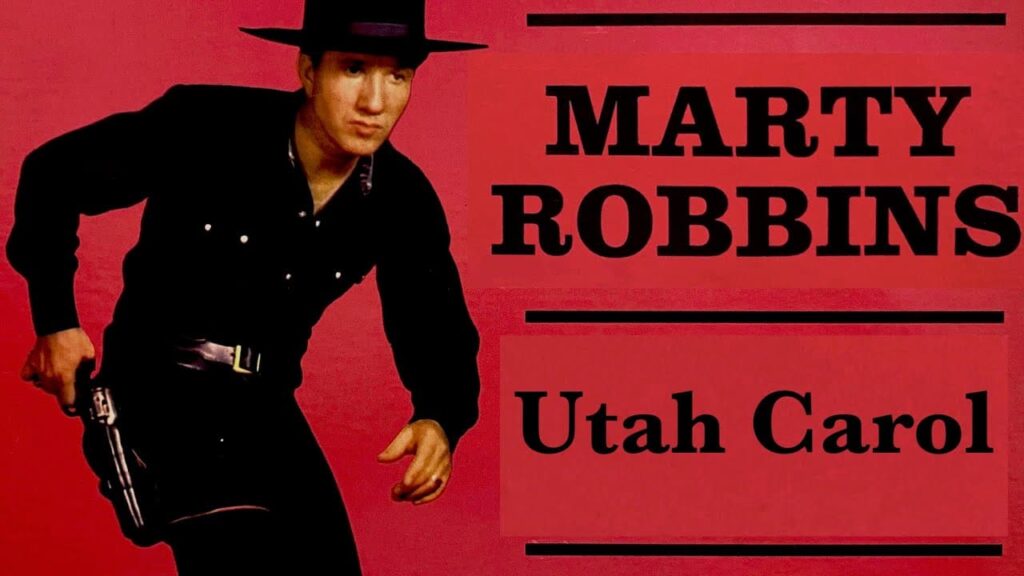
A frontier ballad of sacrifice and quiet heroism “Utah Carol” preserves the rugged heart of the American West through melody and tragedy.
There is a special kind of storytelling that only the old Western ballads can deliver the kind where the dust, the saddle, and the setting sun seem to rise out of the melody itself. Among those enduring tales stands “Utah Carol”, performed with unmistakable warmth and sincerity by Marty Robbins. Before exploring the emotional depth of the song, it is essential to understand its place in Robbins’ larger legacy. Recorded for his landmark 1959 album Gunfighter Ballads and Trail Songs, “Utah Carol” was not released as a charting single and therefore did not appear on the Billboard charts in its own right. Yet, the album it was part of became one of the most celebrated Western recordings in history, spending months on the Billboard charts and carving out a permanent home in American musical folklore.
Although “Utah Carol” was originally a 19th-century cowboy ballad, Robbins reshaped it with a storyteller’s grace, bringing new life to a legend that had traveled for decades through cattle trails, campfires, and handwritten songbooks. His version preserves the tragic heart of the tale while softening it with his soothing tenor a voice that always seemed built to carry both sorrow and nobility with equal ease.
The story itself is steeped in the imagery of the Old West: open skies, thundering hooves, and men whose lives were measured not in years but in courage. The song tells the haunting tale of Utah Carol, a cowboy who gives his life to save a young girl during a stampede. In a split second of instinct and bravery, he throws himself between the child and danger a gesture that costs him everything. It is a story of sacrifice, told in the simple, unadorned language of the frontier, where heroism was not something people announced, but something they carried quietly, like a shadow.
What makes Robbins’ version of “Utah Carol” so compelling is not just the narrative itself, but the sense of memory he weaves into it. His voice never rushes. Every word feels like a recollection, as though he is dipping into a moment long gone, handling it gently, with respect for its weight. The arrangement is sparse, built around warm acoustic guitar and soft harmonies, allowing the story to sit at the center exactly where it belongs.
Robbins had a gift for breathing cinematic life into the old cowboy myths, transforming them from dusty tales into emotional experiences. As he sings about the fateful stampede, one can almost feel the trembling of the earth, the sudden fear, and the heartbreaking stillness that follows. His interpretation turns legend into something personal, something that lingers.
Behind the tragedy lies the deeper meaning of the song: a reminder of the quiet bravery found in everyday people, and how love and loyalty often reveal themselves not in words, but in actions. “Utah Carol” is more than a cowboy ballad it is a meditation on sacrifice, the tenderness hidden behind rough exteriors, and the timelessness of stories passed down from one generation to the next. It asks listeners to remember the heroes who never sought recognition, who simply did what their hearts told them was right.
For those who grew up with Western music spinning on the radio or humming softly from a turntable, “Utah Carol” holds a familiar poignancy. It calls back to evenings when songs carried the weight of legends, and when a voice like Marty Robbins could transport listeners to open plains far from the noise of the world. His rendition preserves not just a song, but a tradition a way of telling stories that valued honor, sacrifice, and the profound humanity hidden beneath a cowboy hat.
In the end, “Utah Carol” stands as a gentle but powerful reminder of why these ballads endure. Through Robbins’ voice, the frontier comes alive once more not with gunfights or glory, but with the kind of quiet heroism that history rarely writes down, yet the heart never forgets.
 Oldies Songs