
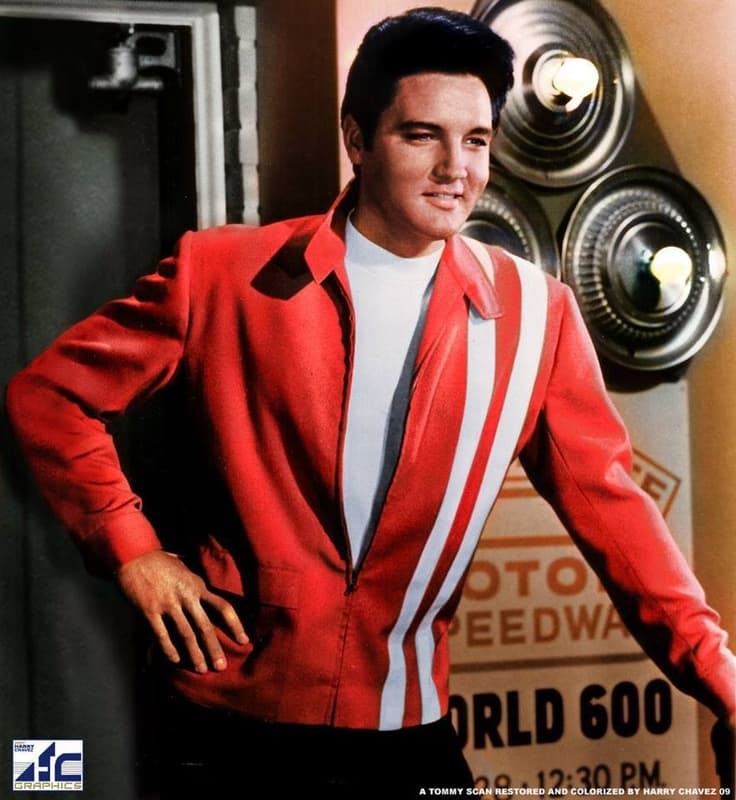
“Speedway” a brief roar of engines, and a snapshot of Elvis caught between the racetrack and the sunset
When you press play on Speedway, you’re instantly thrown into motion the pulse of pistons, the heat of rubber hitting asphalt, a heart beating for speed and freedom.
At first glance, Elvis Presley’s “Speedway” might appear as just another title track from a movie after all, it served as the theme song for the 1968 film Speedway, released by the studio MGM Studios. Recorded on June 20, 1967, at MGM’s Hollywood studio, the song carried the names of writers Mel Glazer and Stephen Schlaks a team charged with giving voice to the roar of engines and the thrill of the racetrack.
When the soundtrack album Speedway (Original Soundtrack) was released in May/June 1968 by RCA Victor (catalogue LPM/LSP-3989), it entered the U.S. charts but only peaked at #82 on the Billboard 200 a modest showing by Elvis standards. The album’s lukewarm commercial reception and low sales contributed to a turning point in Elvis’s career: “Speedway” became the last full soundtrack album tied to one of his dramatic-feature films, marking the end of an era for his movie-song output.
Yet despite its modest chart impact, “Speedway” captures a moment of restless energy and the uneasy crossroads where Elvis found himself in the late 1960s. The song’s driving rhythm, punctuated by guitar, saxophone, and brisk percussion, tries to match the roar of sports cars the 12-bar rock-and-roll-meets-pop arrangement pulls you forward, demanding speed, movement, momentum.
Lyrically, “Speedway” isn’t about deep love or sorrow: it’s about adrenaline, escape, and the fleeting smell of burned rubber under neon lights the thrill of pushing a throttle down, of burning the track before dawn. The verses mention “a ton of bolt and steel,” “engines ripping around,” and a sense of immediacy that leaves no room for hesitation. For a man like Elvis who had once sung from the heart of loneliness, longing, heartbreak this song reads almost like a detour: a chance to wear sunglasses at dusk, to throttle forward, to feel alive in motion instead of memory.
But perhaps the most poignant truth of “Speedway” lies not in its lyrics or instrumentation, but in its context. By 1967–68, the world of popular music was shifting beneath Elvis’s feet. Rock, psychedelia, and soul were rising fast. The soundtrack-film machine that had once guaranteed steady work for him was losing its magic. The release of “Speedway” and the underwhelming reception of its album symbolized that shift. As one source remarks, the album’s poor performance “took over the new low for chart position and album sales by Presley,” and effectively ended the full-soundtrack era of his film career.
In that sense, “Speedway” feels bittersweet: a song born of engines and youthful drive, yet carrying the weight of a changing career, a changing world. It’s the final flame of one chapter not tragic, but gentle, impermanent; not defiant, but acknowledging that time moves too.
When you listen to “Speedway” now perhaps late at night, or in a quiet moment after many years it may not stir up great nostalgia, since it was never the grand “classic” many of Elvis’s earlier songs became. But it carries an honesty all its own: the honesty of a man trying to catch a moment of freedom, to outrun expectations, or perhaps to outrun himself.
And that in its own raw, fleeting way makes “Speedway” worth remembering not as a failure, but as a trace of longing, restlessness, and the bittersweet recognition that some songs aren’t meant to last forever only meant to ride.