
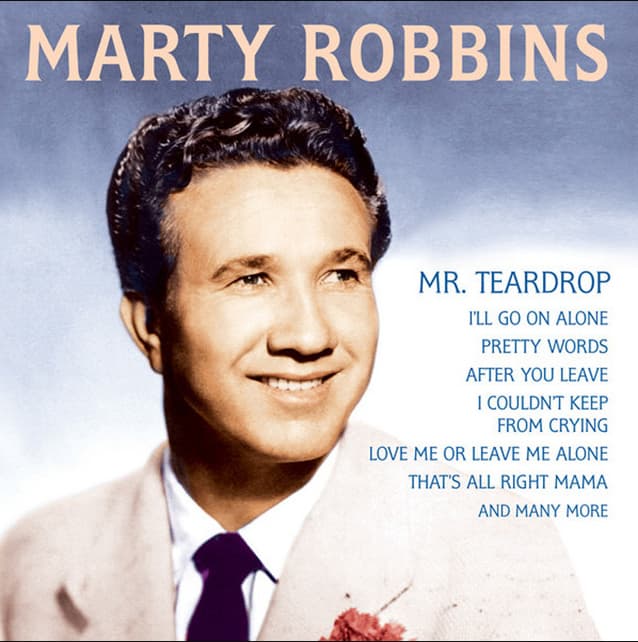
The Solitary Road of Heartbreak and Resolve
When Marty Robbins released “I’ll Go On Alone” in 1952, it marked not only his debut single but also the beginning of one of country music’s most evocative careers. Issued on Columbia Records, the song rose steadily through the Billboard country charts, ultimately reaching the Top 10—a remarkable feat for an artist then virtually unknown beyond the Arizona airwaves. Later included on his early compilation collections, “I’ll Go On Alone” established Robbins as a songwriter capable of merging traditional honky-tonk sorrow with an emotional intelligence that transcended genre boundaries. It was a quiet but potent announcement: a new storyteller had arrived, one who could transform loneliness into art.
The story behind “I’ll Go On Alone” is rooted in Robbins’ own early struggles as a musician, when long nights on the road and uncertain dreams gave shape to songs of endurance and solitude. Unlike many country laments of its era, which often wallowed in bitterness or self-pity, Robbins’ composition walks a finer line between heartbreak and dignity. The narrator accepts his lover’s departure not with rage or despair, but with a kind of stoic grace—a man resolved to continue onward despite the ache that lingers in every note. This emotional restraint became a hallmark of Robbins’ style: he never exaggerated pain; he illuminated it softly, as if aware that true sorrow doesn’t shout—it endures.
Musically, “I’ll Go On Alone” inhabits the transitional space between postwar honky-tonk and the smoother Nashville sound that would emerge later in the decade. The arrangement is spare yet firm: steady guitar strums anchor Robbins’ rich baritone, while subtle steel guitar flourishes mirror the ache beneath his composure. His voice—warm, unhurried, and deeply human—conveys both vulnerability and fortitude. There is no ornamentation here, no theatrical flourish. The song’s power lies precisely in its simplicity; every pause feels deliberate, every inflection a reflection of lived experience.
Lyrically, Robbins crafts a meditation on independence born from heartbreak. The refrain’s quiet resolve transforms personal loss into universal truth: sometimes love cannot be mended, and the only honorable path left is forward motion alone. In this way, “I’ll Go On Alone” anticipates themes that would echo throughout Robbins’ later work—loneliness as both burden and companion, love as something noble yet transient, and self-reliance as the final refuge of a wounded heart.
Culturally, the song stands as a testament to country music’s ability to distill complex human emotions into plainspoken poetry. It speaks to anyone who has ever faced the silence after goodbye and found within it not defeat but endurance. In 1952, Marty Robbins was merely beginning his journey; yet in “I’ll Go On Alone,” he had already captured one of life’s deepest truths—the quiet courage it takes to keep walking when love has gone another way.
 Timeless Melodies
  Oldies Songs