
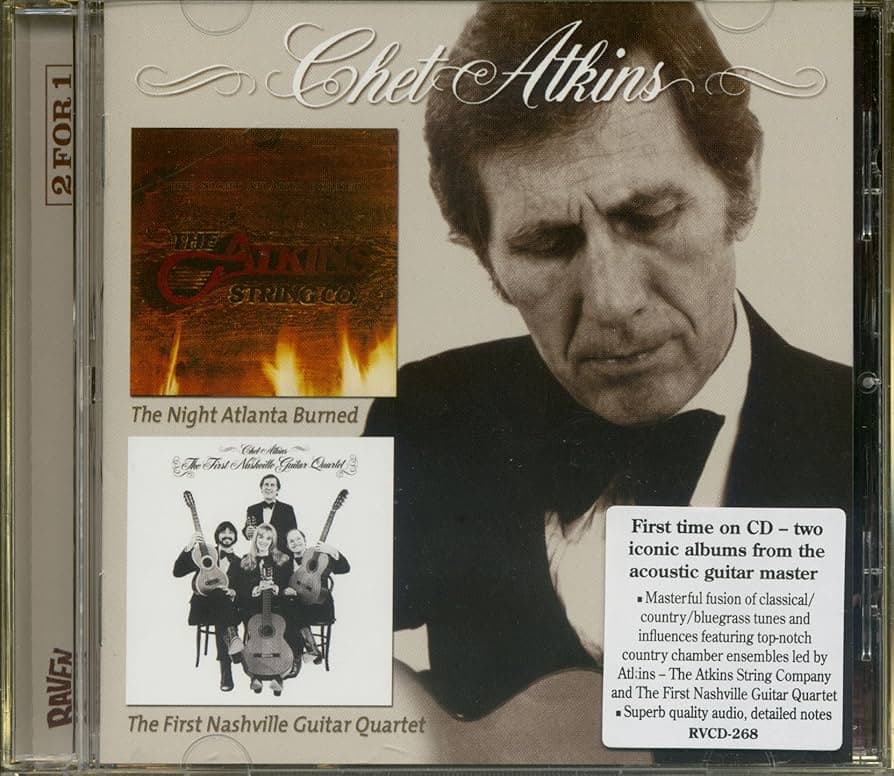
A breathtaking tapestry of four acoustic voices, where a majestic Spanish masterpiece is reborn through the warm, multi-layered soul of Nashville.
There is a sublime, almost meditative quality that occurs when the grand classical traditions of Europe find a new home in the gentle acoustic soil of the American South. In 1979, when Chet Atkins gathered three other master musicians to form The First Nashville Guitar Quartet, they created a sound that was entirely unparalleled in its quiet elegance. Standing as a shimmering centerpiece on side two of their self-titled 1979 RCA Victor album, The First Nashville Guitar Quartet, their instrumental adaptation of the “Rodrigo Concerto”—the famous Adagio theme from Joaquín Rodrigo’s Concierto de Aranjuez—distilled a massive symphonic triumph into an intimate conversation. Though targeted toward the refined, late-70s Easy Listening and Classical-Crossover audiences rather than the fast-paced singles charts, the arrangement achieved legendary status among audiophiles, demonstrating how four distinct acoustic guitars could hold the emotional weight of a full classical orchestra.
The story behind this exquisite recording is a testament to Chet Atkins’ tireless dedication to expanding the boundaries of the acoustic guitar. The original composition, written in Paris in 1939 by the blind Spanish maestro Joaquín Rodrigo, was designed to evoke the majestic, sun-drenched gardens of the Royal Palace of Aranjuez. Its heartbreaking Adagio movement was penned as a profound musical prayer following the tragic loss of Rodrigo’s first child and his wife’s near-fatal illness. Over the decades, it became the most famous classical guitar concerto in human history, interpreted by giants like Miles Davis and Andrés Segovia. For his 1979 project, Atkins wanted to approach the piece differently. Rather than a single guitar struggling against a roaring orchestra, he envisioned a democratic, four-part tapestry where the melody, harmony, counterpoint, and rhythm could breathe together through a unified acoustic perspective.
To bring this complex sonic vision to life, Atkins assembled a true guitar royalty. Joining “Mr. Guitar” were the internationally acclaimed Canadian classical guitarist Liona Boyd (often called the “First Lady of the Guitar”), the brilliant fingerstyle scholar John Knowles, and the masterful fingerstyle composer John Pell. Recorded in the pristine acoustic environment of Nashville’s legendary RCA Studios, the “Rodrigo Concerto” features an astonishingly intricate arrangement. With a steady, comforting pulse grounding the background, the primary melody is passed seamlessly between the players. Liona Boyd’s flawless classical technique adds a crisp, European brilliance, while Chet’s warm, signature thumb-and-finger style infuses the piece with a comforting, rustic texture. There are no synthesized strings or heavy production tricks here—only the pure, organic wood-and-wire vibration of four master musicians pouring their souls into a single, haunting melody.
Revisiting this 1979 masterpiece today feels like opening a beautifully preserved blueprint of musical craftsmanship. It carries the distinct warmth of vintage high-fidelity vinyl, the gentle amber glow of a quiet living room, and the timeless realization that great art never needs to shout to be heard. To hear Chet Atkins, Liona Boyd, John Knowles, and John Pell perform the “Rodrigo Concerto” today is to remember a golden era when music was crafted with immense patience, deep reverence, and a profound respect for the listener. It remains an unforgettable testament to the power of collaboration—a gentle, sweeping melody that continues to echo in the quiet corners of our hearts long after the final chord has drifted into the night.