
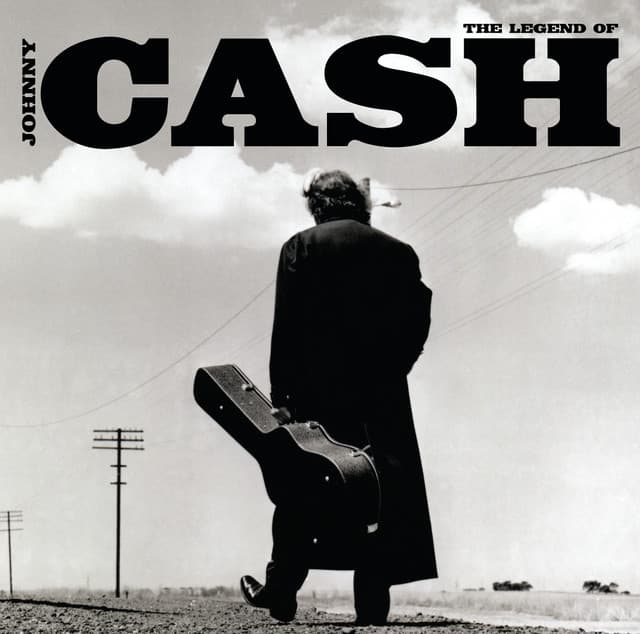
A defiant farewell that turns suffering into faith, and silence into an unbreakable promise of resurrection.
Among the final echoes of Johnny Cash’s legendary voice, “Ain’t No Grave” stands as one of the most powerful and spiritually charged recordings of his entire career a song that feels less like a performance and more like a man staring directly into the mystery of death and refusing to bow. Released in 2010 on the posthumous album American VI: Ain’t No Grave, the track reached No. 3 on the Billboard Top Christian Albums chart, and the album itself debuted at No. 3 on the Billboard 200, a remarkable achievement for a collection recorded by a man in his final, fragile days. Yet the numbers, impressive as they are, barely touch the emotional depth that surrounds this song.
Originally written by Claude Ely in the late 1930s a preacher known as “The Gospel Ranger” the song was born from Ely’s own near-death experience as a young boy battling tuberculosis. But when Cash recorded it in the early 2000s with producer Rick Rubin, the meaning of the song evolved into something larger, something more intimate. By then, Cash had lost his beloved June Carter, his health was failing rapidly, and he was recording with oxygen tanks nearby, sometimes barely able to stand. Every note of “Ain’t No Grave” carries the weight of those final months.
And yet, there is no fear in his voice.
There is weariness, yes. A kind of trembling honesty. But above all, there is resolve the resolve of a man who has walked through storms, through fame, through addiction, through grief, and has arrived at the final threshold with a steady, unbroken spirit. The cracked texture of Cash’s late-life voice becomes the perfect vessel for this message. Where a younger singer might have filled the song with fire, Cash fills it with truth: a quiet, spiritual defiance that feels carved out of bone and memory.
The arrangement itself reflects that same stark beauty. Rubin surrounds Cash with sparse instrumentation a trembling banjo, a slow stomp-and-clap rhythm, hints of Americana and Appalachian gospel. No excess. Nothing distracting. Just the feeling of someone walking toward the horizon with steady steps. The song sounds ancient, weathered, eternal like something sung on a front porch at dusk, or whispered in a candlelit room during a long night.
The emotional power of “Ain’t No Grave” lies in its duality. It is both a farewell and an affirmation. A confrontation with mortality, but also a refusal to let death have the final word. Cash sings, “Ain’t no grave can hold my body down,” and it becomes more than a lyric it becomes his final testimony. A man nearing the end, yet declaring in full conviction that his story does not end here.
For many listeners, especially those who grew up with Cash from his early Sun Records days through his outlaw country years, this song strikes a deep, familiar chord. It reminds them of every moment when life felt heavy but hope endured every loss survived, every night that gave way to morning. Cash’s voice, aged and imperfect, becomes a companion for those who have lived long enough to understand that strength is not loud; it is persistent.
In the years since its release, “Ain’t No Grave” has grown into one of Cash’s most beloved late-career recordings. It is a reminder of legacy the legacy of a man who sang about human weakness, redemption, faith, and the long road between them. But more than that, it is a reminder of spirit. Of endurance. Of the quiet power found in perseverance.
When the song ends, there is a lingering stillness, as if Cash himself has just stepped out of the room — not gone, merely moved on. And you feel, deep down, that he was right: no grave could ever truly hold a voice like his.
 Oldies Songs