
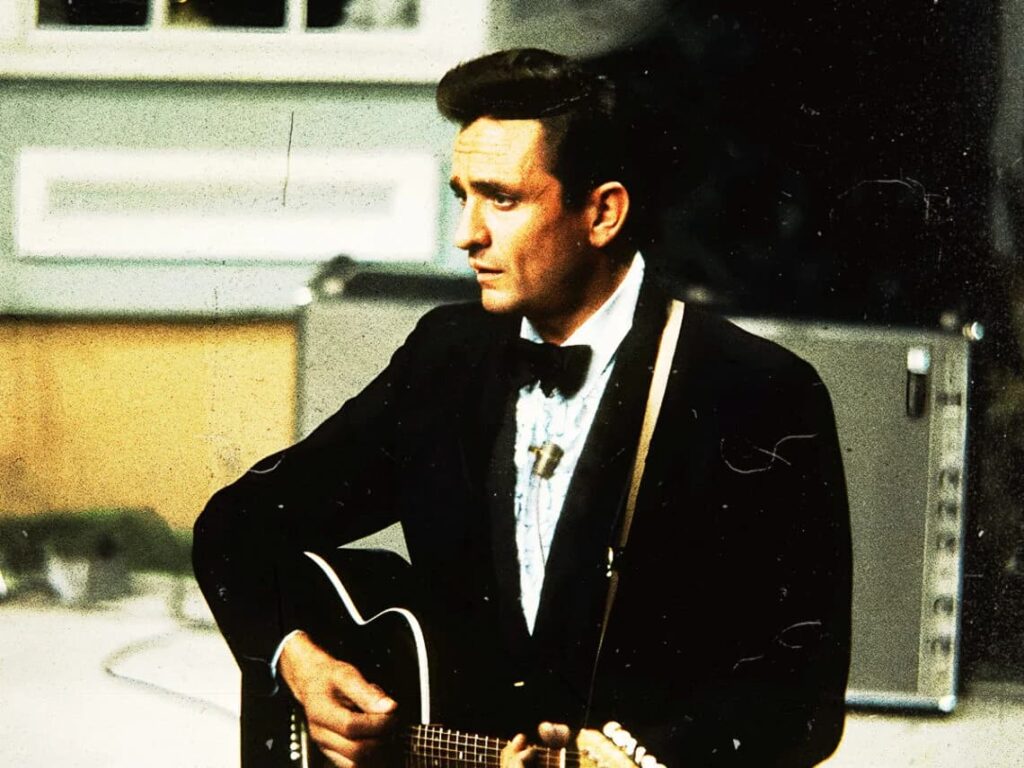
“Man in Black” a solemn oath draped in denim, mourning the downtrodden and defending the unheard.
When you hear Man in Black by Johnny Cash, you sense more than a tune you feel a promise, wrapped in shadows and conviction, speaking for those who walk through hardships while the world looks away.
“Man in Black” was first released in 1971 as part of the album Man in Black, and also issued that year as a single. While the song did not reach the very top of the mainstream pop charts, it resonated powerfully in country music circles and among Cash’s devoted listeners its strength lying less in chart numbers and more in the depth of its message and enduring legacy.
The background of “Man in Black” is as raw and honest as the lyrics themselves. Johnny Cash wrote the song during a period of deep reflection. America was struggling with social unrest, war overseas, growing inequality, and the pain of unspoken suffering. Cash already a voice of conscience and empathy — felt compelled to declare why he dressed in black, earning himself the nickname “the man in black.” The song begins with lines like: “I wear the black for the poor and the beaten down / Livin’ in the hopeless, hungry side of town,” offering solidarity to those often ignored or forgotten.
It was more than fashion. It was a statement. A mourning cloth for injustice. For grief. For solidarity. Cash didn’t just claim the color black because it looked good on stage. He claimed it for those who had no voice, no platform, no spotlight for the weary laborer, the orphan, the prisoner, the disenfranchised. In that simple choice of attire, he gave a presence and dignity to people who otherwise might fade into the margins.
Musically, the song is unadorned, almost austere no frills, no unnecessary ornamentation, just Cash’s steady, resonant baritone, the steady strum of guitar, and a rhythm that feels like footsteps on a dusty road. The arrangement suits the mood: serious, respectful, urgent. There is neither cheer nor excess just plain truth, delivered without apology.
Over the decades, “Man in Black” has aged not like a fashion statement, but like a solemn hymn sometimes overlooked, perhaps when the world preferred louder proclamations, but always present for those who listened. For many, the song became a touchstone: a reminder that music can speak not only to love and heartbreak, but to conscience and compassion. It showed that a country singer infamous for rough edges and outlaw status could also be a moral compass, a voice for the voiceless, a comfort for the wounded.
Its significance grew even stronger with time. In an America wrestling with issues of poverty, war, inequality the themes Cash sang about in 1971 remain painful and relevant. Listeners returning to “Man in Black” not only hear history, but present-day echoes of hardship and hope, of alienation and solidarity. The song feels timeless, and tragically still timely.
What makes “Man in Black” so powerful particularly for those with life’s years behind them, with memories of past struggles and simple living is its sincerity. There is no pretense in the lyrics; no romanticizing of hardship; no cheap sentiment. Just a plain man in a black coat, standing up for others, using what he had his voice, his music to carry burden, to hold memory, to shine light in dark alleys of despair.
And beyond that beyond album lists, beyond cover songs, beyond decades of passing “Man in Black” remains a quiet oath: that someone saw the suffering; someone remembered the poor and the broken; and that someone, in black, stood with them. Whether the world listened or not, Johnny Cash did. And that is the kind of truth that never goes out of style.
 Oldies Songs