
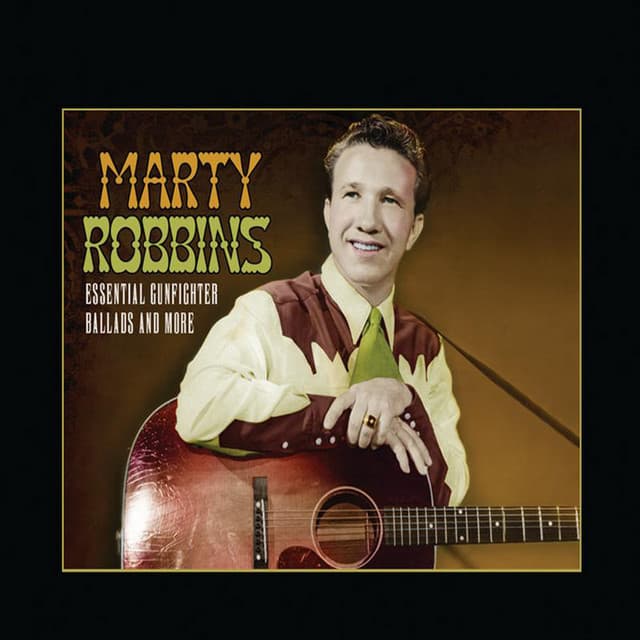
A sweeping ballad of love, destiny, and regret beneath the wide Texas sky
“San Angelo” by Marty Robbins, released on his 1961 album The Gunfighter Ballads and Trail Songs, Vol. II, stands as one of his most cinematic Western narratives — a long-form story-song painted with dust, danger, longing, and the kind of romance only Robbins could make feel both mythic and painfully human. Though it was not released as a charting single, the song quickly became a beloved deep cut among fans who cherished Robbins’ ability to turn a simple melody into an entire world. Today, many consider San Angelo one of his finest storytelling achievements, a spiritual sibling to his earlier masterpieces like “El Paso.”
From the very first guitar lines, “San Angelo” unfolds like a novel — steady, hypnotic, and drenched in atmosphere. Robbins leads listeners into a place where the border winds whisper half-forgotten tales and every choice a man makes seems tied to fate. The song tells the tragic story of a young man drawn to the beautiful and mysterious Feleena — yes, the very same Feleena from “El Paso” — and through this connection, Robbins continues the mythic narrative universe he began in 1959. Few country artists dared to build interconnected stories across albums. Robbins didn’t just dare — he excelled at it.
What makes Marty Robbins so enduring is not merely his voice, though warm, smooth, and unmistakably Western; nor only his songwriting, though rich in imagery and moral weight. It’s the way he touched the emotional memory of listeners. San Angelo is a song of yearning — of a heart pulled toward beauty even when danger hides in the shadows. There’s a tenderness in the melody, but also a foreboding tension that grows with every verse. Robbins captured the timeless truth that love can be both a blessing and a burden, capable of lifting a man beyond himself or leading him into ruin.
The story takes place under the relentless heat of a Texas afternoon, where tempers run hot and jealous rivals lurk at every corner. Yet Robbins refuses to rush. He lets the desert air settle around his words, letting listeners feel the dust beneath the saddle, the glow of cantina lanterns, the trembling uncertainty of a man risking everything for love. By the time the tale turns tragic, the listener is completely immersed — as though witnessing the events firsthand.
In many ways, “San Angelo” reflects Robbins’ deepest artistic strengths: his love for the Old West, his understanding of the fragile human heart, and his gift for transforming simple chords into sweeping emotional landscapes. The song is less about cowboys and more about the universal truth that choices — especially those made in the name of love — echo long after the moment passes.
Listening to San Angelo today feels like opening an old leather-bound book, its pages worn but its story vibrant as ever. It reminds us of a time when music didn’t simply entertain — it accompanied long drives, quiet evenings, and the kind of recollection that softens the edges of memory. Robbins understood that songs could be companions, carrying with them the dust of old roads and the weight of unspoken feelings.
And in San Angelo, he gave us one of his most haunting companions of all — a ballad where love burns bright, fate intervenes, and the echoes of the past linger long after the final note fades.
 Oldies Songs