
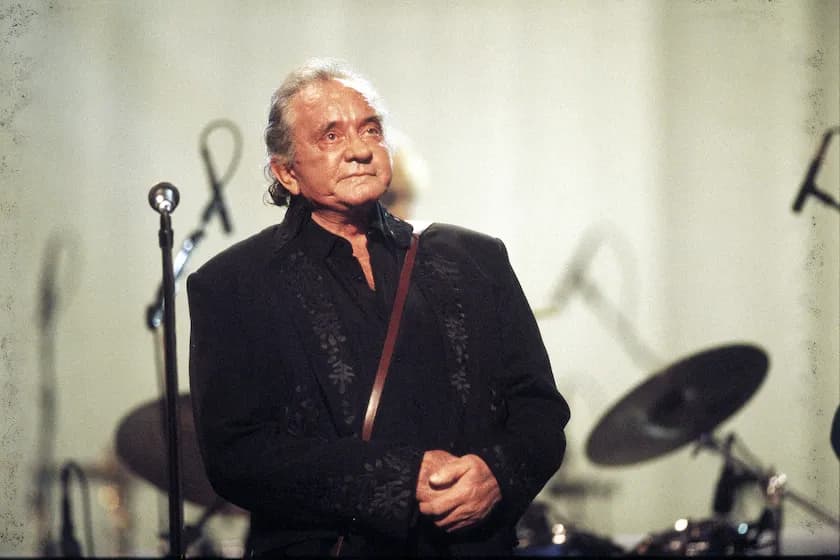
Ain’t No Grave — a final declaration of faith and defiance, where mortality bows before conviction and the human voice refuses to be silenced by death.
When Johnny Cash sings “Ain’t No Grave”, it does not sound like a song recorded for charts or acclaim. It sounds like a man standing at the edge of life, speaking calmly, firmly, and without fear. Released in 2010 as the title track of the posthumous album Ain’t No Grave, the recording stands as Johnny Cash’s last artistic statement. The album debuted at No. 3 on the Billboard 200, an extraordinary achievement for a work released after the artist’s passing, and a clear sign that Cash’s voice still carried immense power even in silence.
The song itself is a traditional African American spiritual, dating back to the early 20th century. Its origins lie in gospel and folk tradition, passed from voice to voice long before it reached Johnny Cash. Yet when Cash recorded it in 2009, just months before his death, the song became something profoundly personal. This was no longer a communal hymn alone. It became a testimony.
By this point, Johnny Cash had already endured immense loss. His wife June Carter Cash, the great love of his life, had passed away in 2003. His health was failing, his body weakened, his voice worn thin by time. And yet, what remains astonishing is not fragility, but resolve. His voice on Ain’t No Grave is cracked, weathered, and unmistakably mortal and that is precisely what makes it so powerful. Every breath feels earned. Every word feels chosen.
“There ain’t no grave can hold my body down.” In lesser hands, such a line might sound defiant or dramatic. In Johnny Cash’s voice, it sounds like certainty. There is no shouting, no attempt to overpower death. Instead, there is calm assurance rooted in faith. The song is not about escaping death, but about what comes after. It speaks of resurrection, of spiritual endurance, of a belief that the soul cannot be confined by earth or time.
The production of the song is stark and restrained. Acoustic guitar, subtle percussion, and silence play as important a role as sound. This sparseness allows the listener to focus entirely on the voice — a voice that carries decades of sin, redemption, doubt, and belief. Producer Rick Rubin, who guided Cash through the American series of albums, understood that nothing should interfere with the truth in that voice. The result is almost confrontational in its intimacy.
Unlike many of Johnny Cash’s earlier songs, Ain’t No Grave does not tell a story with characters and plot. Instead, it delivers a statement of identity. This is a man who has lived fully, stumbled publicly, and made peace with both. There is no apology here, and no fear. The song feels less like a performance and more like a farewell letter, written not in ink, but in breath.
The album Ain’t No Grave as a whole was met with deep respect and emotional response. While it did not produce traditional hit singles, it was never meant to. Its success lay in its impact, not its rotation. Listeners approached it quietly, often returning to it in moments of reflection. The title track became the emotional core of the record, a moment where art, belief, and mortality converged.
What makes Ain’t No Grave so enduring is that it does not ask the listener to share Johnny Cash’s faith. It only asks them to listen. The song speaks to anyone who has faced loss, aging, or the awareness of time passing. It reminds us that dignity at the end of life is possible, that strength does not always roar, and that meaning can exist even as the body fades.
In the vast legacy of Johnny Cash, Ain’t No Grave stands apart. It is not a rebellion song, not a prison song, not a love song in the traditional sense. It is a reckoning. A final stand. A quiet voice saying that life has been lived, and death will not have the final word.
Long after the last note fades, the message remains. Not as comfort alone, but as resolve. Johnny Cash did not leave this world shouting. He left it standing.
 Oldies Songs