
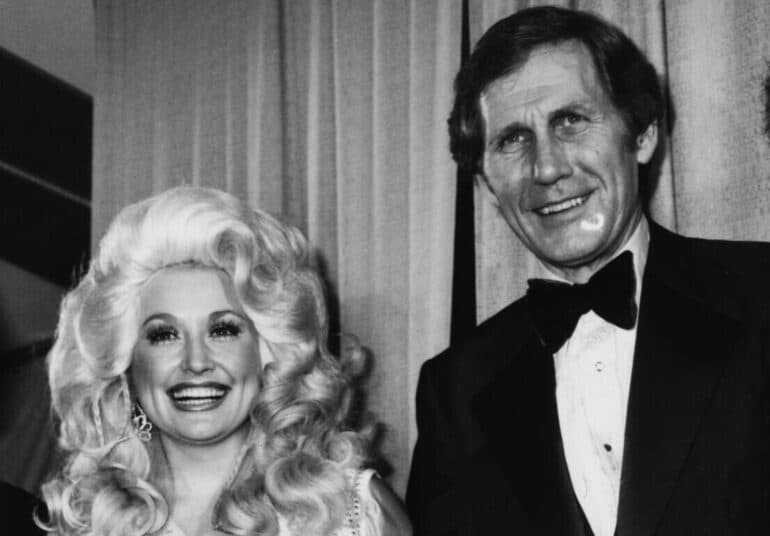
A quiet question left hanging in the air, answered only by memory and melody
When Chet Atkins recorded “Do I Ever Cross Your Mind,” he approached the song not as a confession, but as a reflection the kind that lingers long after the last note fades. Best known as the gentle architect of the Nashville Sound, Atkins had a lifelong gift for taking songs heavy with emotion and removing the excess, leaving behind only what truly mattered. In this case, what remained was longing unspoken, unresolved, and profoundly human.
The song itself was written by Dolly Parton, one of the most gifted songwriters of her generation. She first recorded “Do I Ever Cross Your Mind” in the mid-1970s, and it later became a country standard, interpreted by several artists. The most commercially successful vocal version would come years later, when Dolly Parton and Chet Atkins recorded it together in 1982, earning major chart success and industry recognition. But long before that celebrated duet, Atkins had already explored the song on his own terms without words.
Chet Atkins’ instrumental rendition appeared on his late-1970s recordings, during a period when he was increasingly drawn to introspective material. While his version was not released as a major charting single, it was embraced by listeners who understood Atkins’ language: subtle phrasing, careful pacing, and emotional restraint. His albums during this era regularly placed high on the Billboard Top Country Albums chart, reflecting his enduring influence even as popular music tastes shifted.
What makes Atkins’ interpretation of “Do I Ever Cross Your Mind” so compelling is the way it transforms a direct lyrical question into a quiet inner monologue. In Dolly Parton’s original lyrics, the question is spoken aloud vulnerable, almost fragile. In Atkins’ hands, the question is never asked outright. Instead, it is implied, carried gently by the guitar, suspended between notes.
His fingerstyle technique allows the melody to breathe. There is no urgency, no dramatic crescendo. Each phrase feels carefully considered, as though Atkins is weighing whether the question should even be asked at all. This restraint is the emotional core of the performance. It mirrors real life, where the most meaningful questions are often the ones left unanswered not because they lack importance, but because they carry too much history.
Musically, the arrangement is spare. The guitar tone is warm and intimate, supported lightly by understated accompaniment. Atkins avoids ornamentation, trusting the strength of the melody itself. This was a hallmark of his mature work: confidence without display, emotion without insistence.
The deeper meaning of “Do I Ever Cross Your Mind” lies in its universality. It speaks to relationships that ended without closure, to people who once mattered deeply and now exist only in memory. Atkins’ version does not assign blame or seek resolution. Instead, it accepts the quiet truth that some connections never fully disappear they simply change form.
This philosophy aligned perfectly with Atkins’ broader artistic legacy. Throughout his career, he believed that music should comfort rather than confront, invite rather than demand. Even as rock music grew louder and country music embraced more overt drama, Atkins remained committed to subtlety. His music trusted the listener to feel, to remember, to reflect.
When Atkins later reunited with Dolly Parton for the vocal duet version released on the album The Winning Hand the song achieved new commercial heights, reaching No. 1 on the Billboard Hot Country Singles chart in 1982. That success confirmed what listeners already knew: the song carried a timeless emotional truth. Yet even then, Atkins’ earlier instrumental reading retained a unique power more private, more meditative.
Today, Chet Atkins’ “Do I Ever Cross Your Mind” stands as a reminder of how deeply a song can speak without saying a word. It is not about answers. It is about the courage to ask a question silently, and the wisdom to live with whatever the silence returns.