
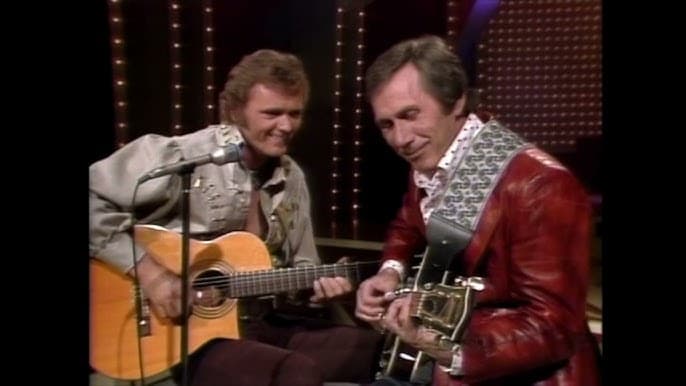
A lighthearted musical conversation where friendship, mastery, and joy speak louder than words
Few instrumental recordings capture the spirit of companionship as vividly as “I’ll Say She Does” by Chet Atkins & Jerry Reed. Released in 1970 on the album Me & Jerry, the track stands not as a bid for commercial dominance, but as a warm, knowing smile between two masters who understood that true artistry often lives in restraint, trust, and shared history.
From the outset, it is important to note that “I’ll Say She Does” was not released as a chart-focused single and therefore did not appear on major pop or country charts at the time of release. Yet this absence from the rankings tells a deeper truth: some recordings are never meant to compete. They are meant to endure. Over time, the piece has earned its place among guitar enthusiasts and country music scholars as a quiet classic—valued not for numbers, but for nuance.
The album Me & Jerry itself was born from genuine friendship. By 1970, Chet Atkins, already revered as “Mr. Guitar,” had reshaped the sound of modern country music as both a performer and a producer at RCA. His smooth fingerstyle technique, rooted in melody and clarity, had influenced generations. Jerry Reed, younger but no less gifted, brought a playful, rhythmic approach that blended country, jazz, blues, and humor. Where Atkins refined, Reed surprised. Together, they balanced each other perfectly.
“I’ll Say She Does” unfolds like a friendly exchange across a kitchen table late in the evening. There are no lyrics, yet the guitars speak with unmistakable personality. Atkins’ lines are clean, conversational, and precise—each note placed with intention. Reed responds with syncopated rhythms, unexpected accents, and a sense of mischievous charm. Neither dominates. Instead, they listen. That act of listening is the true heart of the performance.
The title itself hints at this understated humor. “I’ll Say She Does” feels like the end of a sentence spoken with a grin—an agreement reached without argument, a shared understanding. In musical terms, the song mirrors that sentiment. Themes are introduced, gently challenged, then affirmed. The result is music that feels relaxed yet deeply confident, casual yet expertly crafted.
Within the broader context of 1970, the track arrived during a period of transition. Country music was expanding outward, absorbing influences while struggling to maintain its identity. Many artists chased crossover success. Atkins and Reed, however, turned inward—toward tradition, technique, and mutual respect. Their collaboration was not about proving relevance, but about celebrating connection.
The meaning of “I’ll Say She Does” lies not in a narrative, but in a philosophy. It reminds us that excellence does not need volume. That virtuosity can smile instead of shout. That when two voices trust one another, complexity becomes effortless. For listeners who have lived long enough to recognize the beauty of simplicity earned through experience, the song resonates on a deeper level.
Today, the recording remains a testament to an era when musicians played with each other rather than over each other. It invites reflection, a slowing of pace, and an appreciation for conversation—musical and otherwise. In a world that often confuses speed with progress, Chet Atkins & Jerry Reed quietly offered something timeless.
And that is why “I’ll Say She Does” still matters. Not because it topped charts—but because it never needed to.