
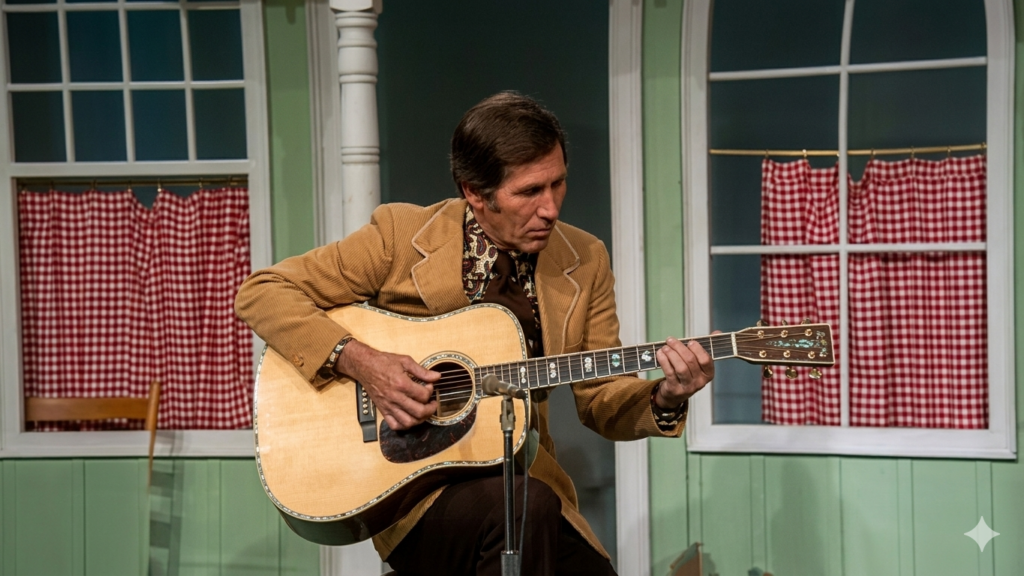
A playful collision of Dixieland spirit and Nashville precision, where the dusty streets of New Orleans are paved anew with the impeccable gold of a guitar master’s touch.
When Chet Atkins turned his attention to the roaring melodies of the early jazz era, the result was nothing short of a musical alchemy. “Muskrat Ramble”, originally composed in 1926 by the legendary trombonist Kid Ory and immortalized by Louis Armstrong and his Hot Five, is a cornerstone of the New Orleans Dixieland tradition. For decades, it was a song defined by brass, banjos, and the boisterous energy of a parade. However, when Chet—the “Certified Guitar Player”—reimagined it for his 1962 album Caribbean Guitar (and frequently revisited it in his iconic live medleys), he transformed that brassy chaos into a masterclass of syncopated fingerstyle elegance. For the listener who remembers the resurgence of traditional jazz in the mid-century or the steady, reassuring presence of Atkins on their television screens, this rendition is a sophisticated bridge between two great American musical landscapes.
Historically, “Muskrat Ramble” has always been a “happy” song, a rhythmic jog that invites the listener to tap a toe and forget their troubles. While the original jazz recordings were about the collective “shout” of a band, Chet’s version is a miracle of singular focus. Using his trademark thumb-and-fingerstyle technique, he manages to play the rolling bassline, the rhythmic “chops,” and the intricate, playful melody all at once on a single hollow-body guitar. It didn’t need to climb the Billboard charts to prove its worth; its “ranking” was established in the stunned silence of other guitarists trying to figure out how one man could sound like three. It helped solidify Chet’s reputation not just as a country star, but as a world-class instrumentalist who could take a song from any era and make it feel both modern and timeless.
The story behind this performance is one of artistic curiosity. Chet Atkins was never content to stay in the “country” box that the industry built for him. He was a fan of the great jazz pioneers, and he saw in “Muskrat Ramble” a technical challenge: how to capture the sliding, slurring energy of a trombone and the bright “ping” of a banjo on the fretboard. By the time he was performing this during the peak of his RCA Victor years, he was the most influential man in Nashville, yet he approached this piece with the joyful playfulness of a child. It reflects a time in American history when music was a shared language—when a kid from the Tennessee hills could pay homage to the masters of the Mississippi Delta with a sense of shared heritage and profound respect.
Meaningfully, “Muskrat Ramble” explores the concept of “musical wit.” There is a humor in the way Chet phrases the melody, a certain “wink” in the notes that suggests he is having as much fun playing it as we are listening to it. For the mature reader, the song acts as a vibrant reminder of the resilience of joy. It carries the weight of the past—the memories of dance halls and radio programs—but it delivers it with a crisp, clean energy that feels eternally young. It is a song about movement, about the “ramble” of life itself, reminding us that no matter how long the road has been, there is always room for a bit of swagger and a bright, upbeat tempo.
There is a tactile, organic beauty in the way Chet’s guitar strings snap and ring throughout this track. Listening to it now, in a world often dominated by heavy percussion and synthetic beats, the clarity of his instrument is a breath of fresh air. It evokes a nostalgic vision of a simpler time, perhaps a Sunday afternoon with the windows open and the record player spinning a story of high-stepping parades and sunny street corners. Chet Atkins didn’t just play “Muskrat Ramble”; he gave it a new soul, proving that the great melodies of the past don’t wither—they just wait for a master’s hand to polish them until they shine like new. For those of us who have lived through the many “rambles” of our own lives, this performance is a celebratory soundtrack, a rhythmic “well done” to a journey still in progress.