
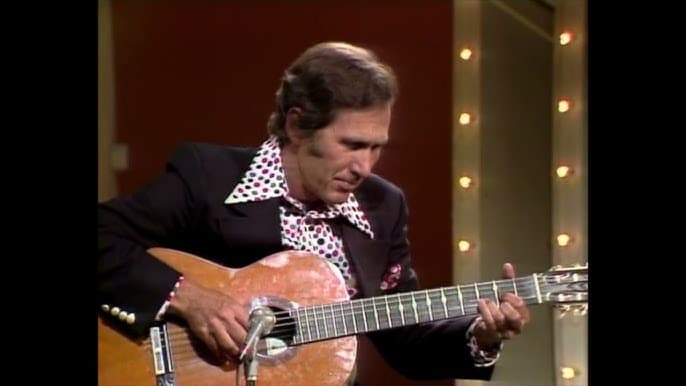
A timeless smile set to strings, where elegance, humor, and memory dance together
When Chet Atkins recorded “The Entertainer”, he was not simply revisiting a classic piece of American music he was gently reminding the world that true entertainment does not shout, rush, or demand attention. It smiles quietly, invites the listener in, and leaves something warm behind. Atkins’ interpretation of Scott Joplin’s ragtime masterpiece stands as one of the most graceful bridges ever built between early American composition and modern instrumental expression.
“The Entertainer” was originally composed in 1902 by Scott Joplin, the great architect of ragtime. For decades, the piece lived mostly in sheet music and memory, admired by musicians but largely absent from mainstream conversation. That changed dramatically in the 1970s, when renewed interest in ragtime swept through popular culture. In this moment of rediscovery, Chet Atkins stepped forward—not to modernize the piece aggressively, but to honor it with taste, clarity, and respect.
Atkins’ version was released in 1975 as the title track of his album The Entertainer, a pivotal record in his late-career renaissance. The album reached No. 2 on the Billboard Country Albums chart, confirming that instrumental guitar music when guided by elegance still had a place in the contemporary world. More importantly, the album earned Chet Atkins a Grammy Award in 1976 for Best Country Instrumental Performance, a recognition not of technical flash, but of musical wisdom.
What makes Atkins’ “The Entertainer” so distinctive is restraint. Ragtime, by nature, can easily become mechanical or overly jaunty. Atkins avoids both traps. His tempo is relaxed, almost conversational, allowing the syncopated rhythm to breathe. The melody unfolds naturally, as if discovered rather than performed. Each note rings with purpose, yet nothing feels forced.
Technically, the performance is a masterclass in fingerstyle guitar. Atkins carries melody, harmony, and rhythm simultaneously, but he never draws attention to the difficulty of the task. This was his lifelong philosophy: technique exists to serve expression, not to dominate it. In “The Entertainer”, that philosophy is on full display. Complexity disappears into ease, and the listener is left only with pleasure.
Emotionally, Atkins’ version feels affectionate rather than exuberant. There is humor here, but it is gentle a knowing smile rather than a laugh. One can almost hear echoes of old parlors, quiet rooms where music was played not for applause, but for companionship. The song becomes less about performance and more about presence.
The meaning of “The Entertainer” shifts subtly in Atkins’ hands. Joplin’s original piece was written to charm audiences, to showcase rhythmic innovation and melodic wit. Atkins retains that charm, but adds something else: reflection. There is a sense that the music is aware of its own history. It knows where it has been. It carries time within it.
This awareness aligns perfectly with Atkins’ role in American music. By 1975, he was no longer just a guitarist he was a curator of musical values. He believed deeply in clarity, balance, and emotional honesty. His version of “The Entertainer” feels like a conversation between generations: Joplin’s early 20th-century optimism meeting Atkins’ late 20th-century wisdom.
The production of the album reinforces this intimacy. There is no excessive polish, no studio trickery. The guitar tone is clean and warm, allowing the natural voice of the instrument to speak. Silence is respected. Space is preserved. These choices make the recording feel timeless rather than dated.
Within The Entertainer album, the track serves as a statement of intent. It declares that instrumental music can still move people not through volume or novelty, but through care. The album as a whole reaffirmed Atkins’ relevance at a time when popular music was rapidly changing, and its success proved that audiences still recognized sincerity when they heard it.
Decades later, Chet Atkins’ “The Entertainer” remains definitive. It does not replace Scott Joplin’s original; it converses with it. It reminds us that entertainment, at its best, is not about spectacle. It is about connection. A shared moment. A familiar tune made new through understanding.
In the end, this recording captures the essence of Chet Atkins himself. He does not demand attention he earns trust. He does not overwhelm he invites. And like the finest entertainers, he leaves the listener not dazzled, but quietly satisfied, carrying a melody that feels both old and endlessly alive.