
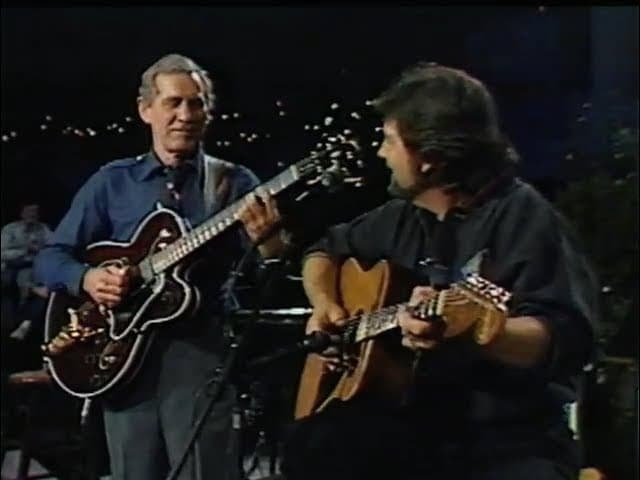
A passing of the torch in motion — tradition, technique, and joy racing forward on six strings.
When Chet Atkins joined forces with Thom Bresh to perform “Cannonball Rag,” the result was far more than a dazzling guitar showcase. It was a living conversation between generations, a moment where heritage was not preserved behind glass, but set in motion. This performance stands as one of the clearest examples of how American guitar tradition survives — not by standing still, but by being played, shared, and reimagined.
“Cannonball Rag” was originally written by Merle Travis in the mid-1940s and first recorded in 1946. The piece quickly became one of the defining works of Travis picking, a fingerstyle technique that forever altered the sound of country and folk guitar. Though it was an instrumental and did not chart on the pop or country singles rankings of its era, its influence spread far beyond charts. Among those deeply influenced by Travis was Chet Atkins, who would later refine and expand the style into what became known as the Nashville Sound.
That lineage gives special meaning to this collaboration. Thom Bresh is not only a gifted guitarist in his own right, but also Merle Travis’s son. When Bresh plays “Cannonball Rag,” he does so with inherited understanding — not imitation, but intimacy. When Chet Atkins joins him, the moment becomes symbolic: the student who became a master now stands beside the son of his own mentor.
Their recorded performance, best known from appearances in the 1970s and associated with projects such as Pickin’ My Way (1974), does not attempt to modernize the piece aggressively. Instead, it honors clarity, swing, and forward motion. The title itself — Cannonball Rag — suggests speed and momentum, and both players embrace that spirit without sacrificing control.
From the opening bars, the dialogue between the guitars is evident. Atkins’ playing is precise, economical, and elegant. Every note has intention. Bresh, by contrast, brings a youthful snap and playful edge, pushing the tempo slightly, smiling through the phrasing. Rather than competing, the two guitarists complement one another — experience and energy moving in parallel.
Technically, the performance is breathtaking, but what lingers is its warmth. Fingerstyle passages roll effortlessly, bass lines walk with confidence, and melody lines sparkle without strain. This is virtuosity without vanity. There is no sense of proving anything. Both players already know who they are.
The meaning of “Cannonball Rag” has always been tied to movement — trains, travel, progress, and the romance of American motion. In this rendition, that symbolism deepens. The song becomes a metaphor for musical inheritance. Ideas moving forward. Knowledge passed hand to hand, string to string.
For Chet Atkins, this performance fits perfectly within his lifelong mission: to elevate guitar playing without removing its soul. Throughout his career, Atkins resisted flash for its own sake. Even here, surrounded by speed and complexity, his tone remains calm and conversational. He leaves space. He listens.
For Thom Bresh, playing this song alongside Atkins is both personal and historical. It connects him to his father’s legacy while affirming his own voice. He is not standing in Merle Travis’s shadow — he is running on the same track, fully aware of where it leads.
Unlike many famous instrumentals, “Cannonball Rag” was never meant to tell a story with words. And yet, this performance tells one clearly. It speaks of respect, continuity, and joy in craft. It reminds us that great music does not age — it moves, adapts, and invites the next set of hands to take hold.
There were no chart positions to announce when this collaboration appeared. No radio countdowns. No commercial urgency. Its success lies elsewhere — in influence, admiration, and the quiet awe of those who recognize what is happening in real time.
In a world increasingly defined by speed without direction, this performance offers something different. It shows speed with purpose. Skill with humility. Tradition without stiffness. The notes fly, but they never lose their way.
Decades later, Chet Atkins & Thom Bresh’s “Cannonball Rag” remains a benchmark — not only for guitarists, but for anyone who believes that excellence is something to be shared, not guarded. It is a reminder that the strongest traditions are not the ones we freeze in memory, but the ones we keep playing.
And as the final notes fade, the feeling remains unmistakable: the train hasn’t stopped. It never was meant to.