
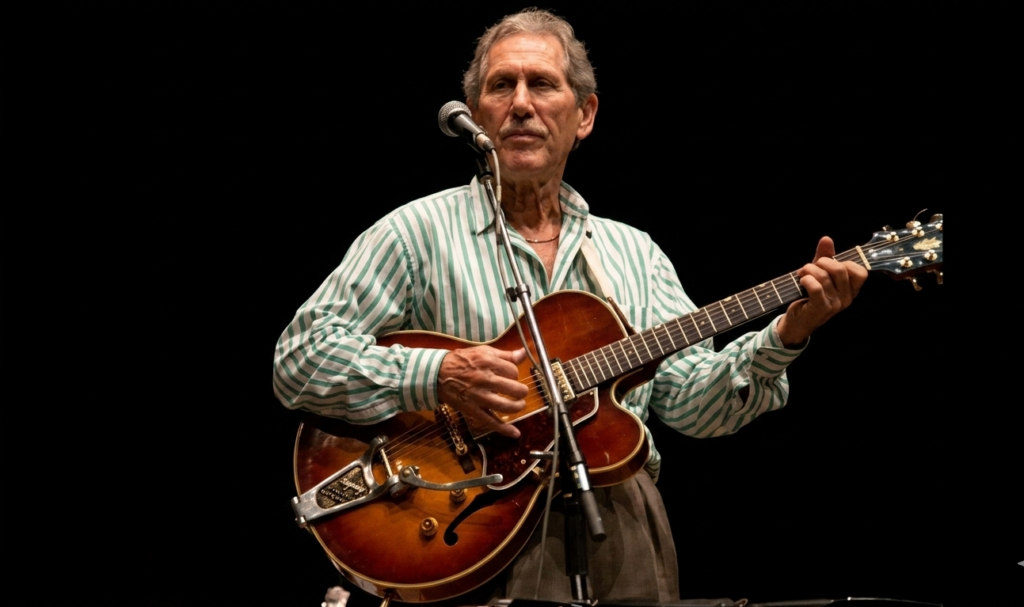
A spark of joy in every note where speed becomes memory and music outruns time
There are performances that entertain, and then there are moments that seem to defy age itself—where the hands move faster than memory, yet every note carries the weight of a lifetime. “Tiger Rag” (Live 1988, France) by Chet Atkins belongs to that rare second category. Captured during Chet Live in France, this rendition is not merely a revival of a jazz-age standard—it is a masterclass in control, wit, and the quiet confidence of a musician who had long since mastered both his instrument and his place in music history.
Originally written in 1917 by the Original Dixieland Jass Band, “Tiger Rag” became one of the earliest jazz standards, known for its playful chaos and breakneck tempo. By the time Chet Atkins approached it in 1988, the song had already lived many lives. Yet what he brought to it was something entirely different: not imitation, not nostalgia—but transformation. There are no official Billboard chart positions tied to this live instrumental performance, nor to Atkins’ version specifically, as it was not released as a commercial single. However, the significance lies elsewhere. By 1988, Atkins was already a towering figure—a multiple Grammy winner and a defining architect of the “Nashville Sound,” with decades of chart success behind him. This performance was not about climbing charts; it was about reaffirming mastery.
From the very first notes, there is a sense of playful mischief. The tempo is brisk, almost daring the listener to keep up, yet Chet Atkins never rushes. His fingers glide with a precision that feels effortless, but never mechanical. What stands out most is his ability to maintain clarity within complexity. Each run, each flourish, is articulated with a cleanliness that turns what could be chaos into something deeply musical. It is not just speed—it is storytelling through speed.
There is also something deeply human in this performance. Between phrases, you can almost hear the smile. Atkins was known for his relaxed stage presence, and here, that ease translates directly into the music. The pauses are just as meaningful as the notes themselves. He allows the melody to breathe, even as it races forward. In those fleeting moments of space, one senses reflection—a quiet acknowledgment of the many years that brought him to this stage in France, playing a tune born in another century, yet still alive in his hands.
Behind this performance lies a broader story of musical bridge-building. Chet Atkins was never confined by genre. Though often associated with country music, his influences stretched into jazz, pop, and classical guitar. “Tiger Rag” becomes, in his hands, a conversation between worlds—a meeting point of early jazz exuberance and Nashville refinement. It is a reminder that great musicians do not simply preserve tradition; they reshape it.
And perhaps that is the deeper meaning of this performance. “Tiger Rag,” in its original form, was about energy, novelty, and the thrill of something new. But in 1988, played by Chet Atkins, it becomes something more reflective. It speaks of endurance—the ability of music to evolve without losing its spirit. It suggests that speed is not just about youth, but about clarity of thought, economy of motion, and a lifetime of listening.
As the final notes fade, there is no grand statement, no dramatic ending. Just a sense of completion—as if the music has said exactly what it needed to say. In that quiet resolution, one is left not with excitement alone, but with a deeper appreciation: that sometimes, the most dazzling performances are not about proving anything at all, but simply about continuing the conversation between past and present, one note at a time.