
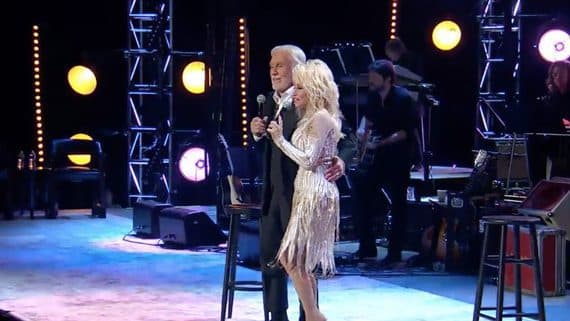
A Final Promise Spoken in Song, Where Gratitude, Love, and Goodbye Became One
When Dolly Parton and Kenny Rogers stood together on stage in 2017 during Kenny Rogers’ Farewell Concert – All in for the Gambbler, the performance of “I Will Always Love You” was far more than a song. It was a moment suspended in time a graceful farewell, shaped by decades of friendship, shared music, and mutual respect. Though widely known as one of Dolly Parton’s most iconic compositions, sung countless times across generations, this particular rendition carried a weight that no chart position could ever measure.
Originally written and recorded by Dolly Parton in 1973, “I Will Always Love You” was released in 1974 and achieved an extraordinary feat: it reached No. 1 on the Billboard Hot Country Songs chart twice first in 1974, and again in 1982 after Parton re-recorded it for the film The Best Little Whorehouse in Texas. Few songs in American music history have demonstrated such enduring relevance. While later versions introduced the song to new audiences worldwide, its emotional core has always remained rooted in Dolly Parton’s original intention: a song about letting go with love intact.
Dolly Parton wrote “I Will Always Love You” as a personal farewell to her longtime professional partner Porter Wagoner. Rather than anger or resentment, the lyrics express gratitude, respect, and the quiet ache of parting ways when love still exists. That emotional clarity is what has allowed the song to transcend its original context and speak meaningfully in countless other moments including Kenny Rogers’ farewell.
At the 2017 farewell concert, Dolly Parton performed the song directly to Kenny Rogers, transforming it into a deeply personal tribute. Their history together was rich and well-documented. As duet partners on songs like “Islands in the Stream” and “You Can’t Make Old Friends,” they embodied musical chemistry built not on drama, but on trust. Their friendship extended far beyond the stage, rooted in humor, loyalty, and an unspoken understanding earned over decades.
Musically, the performance was restrained and reverent. There was no attempt to overshadow the moment with vocal excess. Dolly’s voice clear, steady, and emotionally transparent carried the song with dignity. Kenny Rogers, standing beside her, listened more than he sang. That choice was powerful. It allowed the song’s meaning to shift from declaration to offering, from performance to conversation. Every line felt intentional, spoken rather than delivered.
The lyrics “I wish you joy and happiness, but above all this, I wish you love” took on new resonance in that setting. They sounded less like poetry and more like truth. The song was no longer about career separation or romantic farewell; it became a statement of gratitude for a shared journey. In that moment, the audience was not witnessing nostalgia, but closure gentle, respectful, and deeply human.
Kenny Rogers’ farewell concert itself was a celebration of a life in music. Featuring appearances from artists who had crossed paths with him over the years, it reflected the breadth of his influence. Yet it was this quiet performance with Dolly Parton that lingered most strongly. It encapsulated who Rogers was not just as a singer, but as a collaborator and friend. The absence of spectacle made the moment unforgettable.
The meaning of “I Will Always Love You” has evolved over time, but its essence remains unchanged. It is not a song about clinging or regret. It is about recognizing when something meaningful has run its course and honoring it without bitterness. Sung at Kenny Rogers’ farewell, it became a musical benediction, a way of saying goodbye without erasing what came before.
In the broader history of popular music, few moments capture the intersection of legacy and emotion so clearly. This was not a reunion staged for publicity, nor a performance designed to relive past success. It was a quiet acknowledgment of shared history, delivered with grace.
Long after the final note faded, what remained was not applause, but stillness. The kind that follows something sincere. In that stillness, Dolly Parton and Kenny Rogers reminded us that the most powerful goodbyes are not loud.