
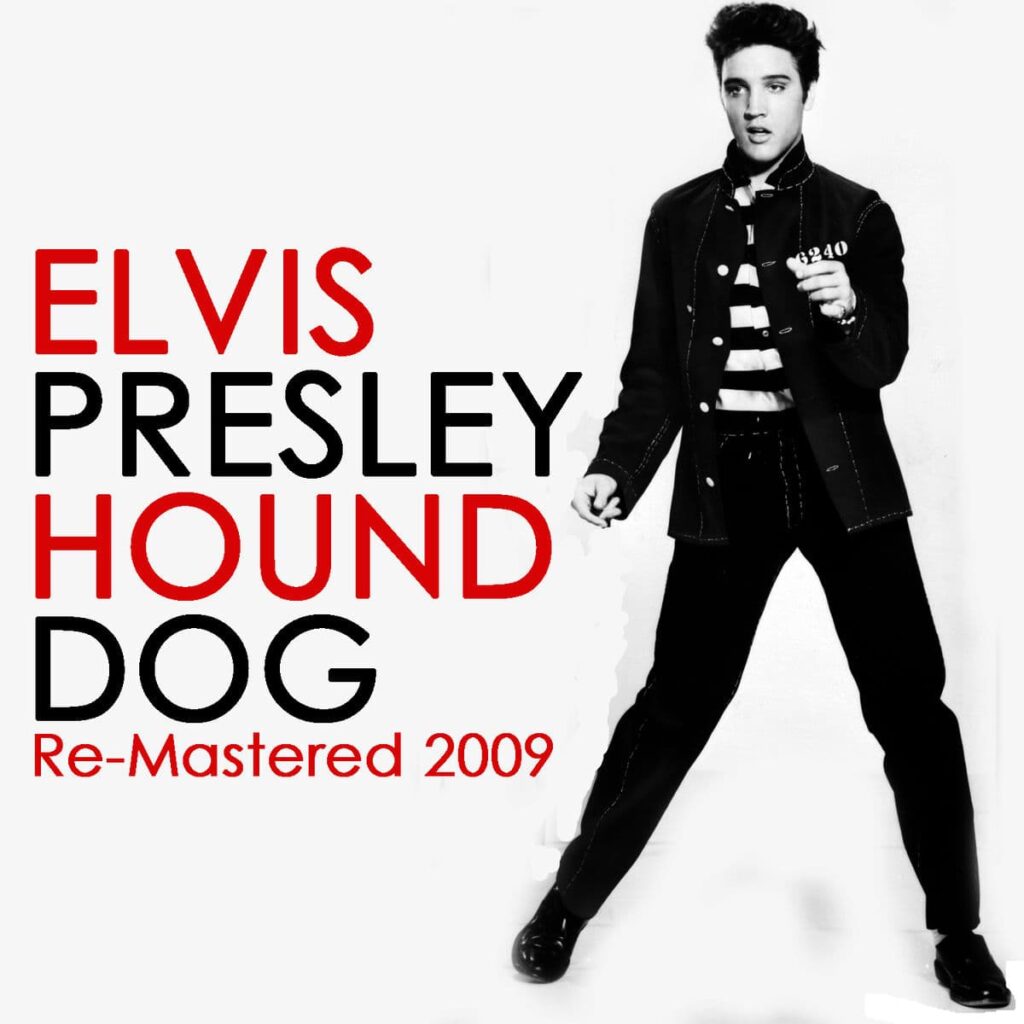
A raw, electric challenge to convention Hound Dog as Presley’s bold roar into rock ’n’ roll
When Elvis Presley unleashed Hound Dog in 1956, it was more than just a song it was a cultural thunderbolt, a bold fusion of rhythm, bravado, and rebellion that catapulted him into rock ’n’ roll immortality.
From the moment the single was released on July 13, 1956, back to back with Don’t Be Cruel, it refused to be ignored. The record stormed the charts, claiming the No. 1 spot on Billboard’s Top 100, as well as topping the country and R&B charts. In the UK, Hound Dog also enjoyed remarkable success it spent 23 weeks on the chart and reached No. 2 at its peak. This was not simply a song climbing the charts: it was a defining moment for Elvis, the song that helped cement his legend.
The story behind Hound Dog is deeply rooted in musical tradition. The song was originally written by Jerry Leiber and Mike Stoller for Big Mama Thornton, who recorded a gritty, blues-inflected version in 1952. But by the time Elvis heard it, it had already evolved. He became enchanted with Freddie Bell & the Bellboys’ 1955 Las Vegas version, which altered some lyrics to speak not of a deceitful lover, but of a literal dog. Inspired, Elvis brought the song into his own sound world, blending country, rock, and pop into something new and electrifying.
When he recorded Hound Dog on July 2, 1956, at RCA Victor’s New York studio, he demanded perfection. Backed by Scotty Moore on guitar, Bill Black on bass, D.J. Fontana on drums, and the Jordanaires providing harmonies, Elvis pushed through 31 takes before finally declaring “take 28” the one. The result is a lean, driving performance the staccato guitar riff, the crackling rhythm, and Elvis’s own vocals bursting with both swagger and raw energy.
But the meaning of the song, under Elvis’s fierce delivery, transcends literal imagery. While the Bell version made the song about a dog, Elvis’s performance reintroduces a sense of metaphor and defiance. In his hands, Hound Dog becomes a declaration of not-tolerating disrespect, of asserting identity, of challenging who has the power in a relationship. It’s not just a playful insult; it’s a statement: “You ain’t nothing but a hound dog / Cryin’ all the time.”
The cultural impact was immediate and profound. Elvis performed Hound Dog on national television, most memorably on The Milton Berle Show, where his gyrating hips caused uproar and scandal, symbolizing the youthful rebellion of rock ’n’ roll. Critics were divided, some decrying the performance as vulgar, others recognizing in it an electric force that spoke directly to a generation hungry for freedom.
Sales exploded. The single sold millions in the U.S., becoming one of Elvis’s best-selling records, and his version of Hound Dog spent 11 weeks at No. 1 on Billboard a record at the time. For all its commercial might, the song also carried a stain of controversy. It raised serious conversations about race, originality, and the music industry, because the version that brought global fame to Elvis was rooted in a Black artist’s original Big Mama Thornton’s.
Yet what makes Elvis Presley’s “Hound Dog” enduring is not just its chart success or its shock value it is its raw, unapologetic energy, and how it captures the spirit of a young man refusing to be constrained. With a voice that conveys both playfulness and menace, he turned a blues tune into a rock ’n’ roll anthem that challenged authority, flirted with irreverence, and made a bold statement: this is his sound, his stage, his moment.
As we reflect on Hound Dog today, decades later, we sense more than nostalgia. We hear the echoes of a cultural shift, of a voice that broke boundaries and redefined what popular music could be. We remember the first time it cut through the airwaves, the way it made people gasp, laugh, and dance and we feel again the thrill of a young artist roaring into his destiny.