
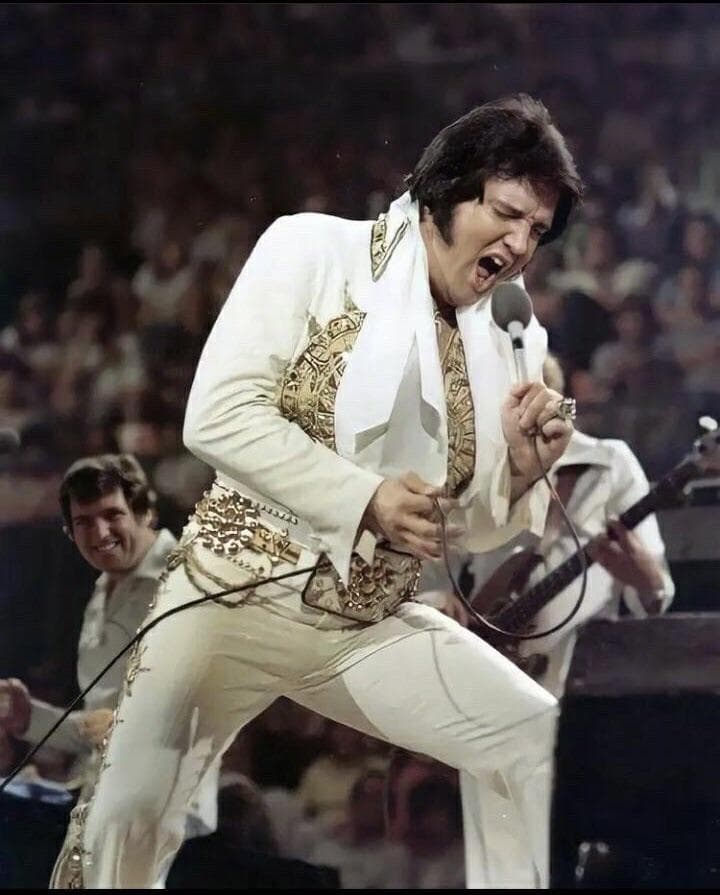
A haunted confession of pain and longing carried by Elvis’s mature voice
In 1976, Elvis Presley released Hurt a raw, emotionally charged rendition that laid bare the ache of betrayal and loss, rediscovering an old R&B classic through the lens of a man who had known too much heartache. The song entered the charts modestly but meaningfully: it reached No. 28 on the U.S. Billboard Hot 100, climbed to No. 6 on the Billboard Hot Country Singles chart, and even made No. 37 on the UK Singles Chart, while also becoming a staple in his live shows and a beloved track among fans.
Originally written by Jimmie Crane and Al Jacobs and first recorded by R&B singer Roy Hamilton in 1954, Hurt already carried years of sorrow in its melody and lyrics. By the time Elvis returned to it in February 1976 in the now-famous “Jungle Room” sessions at his home in Graceland the song took on new weight. Working with a full group of musicians and backing vocalists, Elvis transformed the track into something larger than heartbreak: a solemn lament infused with desperation, regret, and finality.
What stands out most is how Elvis uses his voice not the youthful rock-and-roll growl of his early years, but a deeper, world-worn timbre. Every word carries the weight of past mistakes and heavy memories. At times he strains, at times he trembles; there’s a fragility and fragility-and-strength intertwined, as if every note is a confession. The sparse instrumentation subtle piano, low bass, aching guitar lines leaves space for that voice to echo in the listener’s heart long after the record stops.
The lyrics themselves speak of love once believed true, now broken. “You said our love was true / And we’d never, never part / But now you’ve gone / And it hurts… so deep inside of me.” It’s a universal grief loss of love, loss of trust, loss of what could have been. But Elvis doesn’t just sing sorrow; he makes you feel it, as if the wounds are his own, open and unhealed.
It’s no wonder critics over the years have described this performance as visceral and harrowing. One rock historian went so far as to call it “apocalyptic,” arguing that the track reveals a man grappling with regret, mortality, and the ghosts of his own life.
Beyond the charts and the critical praise, Hurt found its way into Elvis’s catalog of deeply personal songs the ones he turned to when the applause faded and the lights dimmed. It became not merely a cover, but a mirror: reflecting not only heartbreak, but the passage of time, the weight of living, and the sorrow that sometimes lingers long after love has gone.
For those who grew up alongside Elvis’s career when radio played records, when heartbreak meant letters and silence Hurt resonates as an echo from a different era, but one that carries timeless truth. It reminds us that songs can age like fine whiskey: richer, deeper, more resonant. And that sometimes the greatest artistry lies in admitting pain, singing it out loud, and trusting the listener to carry it home.
In revisiting Hurt, we are invited not only to remember a voice, but to feel it to sit with the ache, understand the sorrow, and perhaps find in it a strange kind of solace: that even in pain, beauty remains.