
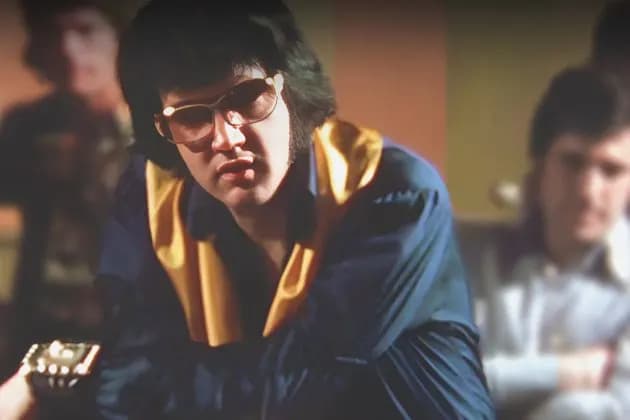
A Late-Night Confession of Loneliness and Desire: Elvis Presley “It’s Midnight”
“It’s Midnight” captures Elvis Presley in a moment of quiet intensity—a song steeped in longing, restlessness, and emotional vulnerability, sung by an artist who, by the mid-1970s, had learned how to turn solitude into sound.
Released in November 1974 as a single, It’s Midnight occupies a significant place in Elvis’s later career. On the charts, it achieved respectable success: it reached No. 9 on the UK Singles Chart, confirming that Presley’s appeal in Britain remained strong well into the 1970s, while in the United States it peaked at No. 79 on the Billboard Hot 100 and performed better on the country chart, reaching No. 15 on the Billboard Hot Country Singles. These positions reflect a period when Elvis was no longer chasing pop dominance, but instead resonating deeply with listeners who valued emotional truth over chart spectacle.
The song was written by Billy Edd Wheeler a respected songwriter known for blending folk, country, and introspective lyricism and recorded earlier in 1974 during Elvis’s sessions at Stax Studios in Memphis. These sessions were particularly meaningful: Elvis had returned to his hometown studios seeking creative grounding, surrounded by musicians who understood the gravity and subtlety of his voice. The result was a body of work marked by introspection, emotional restraint, and lived-in wisdom. It’s Midnight emerged as one of the most evocative tracks from this period.
Musically, the song unfolds slowly, almost cautiously. A gentle, blues-tinged arrangement sets the stage for Elvis’s voice, which enters not with bravado, but with a weary intimacy. The lyric “It’s midnight, and the clock on the wall is striking the hour” immediately places the listener in a familiar emotional space: the late hours when thoughts grow heavier, memories sharper, and loneliness harder to ignore. This is not the midnight of excitement or romance, but the midnight of reflection, of unanswered questions, of longing for a voice on the other end of the line.
What gives It’s Midnight its lasting power is the way Elvis inhabits the song. His vocal delivery is controlled, almost conversational, yet layered with yearning. There is a subtle ache in his phrasing, a sense that the words are not merely being sung but lived. By this stage in his career, Elvis no longer needed to project youthful confidence; instead, he allowed fragility to become part of his artistry. The result is a performance that feels deeply personal, even confessional.
Thematically, It’s Midnight explores emotional isolation within love the feeling of wanting connection while being separated by distance, circumstance, or emotional walls. The narrator waits, hoping, listening to silence, suspended between desire and resignation. This theme aligned closely with the broader tone of Elvis’s mid-1970s recordings, which often reflected uncertainty, emotional fatigue, and a search for reassurance. Songs like “My Boy,” “Solitaire,” and “It’s Easy for You” belong to this same emotional family, forming a late-career portrait of an artist unafraid to confront vulnerability.
It’s Midnight was later included on the album Promised Land (released in January 1975), an album that blended energetic country-rock with reflective ballads. While Promised Land is often remembered for its driving title track, It’s Midnight serves as its emotional counterweight a reminder that even strength has its quiet hours. The album itself reached No. 47 on the Billboard Top LPs chart and performed strongly in the country category, further cementing Elvis’s role as a cross-genre figure in the 1970s.
For many listeners, It’s Midnight carries a particular resonance because it mirrors real emotional experiences. It evokes memories of long nights with the radio softly playing, the world asleep while thoughts remain restless. Elvis’s voice, rich with experience, becomes a companion in those moments a presence that understands without explanation.
Looking back, It’s Midnight stands as one of Elvis Presley’s most understated yet emotionally honest recordings. It does not rely on spectacle or nostalgia; instead, it offers something quieter and more enduring: empathy. In this song, Elvis does not perform for the crowd he sings into the darkness, trusting that somewhere, someone is listening and feeling the same ache.
In the twilight of his recording career, Elvis Presley gave voice to the hours when life slows, emotions surface, and the heart speaks most clearly. It’s Midnight remains a testament to that truth a song that proves the King’s greatest strength was not only in commanding a stage, but in whispering directly to the soul.