
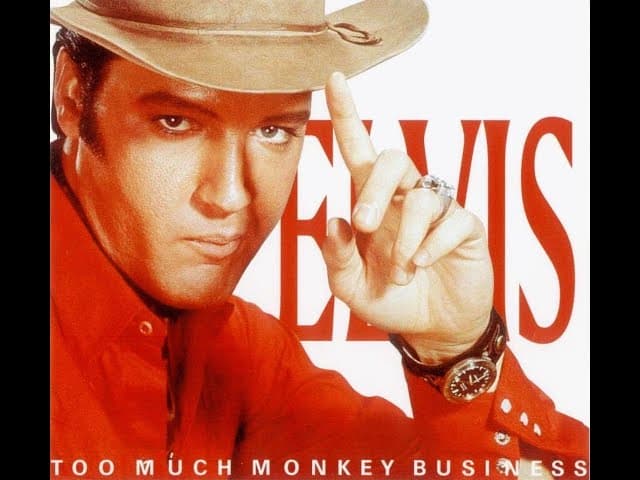
Desire on the Edge of Control: Elvis Presley “Too Much”
“Too Much” is one of Elvis Presley’s most electrifying early statements a song that captures the restless energy, raw desire, and barely contained urgency that defined his mid-1950s ascent and permanently altered the sound of popular music.
Released in April 1957, Too Much arrived at a moment when Elvis was no longer a promising newcomer but a cultural force reshaping the musical landscape. Issued as a double-sided hit with “Playing for Keeps”, the single surged to No. 1 on the Billboard Top 100, holding the top position for three weeks, and also reached No. 1 on the Billboard Rhythm & Blues chart. In the United Kingdom, it climbed to No. 2 on the UK Singles Chart, confirming Presley’s international dominance at a time when few American artists could command such reach. These chart positions place Too Much firmly among the defining hits of Elvis’s golden era.
The song was written by Lee Rosenberg and Bernard Weinman, and recorded on January 12, 1957, at Radio Recorders in Hollywood. It was closely associated with Elvis’s second feature film, Loving You (1957), appearing on the soundtrack album that further solidified his image as both rock ’n’ roll star and screen idol. The Loving You soundtrack itself became a major success, reaching No. 1 on the Billboard album chart, and Too Much played a crucial role in maintaining the feverish momentum surrounding Presley at the height of his early fame.
Musically, Too Much is pure kinetic energy. Driven by sharp guitar lines, snapping rhythm, and a vocal performance charged with urgency, the song feels almost breathless. From the opening line “Honey, you’re too much” Elvis plunges straight into the emotional core of the song without preamble. There is no slow build, no gentle introduction; instead, desire arrives fully formed, impatient and overwhelming. This immediacy mirrors the spirit of rock ’n’ roll itself as it existed in the 1950s: direct, physical, and impossible to ignore.
What sets Too Much apart from many of Presley’s contemporaries is the tension in his delivery. His voice teases the melody, alternately restrained and explosive, as though constantly threatening to break free of its boundaries. It is flirtation and frustration at once a musical embodiment of wanting more than words can safely express. In this performance, Elvis channels the rhythm-and-blues influences that shaped him while filtering them through his own unmistakable vocal identity, creating something that felt dangerous and thrilling to audiences of the time.
Lyrically, the song is deceptively simple. It speaks of desire that has crossed the line from pleasure into obsession, of attraction so powerful it becomes almost unbearable. Yet within that simplicity lies its strength. Too Much doesn’t explain or justify emotion; it simply states it. This emotional directness resonated strongly in an era when popular music was still largely polite and controlled. Elvis’s delivery gave voice to feelings many recognized but rarely heard expressed so boldly on the radio.
In the broader context of Elvis’s career, Too Much represents a peak moment of youthful intensity before military service, before Hollywood formula films softened his musical edge, before the reflective depth of his later ballads. It belongs to the same lineage as “All Shook Up,” “Jailhouse Rock,” and “Heartbreak Hotel”, songs that didn’t just succeed commercially but redefined what a hit record could sound and feel like.
The cultural impact of Too Much extended beyond its chart performance. It was part of the soundtrack to a generational shift, a period when music became a language of emotional honesty and physical presence. For many listeners, the song is inseparable from memories of jukeboxes, transistor radios, crowded living rooms, and the sensation that something new and slightly dangerous was happening in music.
Listening to Too Much today, decades later, its power remains remarkably intact. The production may reflect its time, but the emotion does not. There is still urgency in Elvis’s voice, still heat in the rhythm, still that unmistakable sense of desire pressing against restraint. It reminds us why Elvis Presley mattered not only because he could sing beautifully, but because he could make emotion feel immediate and unavoidable.
In the end, “Too Much” stands as a snapshot of Elvis at full voltage: young, confident, and utterly compelling. It is a song that doesn’t look back or slow down; it surges forward, carried by instinct and intensity. In that surge lies the essence of early rock ’n’ roll and the reason Elvis Presley remains, even now, impossible to ignore.