
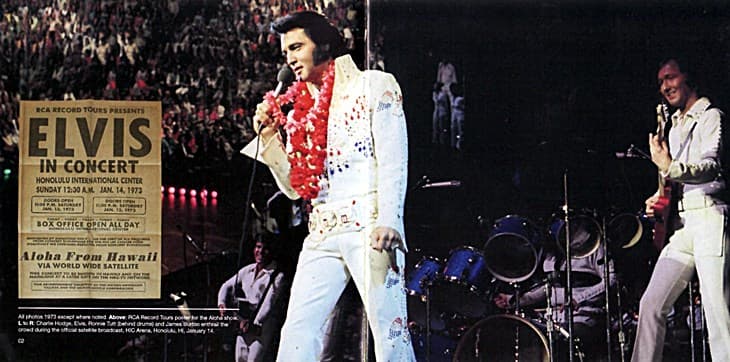
A rock ’n’ roll salute under Hawaiian lights where legacy, joy, and raw energy meet in one fearless performance.
When Elvis Presley stepped into “Johnny B. Goode” during Aloha From Hawaii in January 1973, it was more than a cover. It was a declaration. In front of a global audience, broadcast live via satellite, Elvis reached back to the roots of rock ’n’ roll and lifted them into the present with confidence, humor, and unmistakable authority. This was not a man trying to reclaim relevance — it was an artist reminding the world where the fire began.
Originally written and recorded by Chuck Berry in 1958, “Johnny B. Goode” is one of the foundational anthems of rock history. By the time Elvis performed it live in Honolulu on January 14, 1973, the song was already immortal. Berry’s original had reached No. 8 on the Billboard Hot 100 and became a blueprint for generations of guitar-driven music. Elvis knew exactly what he was touching and he approached it with respect, not imitation.
The Aloha From Hawaii concert itself holds a unique place in music history. It was the first solo artist concert broadcast live around the world via satellite, reaching an estimated 1 to 1.5 billion viewers. Elvis, dressed in his now-iconic American Eagle jumpsuit, was not merely performing a setlist he was representing an era, a culture, and a musical lineage that traced directly back to rhythm & blues and early rock pioneers like Chuck Berry.
When “Johnny B. Goode” begins, Elvis doesn’t rush. There’s a playful confidence in his delivery, a knowing smile in the phrasing. His voice is looser here than on his ballads, less controlled, more instinctive. He leans into the rhythm, lets the band drive, and allows the song to breathe. This performance isn’t polished to perfection and that is precisely its charm.
The backing band, led by James Burton on guitar, delivers a sharp, driving arrangement that honors Berry’s original riff while giving it a fuller, more modern stage presence. Burton’s guitar doesn’t compete with the song’s history it converses with it. Elvis, meanwhile, becomes both narrator and witness, singing about a country boy who “could play the guitar just like ringing a bell,” fully aware that the line could just as easily describe his own journey.
What gives this rendition emotional weight is its placement within Elvis’s career timeline. By 1973, he had already conquered radio, film, television, and live performance. He had nothing left to prove. Yet here he was, choosing to spotlight a song that celebrates the dream of making it through sheer talent and persistence. In doing so, Elvis quietly acknowledged the shoulders he stood upon the Black artists and early innovators who shaped the sound he helped popularize.
There is also joy in this performance unmistakable, unforced joy. Elvis looks relaxed, energized, fully present. He moves with ease, interacts with the band, and seems genuinely amused by the song’s youthful optimism. For a moment, the weight of expectation falls away, replaced by the simple thrill of playing rock ’n’ roll on a big stage.
Unlike the dramatic ballads and gospel numbers that define much of the Aloha From Hawaii set, “Johnny B. Goode” serves as a reminder of Elvis’s playful side. It reconnects him with the teenage spark that first shook American culture in the mid-1950s. Not nostalgia continuity. A straight line drawn from the past to the present.
The meaning of “Johnny B. Goode” has always been about possibility: talent rising from obscurity, music as escape, sound as destiny. In Elvis’s hands, the song gains an added layer gratitude. He sings it not as a young man dreaming of success, but as someone who lived that dream and understands its cost and its wonder.
Decades later, this performance endures because it feels honest. There is no attempt to modernize the song beyond recognition, no effort to overshadow its origin. Elvis simply steps into it, inhabits it, and lets it speak. The Hawaiian lights, the global broadcast, the cheering crowd all of it fades behind the groove.
In “Johnny B. Goode” (Aloha From Hawaii, Live in Honolulu, 1973), Elvis Presley didn’t just revisit rock ’n’ roll history. He celebrated it. He honored it. And for a few electric minutes, he reminded the world that great music never ages it only finds new voices to carry it forward.