
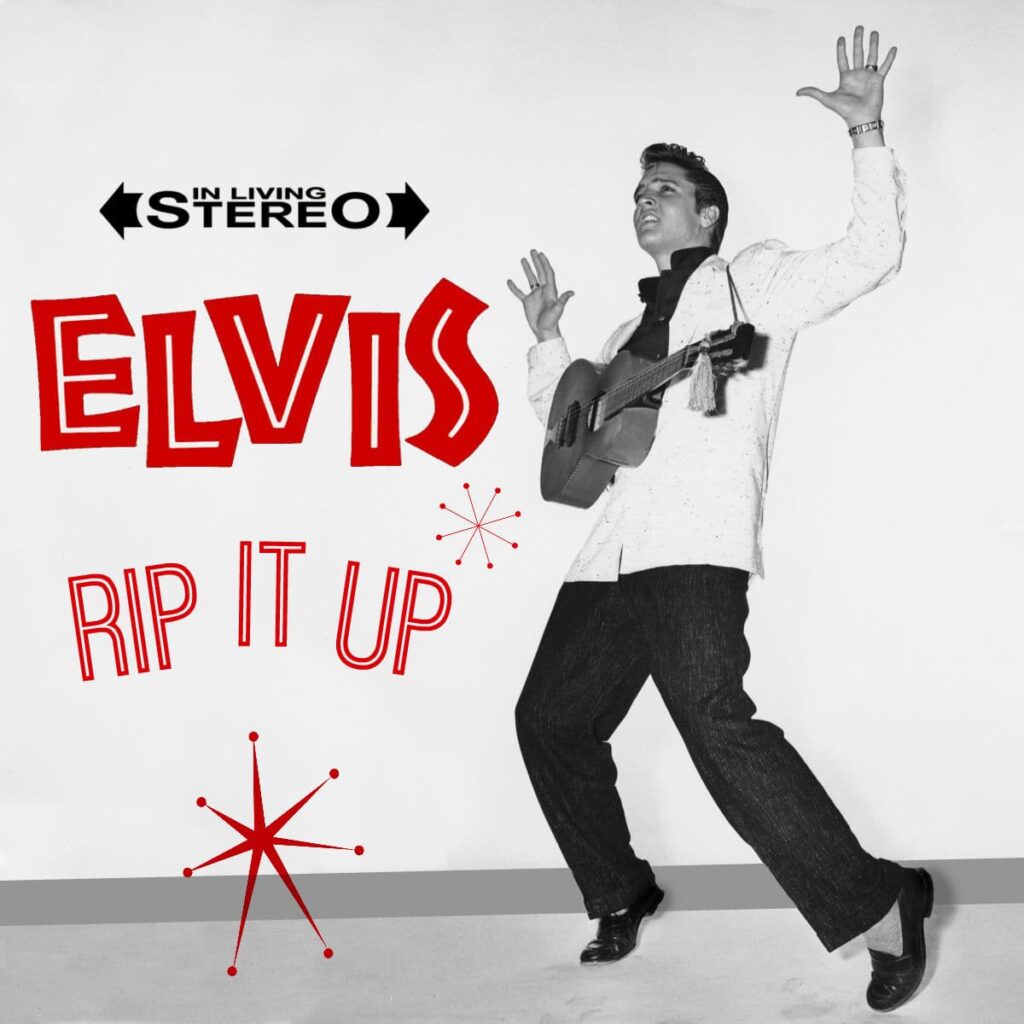
Pure Fire on Wax: Youth, Rhythm, and Release in “Rip It Up”
“Rip It Up” captures Elvis Presley at his most uninhibited raw, joyful, and driven by rhythm rather than reflection. Recorded in 1956, during the fevered sessions that produced his historic debut album Elvis Presley, the song stands as a snapshot of a moment when popular music was shedding restraint and discovering physical freedom. It is not a song built for contemplation. It is built for movement, for release, for the sheer thrill of sound.
Originally written by Robert “Bumps” Blackwell and John Marascalco, “Rip It Up” was first recorded the same year by Little Richard, whose version embodied the explosive spirit of early rock ’n’ roll. Elvis did not attempt to outdo Little Richard’s ferocity. Instead, he translated that energy into his own musical language rooted in rhythm and blues, shaped by country instinct, and delivered with a confidence that felt instinctive rather than rehearsed.
Elvis recorded “Rip It Up” at RCA Victor’s Nashville studios, backed by his trusted band: Scotty Moore on guitar, Bill Black on bass, and D.J. Fontana on drums. The arrangement is tight, fast, and unembellished. There is no excess instrumentation, no attempt to smooth the edges. Everything about the recording points forward driven by momentum and urgency. The song feels as if it might outrun itself.
Though “Rip It Up” was not released as a major standalone single for Elvis and did not carry its own chart legacy, its importance lies elsewhere. It helped define the sound and attitude of his debut album, which would go on to spend ten weeks at No. 1 on the Billboard Top Pop Albums chart, becoming the first rock-and-roll album to do so. Songs like “Rip It Up” made that achievement possible by proving that Elvis was not simply a ballad singer or novelty act he could deliver rhythm with authority.
Elvis Presley’s vocal performance on “Rip It Up” is playful, confident, and infectious. He sings with a grin in his voice, leaning into the groove rather than overpowering it. There is no dramatic phrasing, no emotional exposition. The joy here is immediate and physical. Elvis understands the song’s purpose and never strays from it. He invites the listener into motion, not introspection.
Lyrically, the song is simple to the point of minimalism an invitation to enjoy the night, the music, and the moment. There is no story to follow, no message to decipher. That simplicity is intentional. In the mid-1950s, this kind of directness felt revolutionary. Music no longer needed to explain itself. It could simply exist, and that existence could be enough.
What makes Elvis’s version of “Rip It Up” particularly effective is his sense of control. Even at high speed, he never sounds frantic. His timing is precise, his phrasing relaxed. This balance between abandon and discipline was one of Elvis Presley’s greatest gifts. He could sound wild without losing command, free without sounding careless.
Within the broader context of Elvis’s early catalog, “Rip It Up” serves as a reminder of what first made him dangerous to the establishment. It is music that does not ask permission. It does not explain itself to older generations or soften its edges for approval. It moves forward, daring the listener to keep up.
The year 1956 was transformative, not only for Elvis but for popular music itself. Songs like “Heartbreak Hotel” introduced emotional darkness, while tracks like “Rip It Up” celebrated joy and physicality. Together, they revealed the full range of what rock ’n’ roll could be. Elvis was not confined to one mood or message he embodied the entire spectrum.
Today, “Rip It Up” may not carry the iconic status of Elvis’s most famous hits, but it remains essential listening for anyone who wants to understand his early power. It preserves the sound of a young artist in motion, unconcerned with legacy, focused only on feel.
In its driving rhythm and fearless simplicity, “Rip It Up” reminds us why rock ’n’ roll mattered when it first arrived. It was not about perfection or polish. It was about energy, freedom, and the courage to let music move the body before it ever reached the mind. Elvis Presley understood that instinctively and in “Rip It Up,” he let it loose.