
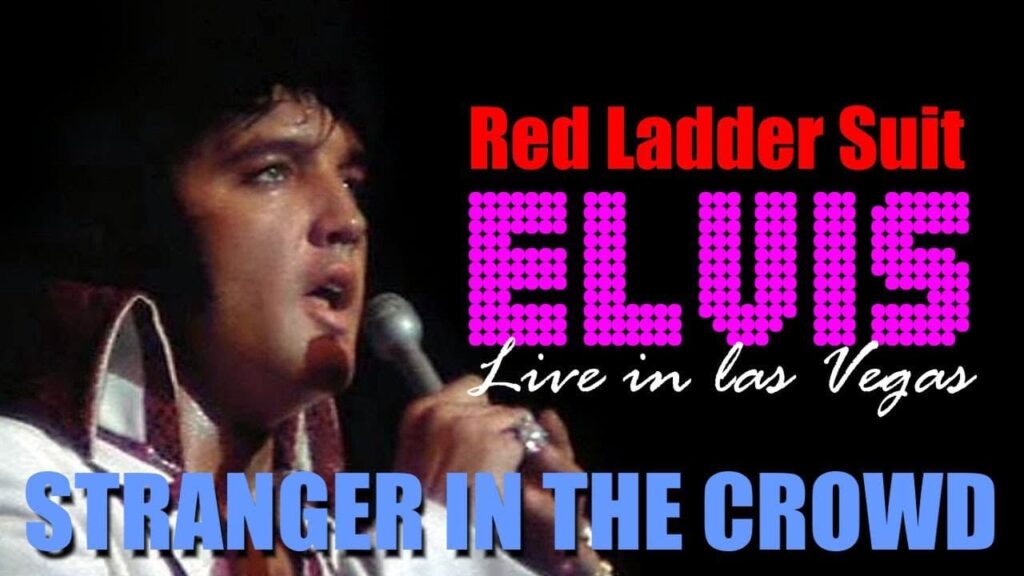
A lonely voice surrounded by faces — Elvis sings the ache of being unseen in a crowded world
“Stranger in the Crowd” stands as one of Elvis Presley’s most introspective and quietly haunting recordings, a song that captures not heartbreak through loss, but through isolation. Released in 1970 on the album That’s the Way It Is, the song arrived during a pivotal moment in Elvis’s career — a time when he was redefining himself not as a myth or symbol, but as a deeply human artist confronting solitude, doubt, and emotional distance.
Written by Winfield Scott, “Stranger in the Crowd” did not chart as a major single, yet its emotional resonance has endured far beyond the metrics of popularity. It speaks to a universal feeling that grows more familiar with age: the strange realization that one can be surrounded by people and still feel completely alone.
From the opening moments, the song establishes its mood with restraint. The arrangement is gentle and reflective, built around soft instrumentation that never overwhelms the vocal. Strings appear, but they are understated — not sweeping, not cinematic. The music feels intentionally contained, mirroring the emotional confinement of the narrator himself. This is not a performance meant to impress; it is meant to confess.
Elvis’s vocal delivery here is masterful in its subtlety. By 1970, his voice had gained a rich, burnished depth — no longer the youthful fire of the 1950s, nor the polished gloss of his film years. On “Stranger in the Crowd,” he sings with a controlled sadness, carefully holding back emotion rather than releasing it all at once. Each phrase sounds weighed down by thought, as though the words have been lived with for a long time before finally being spoken.
Lyrically, the song is deceptively simple. There is no dramatic narrative, no betrayal or confrontation. Instead, it focuses on emotional displacement — the feeling of no longer belonging, even in familiar spaces. The narrator watches, observes, remembers, and realizes that something essential has slipped away. He is present, yet invisible. Known, yet unknown.
This theme resonated deeply with Elvis’s own life at the time. Following his triumphant 1968 Comeback Special, Elvis returned to live performance and recording with renewed purpose. Yet success did not erase personal struggles. Fame had given him everything except privacy, stability, and emotional closeness. In that sense, “Stranger in the Crowd” feels eerily aligned with his reality — a man adored by millions, yet often isolated from genuine connection.
The album That’s the Way It Is itself marked a new artistic maturity. Recorded alongside rehearsals and live performances in Las Vegas, it showcased Elvis in transition — confident on stage, yet reflective in the studio. “Stranger in the Crowd” stands out as one of the album’s most inward-looking moments, a pause amid grandeur where the curtain is briefly pulled back.
What makes the song especially powerful is its lack of resolution. There is no promise of change, no comforting conclusion. The song ends much as it begins — suspended in quiet resignation. That emotional honesty is rare, especially in an era when popular music often sought reassurance or escape. Elvis allows the discomfort to remain, trusting the listener to recognize themselves within it.
Over time, “Stranger in the Crowd” has grown in stature, particularly among listeners who return to Elvis’s catalog not for nostalgia, but for understanding. It speaks most clearly to those who have lived long enough to know that loneliness is not always about being alone — sometimes it is about being misunderstood, or simply unseen.
In this performance, Elvis does not play the King. He plays the observer. The outsider. The man standing just slightly apart, looking in. And in doing so, he reminds us that even the most celebrated voices can carry quiet sorrows — sung softly, but felt deeply.
“Stranger in the Crowd” endures because it tells a truth that time does not erase: that belonging is fragile, and that the deepest loneliness often arrives not in silence, but in company.